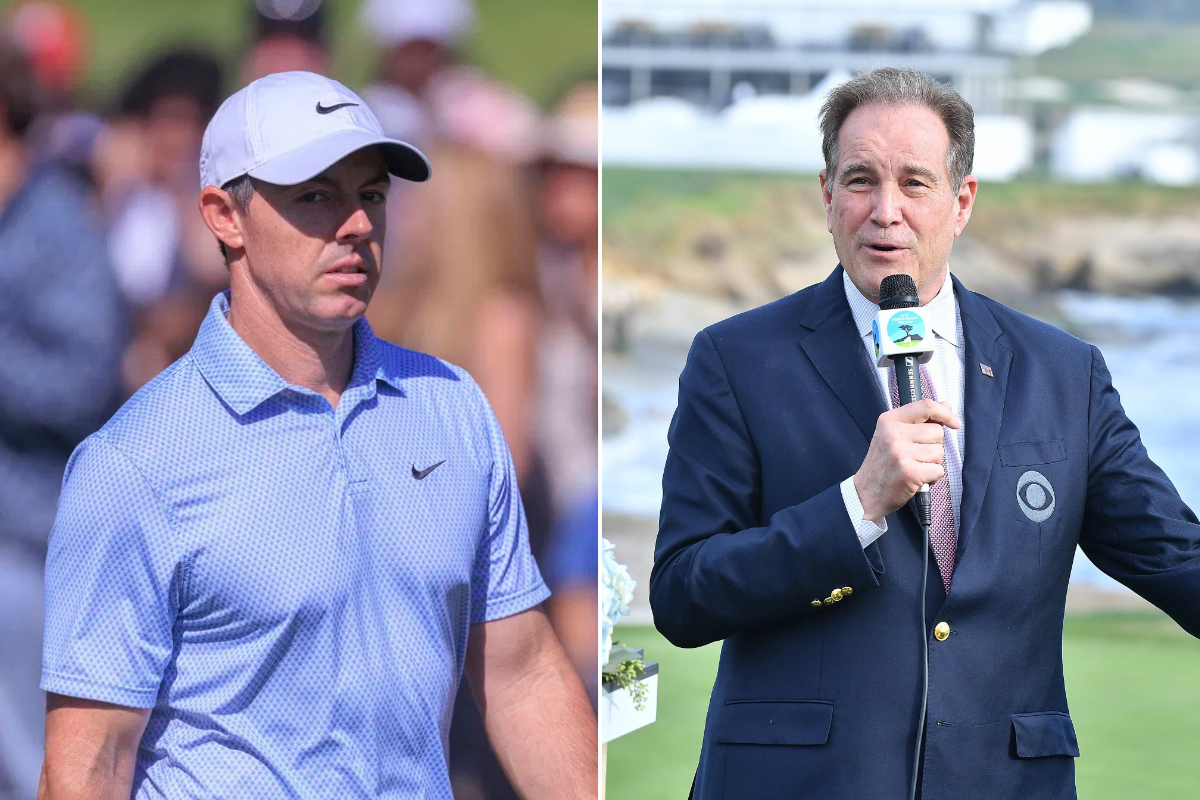
Imago
Source – IMAGO
Imago
Source – IMAGO
When Jim Nantz talks about his first trip to Augusta National Golf Club, the details come almost immediately to him. While covering his first Masters for CBS, he quickly learned a few important things. One time, he asked Frank Chirkinian how to call a hole-in-one. Calling it a “silly” question, Chirkinian told him to figure it out on his own. Nantz quickly understood why; the feelings the Masters brings out are too strong to put into words.
This is something that has stuck with him since then, and that’s why, in a special Masters edition of the Vanity Index Podcast on Golf Channel, Nantz opened up about what it feels like to sit in that booth and mentioned the moment that makes it difficult for him to remain composed.
“There’s a scene that always gets me. That’s when the Masters ends, and you have the triumphant coronation on the 18th green. Then they walk up that rise, and they see the family. From there, they gather themselves and collectively, as a family unit, go through this massive human tunnel all the way to scoring.”
Top Stories





These emotions flooded him during the Masters tournament itself. He has talked about the kick-in birdie by Jack Nicklaus on the 16th hole before. And as Nicklaus’s tee shot got closer to the cup, Nantz found it hard to utter even a single word.
“I was having a hard time getting my mouth to move. My teeth were chattering. I had chill bumps up and down my arm.”
Following that, Nicklaus, sporting a smile full of happiness, was rushed into the Butler Cabin, where he received his sixth green jacket. His son was caddying for him then, and the two together strode off the 18th green.
Then there is Tiger Woods (“A win for the ages!”), who won his first one way back in 1997. One of the most memorable moments from that win was how immediately Tiger rushed up to his father, Earl Woods, to hug him tightly. Fast forward 22 years, and the moment repeated itself. When Woods won his 15th major and fifth Green Jacket, he went looking for his son, Charlie, for a hug.
“The return to glory,” said Nantz, and didn’t speak another word. Why? “I never thought we’d see anything that could rival the hug with his father in 1997 but we just did,” Jim later recalled.
And the question was rather simple. Rory responded with “yes, they did” and could not hold it together. “You could see him tearing up,” Nantz said. “I’m not trying to make anybody cry. It’s not a goal.”
For Nantz, Rory’s 2025 win belongs alongside Tiger Woods’ 2019 and Jack Nicklaus’ 1986 victory. “Those three — Jack, Tiger, Rory — I would say those were the three greatest Masters I’ve ever witnessed,” he said.
Jim Nantz has anchored CBS coverage of the Masters since 1989 and has been the lead play-by-play voice on CBS NFL coverage since 2004. In 2007, he became the first broadcaster in history to complete what has been called the Triple: calling the Super Bowl, the NCAA Men’s Basketball Championship, and the Masters all within about 60 days. He has done it multiple times since. However…
“If I had to define my occupation, it’s a storyteller,” he has said. “I want people to have a reason to root for them. I like to bring humanity to a broadcast.”
So, Nantz’s approach has always been rooted in restraint and storytelling. Over the years, he has become known as much for what he doesn’t say as for what he does. His longtime friend and CBS golf producer, Sellers Shy, once summed up his role in the unpredictable demands of live television:
“You need Jim Nantz when you need to fill a 4-hour show without showing a golf shot. You need Jim Nantz when Grayson Murray passes, and you need to go to air in 30 seconds. You need Jim Nantz when protestors storm the 18th green.”
However, like everyone else, he has also doubted himself in this journey.
Nantz and Nicklaus at the 1986 Masters
After Jack Nicklaus made his birdie putt on 16 during that legendary 1986 Sunday charge, Nantz exclaimed, “There is no doubt about it, the Bear has come out of hibernation.” To anyone listening, it was a perfect call. To him, it felt like a blunder.
“I walked back dejectedly to the compound,” he admitted.
The line had come to him in the moment, without planning, and it unsettled him. He questioned where it came from and convinced himself he had heard it before and repeated it unknowingly. In his mind, he had crossed a line as a broadcaster.
As he was returning to the compound, a golf cart pulled up beside him, carrying his future broadcast partner, Ken Venturi, who had watched it all unfold. He did not see a mistake; he saw history. Venturi told him that he might go on to call many Masters, but he would never witness a day greater than that one.
After 41 years in that booth, Nantz still lets Augusta speak first. Venturi had also made a prediction of 50 Masters, and that is what Nantz is eyeing right now.
Written by

Edited by

Shreya Singh