
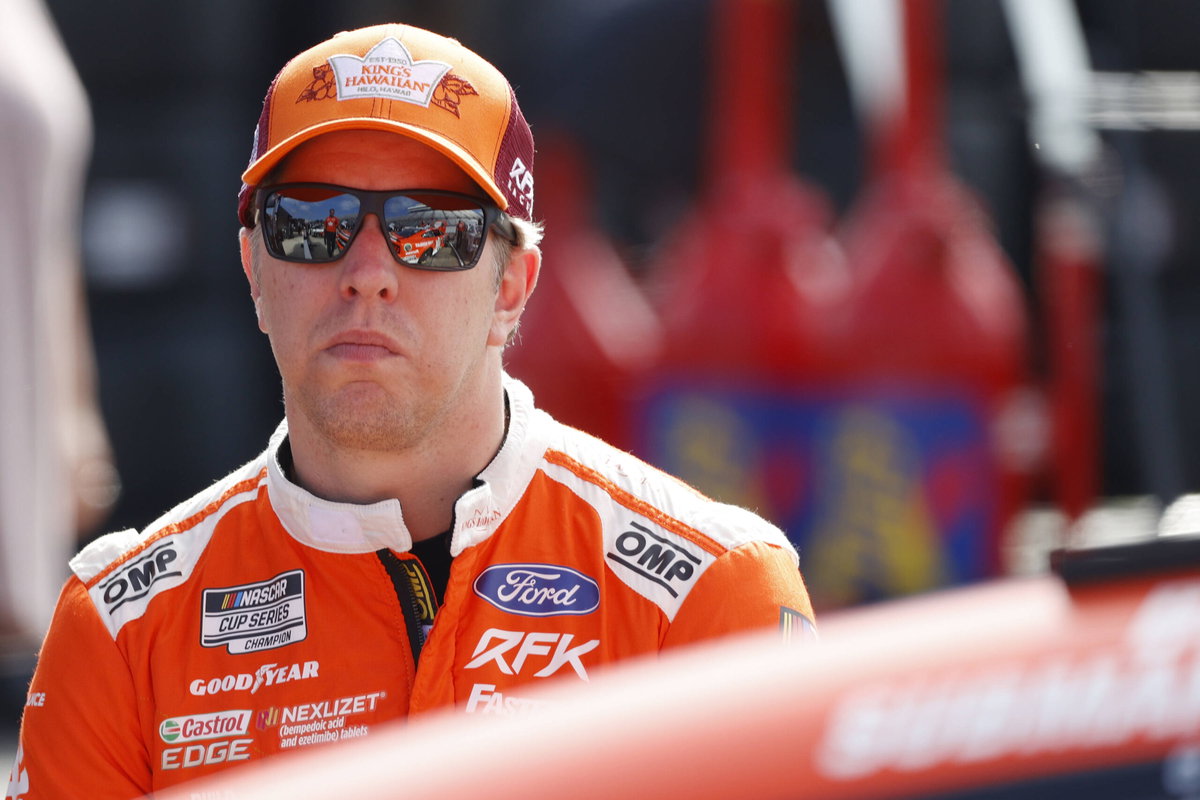
NASCAR doesn’t like intentional wrecking. And for good reason, as it’s not particularly great to put someone else’s race (or even life) in danger and use a car as a weapon. Even thinking out loud along those lines is a big no-no for the sport. So, when Ryan Preece deliberately punted Ty Gibbs earlier this year at Texas after admitting on the radio that he wanted to, NASCAR acted immediately, giving him a $50,000 fine and docking him 25 points. Now, his teammate and boss, Brad Keselowski, has invoked the Miranda Rights while weighing in on the situation.
Watch What’s Trending Now!
Brad Keselowski feels that drivers need their rights
“At all times. I think that they can read that to you in your rights, NASCAR Miranda Rights. I think the button on the steering wheel can be your friend, it can be your enemy, it can be a little bit of both,” he told Kelly Crandall.
Preece, on Lap 101 at Texas earlier this season, appeared to intentionally make contact with the rear of Gibbs’ car after he got upset with his aggressive moves a few laps before. But it wasn’t that which got him into trouble. It was the “All right, when I get to that 54, I’m done with him” radio message, which NASCAR deemed enough evidence to slap him with a penalty.
RFK Racing appealed the decision, but it was rejected, and they didn’t agree further.
“I didn’t follow all the logic, but I do follow the logic of when you say something over the radio. Then it happens, that’s why NASCAR would be upset,” Keselowski further said in his interview.

"The NASCAR Miranda Rights." Brad Keselowski feels for Ryan Preece after his appeal was denied. RFK Racing is moving on from it, though. Keseloski also admitted that he wouldn't call it a bad precedent, but a bit confusing.
Normally, when a person is arrested for an alleged crime in the U.S., the system grants them legal protections from self-incrimination. That’s what the Miranda Rights are all about. We’ve all heard this in movies: “You have the right to remain silent, and anything you say can and WILL be used against you.”
Well, according to Keselowski, Preece should have remembered a movie that had this dialogue when he pressed the radio button on that fateful day.
Had Preece stayed silent and rammed into Gibbs, he might just have gotten away with it. And that brings NASCAR’s inconsistency about punishing intentional wrecks into the spotlight. To them, it’s not really about telemetry or what they can actually see. They just want to hear what the drivers say on the radios or afterwards to determine if someone is guilty or not.
In the same race as Preece, Kyle Busch also appeared to intentionally make contact with Ryan Hunter-Nemechek. But the officials didn’t penalize him, because, well, Rowdy chose to remain silent. “There was no audio that came out that said, ‘I’m going to wreck the 42,’ and then he wrecked the 42,” NASCAR official Mike Forde said.
This didn’t sit well with fans, and other drivers like Denny Hamlin, who spoke from experience.
“I hate to say it, it’s a stupid sport if you just depend on what people say to make official calls,” he said on his Actions Detrimental Podcast. Hamlin himself revealed that in 2023, NASCAR fined him $50k after the race in Phoenix, only because he got on his podcast and admitted to intentionally wanting to crash into Ross Chastain.
If it’s all about staying quiet and carrying on business as usual, many could take a leaf out of Keselowski’s Miranda Rights playbook. Keep your mouth shut and just ram into anyone you want. But that’s not how it should be, and for a sport as modern as NASCAR, with all the resources in the world available to determine whether a driver actually meant to make contact with someone or not, that definitely should not be the case.