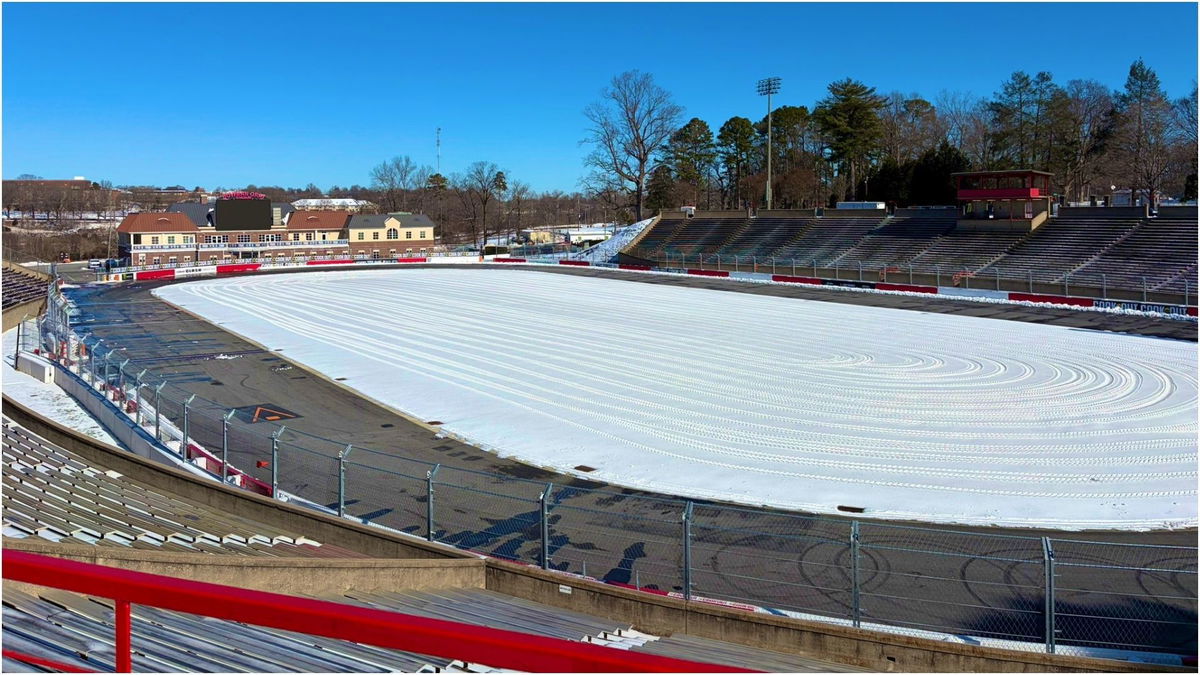
Imago
Bowman Gray Winston-Salem (via @BenKennedy33)
Imago
Bowman Gray Winston-Salem (via @BenKennedy33)
February 1 may bring sunny skies to Winston-Salem. But even with a forecasted high of 30 degrees and lows near 10, the real concern has always been January 31, the day before the big event. Forecasts predicted five to nine inches of snow, backed by a winter storm warning and an extreme cold advisory that would push wind chills to -5 degrees. And now, with that prediction coming true, the Clash is closer to cancellation than ever before.


Fresh snowfall throws Clash weekend into deeper uncertainty
Watch What’s Trending Now!
Just when it looked like Winston-Salem might finally be digging its way out, Bob Pockrass updated that snow has officially started falling again over Bowman Gray Stadium. The region has already spent several days under heavy winter weather, with crews working nonstop to clear snow and ice ahead of the weekend.
For a moment, conditions seemed to be improving. The roads were reopening, and the stadium was slowly returning to race-ready shape. But the renewed snowfall has complicated everything.
Fresh accumulation on top of an already fragile surface means more delays, more cleanup, and far fewer guarantees as NASCAR inches closer to Sunday. And the biggest issue isn’t just the track. Rather, it’s the total lack of clarity surrounding what happens if the weather doesn’t cooperate.
Snow is starting to fall in Winston-Salem (where Bowman Gray Stadium is located) and forecasts vary from four to nine inches. Area is under a winter storm warning until 7a ET today and an extreme cold warning (wind chill -5) from 1a-10a ET Sunday.
— Bob Pockrass (@bobpockrass) January 31, 2026
Right now, fans have no firm answer beyond NASCAR’s previously announced plan to condense all racing activities into a single, frigid Sunday. The sanctioning body has yet to outline what a true contingency plan looks like if snow removal becomes impossible, if temperatures stay too low for safe competition, or if travel conditions deteriorate further.
To be clear, the race is not canceled. NASCAR has made no indication that the event is off the table or will be shifted to Daytona. But looking at road conditions, the volume of accumulating snow, and the challenges of readying a historic short track that isn’t built for winter racing, the uncertainty is unavoidable.
Icy access roads could make team travel difficult, threaten emergency service readiness, and potentially keep fans from attending, all of which could jeopardize the race. So from “Will it snow?” the question has now shifted to “Will Sunday still be possible?”
NASCAR commits: “Come hell or high snow, we’re going racing”
Despite the uncertainty surrounding Winston-Salem’s winter blast, NASCAR has made one thing abundantly clear: the Cook Out Clash will run at the first available opportunity. Officials plan to restart track preparations early Saturday morning, aiming to have Bowman Gray Stadium race-ready for Sunday’s condensed schedule (if the weather allows).
Justin Swilling, NASCAR’s Senior Director of Marketing Services and the point man for Clash operations, emphasized on the latest Hauler Talk podcast that the sanctioning body is treating this weekend the same way it would handle a rain delay. If the forecast hits hard, they’ll wait. If the track becomes safe and dry, they’ll race.
“Come hell or high snow, we’re going to be racing,” Swilling vowed. “We’re going to race as soon as that place is ready to roll.”
While the heat races were canceled, NASCAR has already finalized the procedure for setting Sunday’s starting lineup. On the podcast, Managing Director of Communications Mike Forde broke down the adjusted practice and qualifying format. Teams will get two eight-minute practice sessions within a two-hour window, followed by a group-style qualifying session. Each car will have four minutes on track to post its fastest lap with as many attempts as the clock allows.
“We want to have fewer cars on the race track so that they can have a clean lap for qualifying,” Forde explained.
From there, the top 20 drivers lock directly into the main event. Two more advance through the Last Chance Qualifier, and the final starting spot (23rd) goes to the highest-ranked driver from the 2025 standings who hasn’t yet qualified.
All 38 entered cars cleared inspection on Thursday, and there will be no change to the tire allotment. The rubber tagged for the canceled heats simply shifts into practice and qualifying.
If the track can be thawed, dried, and deemed safe, the green flag will fly. NASCAR is ready. Now it’s a race against the weather.