
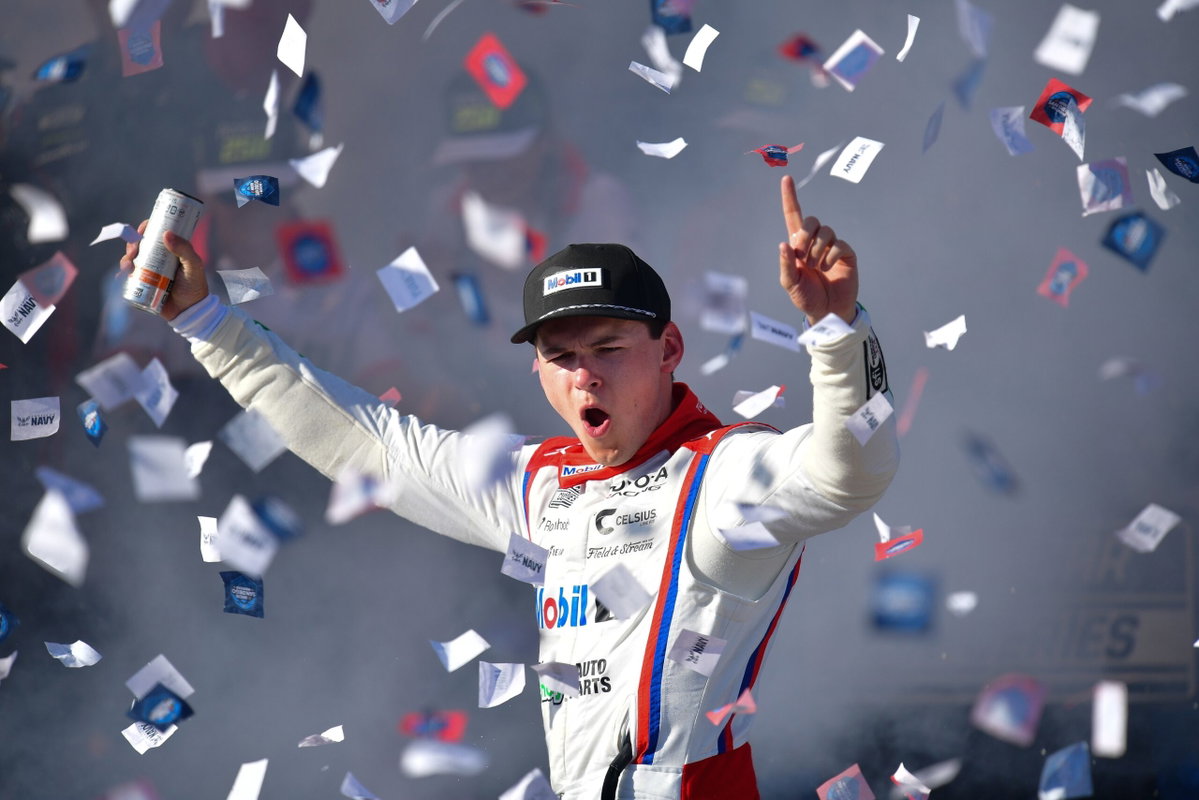
Corey Heim’s first Cup victory on the Naval Base Coronado street circuit stunned NASCAR observers. The 23-year-old, already a decorated Truck Series champion, powered his No. 67 23XI Toyota to a win in just his 13th Cup start. On the twisting 16-turn, 3.4-mile Coronado course, Heim drove aggressively in the closing laps to overtake teammate Tyler Reddick and claim the checkered flag.
Watch What’s Trending Now!
It was a storybook moment for the Georgia native, who famously “strapped another set of tires on, and [the car] was just fine,” as he later explained. Yet amid the jubilation, motorsports radio broadcaster Kenny Sargent, with 26 years behind the mic, took to the airwaves with a contrarian take, warning not to hop on any “superstar” bandwagon just yet.
People have already begun to hype up Corey Heim
Kenny Sargent said on Speedfreaks, “Then when I hear ‘superstar’! Corey Heim superstar! Yes, it’s a killer race, I drove the hell out of that race car! I get all that, I understand all that. Let’s just don’t crowd the guy just yet. Let’s just get some wear on those tires first. He’s a part-time freaking driver in the Cup Series. The guy can drive, we know that, but really Ritchie? Superstar? Already?”

Did Corey Heim already solidify his status as a “superstar” with his San Diego win, or should we pump the brakes? The Freak sound off on NASCAR, INDYCAR & more! 👇 YouTube: youtube.com/live/1BFqxvNaN… Spotify: open.spotify.com/episode/7kb9dn… Apple: podcasts.apple.com/us/podcast/spe…
Heim is running a 12-race Cup schedule in 2026 as a development driver for 23XI Racing, a setup the team has framed as a notebook year ahead of his full-time duty in the No. 35 Toyota starting 2027. And as recently as April at Kansas Speedway, 23XI’s senior director of competition, Dave Rogers, pulled Heim aside specifically to urge him to take bigger risks on track.
Rogers comments came as Heim struggled to a 15th-place finish at Kansas in a car that demanded better, as he couldn’t figure out where to put his car, how to run the wall, and push himself into risks that would have propelled him towards a better finish.
In fact, even Coronado offered some perspective. Heim openly acknowledged the car was a struggle through the opening two stages. He started 13th, fell to 20th, and was sliding backwards before crew chief Bootie Barker kept insisting the worst tires were behind them. But then came the multi-car crash that helped his case. But then there was Tyler Reddick, as well.
With the two separated from the rest of the field, Heim attempted to take the very risk Rogers had asked him to, as he tried to force Reddick into a mistake exiting Turn 3. Reddick, however, outmanoeuvred him. The two then arrived side-by-side at Turn 5, and that’s when Reddick did what could have won him the race had he not backed out.
Reddick dived to Heim’s left, shoved the #67 out of the grooves, and sent Heim towards the wall. Now, here, Reddick had the option of continuing with the aggressiveness, but he chose not to.
“He doored me down there in five and gave it back to me,” Heim himself admitted in a post-race media interaction. “That’s something you don’t see every day. That’s a great teammate.”
Reddick got loose in Turn 2 on Lap 73. Heim pounced, and a flat tire ended any remaining threat. Heim’s win was surely hard-fought, legitimately earned, but there are still too many other factors to consider.
Sargent hence acknowledged that Heim enjoyed a fantastic race, but people need to pump the brakes. History has shown that hyping up a young, talented driver doesn’t always work out in their favour. Everybody is looking for the next big superstar, but the path is not easy at all.
Just take into account Trevor Bayne, who won the 2011 Daytona 500 at 20 years and one day old, becoming the youngest winner in race history. The victory came in only his second Cup start, but what happened afterwards? Bayne never won another Cup race, finished with just one victory in 187 Cup starts, and his best points finish was 22nd.
There is the “Next Jeff Gordon” as well, Casey Atwood, a young talent championed by Ray Evernham – the same crew chief who guided Gordon to early NASCAR dominance. At just 18 years old, Atwood became the youngest winner in NASCAR history at the time when he captured a Busch Series race at Milwaukee in 1999. Yet Atwood’s Cup career produced just one top-five finish before he faded from the sport.
Evernham said at the time: “He’s just not been able to find whatever it is inside to develop that talent into something bigger. That’s a shame. I really enjoyed being around him. But in this sport, only the strong survive.”
Many back then believed that the hype made him not work as hard as he should have. Atwood, too, confessed in 2014 that he didn’t really grasp the work ethic that was required, with the immense pressure being a key factor.
That is probably the biggest cautionary tale.