Imago
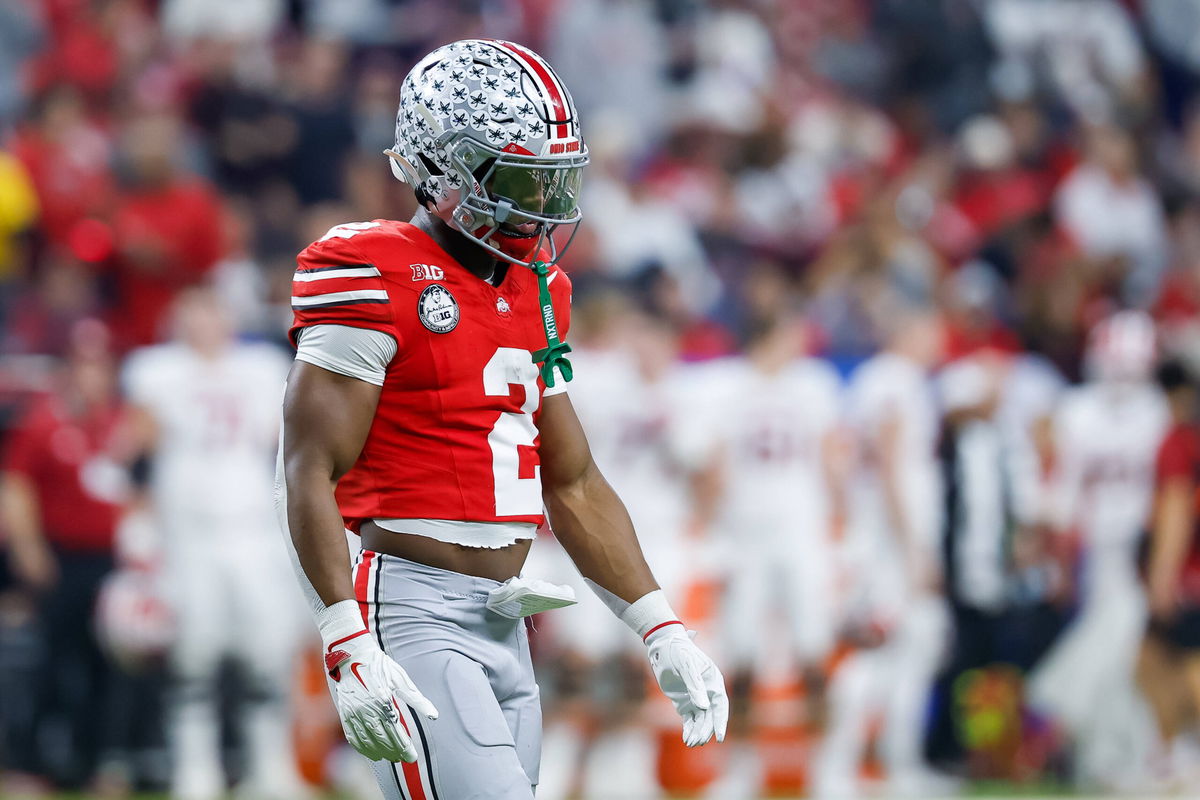
December 6, 2025: Ohio State Buckeyes defensive back Caleb Downs 2 during the NCAA, College League, USA Big Ten Championship football game between the Ohio State Buckeyes and the Indiana Hoosiers at Lucas Oil Stadium in Indianapolis, Indiana. /CSM. Indianapolis United States of America – ZUMAc04_ 20251206_zma_c04_575 Copyright: xDarrenxLeex
Imago
December 6, 2025: Ohio State Buckeyes defensive back Caleb Downs 2 during the NCAA, College League, USA Big Ten Championship football game between the Ohio State Buckeyes and the Indiana Hoosiers at Lucas Oil Stadium in Indianapolis, Indiana. /CSM. Indianapolis United States of America – ZUMAc04_ 20251206_zma_c04_575 Copyright: xDarrenxLeex
The Ohio State Buckeyes vs. Michigan Wolverines rivalry has been ruling college football since the 1980s. It’s so strong that even with the Buckeyes players now off to the NFL, Michigan gets dragged into the conversation. And on The Buckeye Nut podcast featuring former Ohio State players, Caleb Downs ripped Michigan for its questionable antics.
Watch What’s Trending Now!
“The O-line literally does hold every player, so do the tight ends,” Caleb started the lively back-and-forth. The former safety’s comment reflected a defensive player’s frustration with blocking techniques in the trenches. Defenders often feel that blockers grab jerseys or shoulder pads to keep them from shedding blocks, even if referees do not always call penalties.
“That’s not true. I don’t think that’s true. I don’t think the O-line holds on every play,” defended former Ohio State running back Quinshon Judkins, suggesting that players usually use proper blocking techniques rather than committing penalties.
“What? Michigan?” Caleb placed his opinion, dragging Michigan into the conversation to bolster his claim with an example. “Got the back of your pads, just run. I’m like, ‘Bro, this is bad football.’”
Caleb Downs and Quinshon Judkins say Michigan’s offensive line holds on every play.
It’s the Michigan way 😂🏈 pic.twitter.com/yzjXlV7S5A
— The Buckeye Nut (@TheBuckeyeNut) March 5, 2026
The former Ohio State safety plays into a common rivalry stereotype that dominant offensive lines get away with holding more often than others. While Judkins responded by saying Michigan might be “an exception,” he quickly added that he would probably say the same about many schools. However, the closing statement came from Caleb.
He described a scenario where a blocker grabbed the back of the defender’s pads and kept running. That was when he ripped the Wolverines, calling it “bad football.” His remark reinforces his original point that certain techniques cross the line into clear holding. Caleb had faced the Michigan Wolverines thrice, once while donning the Alabama jersey and twice while being part of the Buckeyes squad. It’s only last season that he could see a win against the Wolverines, when Ohio State sealed a 27-9 victory.
Even though the exchange has been good-humored, Caleb tried to bring attention to a major problem in college football. Taking his experience against Michigan as an example, he tried to shed light on how the rule against holding is not always black-and-white.
“The hand(s) and arm(s) shall not be used to grasp, pull, hook, clamp, or encircle in any way that illegally impedes or illegally obstructs an opponent. PENALTY − 10 yards. Penalties for Team A fouls behind the neutral zone are enforced from the previous spot. Safety if the foul occurs behind Team A’s goal line [S42: IUH/OFH],” reads Article 3 of Rule 9 – Conduct of Players and Others Subject to the Rules, according to Sports Collaboration.
But modern offensive line coaching teaches players to keep their hands inside the defender’s pads. When done well, it can look like holding. But it is technically legal because the blocker is controlling the defender rather than grabbing outside the frame.
A critical nuance in both NCAA and NFL rules is the “rip move” exception. If a defensive rusher uses a rip move (putting their arm under the blocker’s arm and lifting), the offensive lineman is not penalized for holding if their arm ends up around the defender’s neck, as the defender technically put themselves in that position.
Officials also typically prioritize calls at the point of attack, where the ball carrier is. A blatant “jersey pull” on the opposite side of the field often goes uncalled because it did not materially affect the outcome of the play.
In the 2025 Orange Bowl, Notre Dame was accused by fans of benefiting from several missed holding penalties against Penn State star Tyler Warren during a critical fourth-quarter drive.
In the 2024 National Championship between Michigan and Washington, fans and analysts pointed to several uncalled holding penalties against Michigan during key scoring runs. Conversely, a critical 32-yard completion for Washington was called back due to a holding penalty, drastically shifting the game’s late-stage momentum.
Elite programs, like Ohio State, emphasize that holding usually happens when a lineman’s feet stop moving. Once a defender beats a blocker’s feet, the natural instinct is to reach and grab, which is when the 10-yard flags almost always fly.
There is also a strategy around volume. Similar to how defensive backs are sometimes coached to hold on every play to see what officials will allow, some analysts suggest offensive lines adopt a high-volume holding strategy, knowing officials will not “bog the game down” by calling it every time.
Furthermore, the rise of the Run-Pass Option (RPO) has made holding harder to call. Because linemen are often blocking as if it’s a run play while the quarterback quickly throws a pass, the duration of the engagement is shorter. This “quick-strike” nature allows linemen to be more aggressive because the ball is gone before an official can process if a “material restriction” occurred.
Ohio State alum Caleb Downs’ claim backed by examples and stats
Back in 2024, the Washington Huskies faced 2nd-and-10 from their own 33 when the offense finally sparked to life. Michael Penix Jr. found Rome Odunze on the edge, and the star receiver dashed for 32 yards before tumbling out of bounds. It flipped both field position and momentum for the Washington Huskies football. But just as the play breathed life into the drive, a late yellow flag rained on their party. The call?
Holding on to 6-foot-6, 300-pound right tackle Roger Rosengarten. To make matters worse, officials appeared to miss two blatant holding calls against Michigan. The first happened in the opening half when Michigan’s J.J. McCarthy hooked up with Colston Loveland for a 41-yard touchdown.
On the edge, 6-foot-4, 325-pound lineman Trente Jones grabbed a handful of Zion Tupuola-Fetui’s jersey and tugged as the Huskies pass rusher closed in. The grab was clear, but the flag never flew. That’s what Caleb must be pointing at.
Last season, too, an instance showed a glaring statistic. Against Ohio State, Michigan got 4/50 penalties, whereas against other opponents, the Wolverines averaged 4/ 38.7 penalties. That’s how, even though Caleb Downs is now NFL-bound, this aspect still bothers him.