
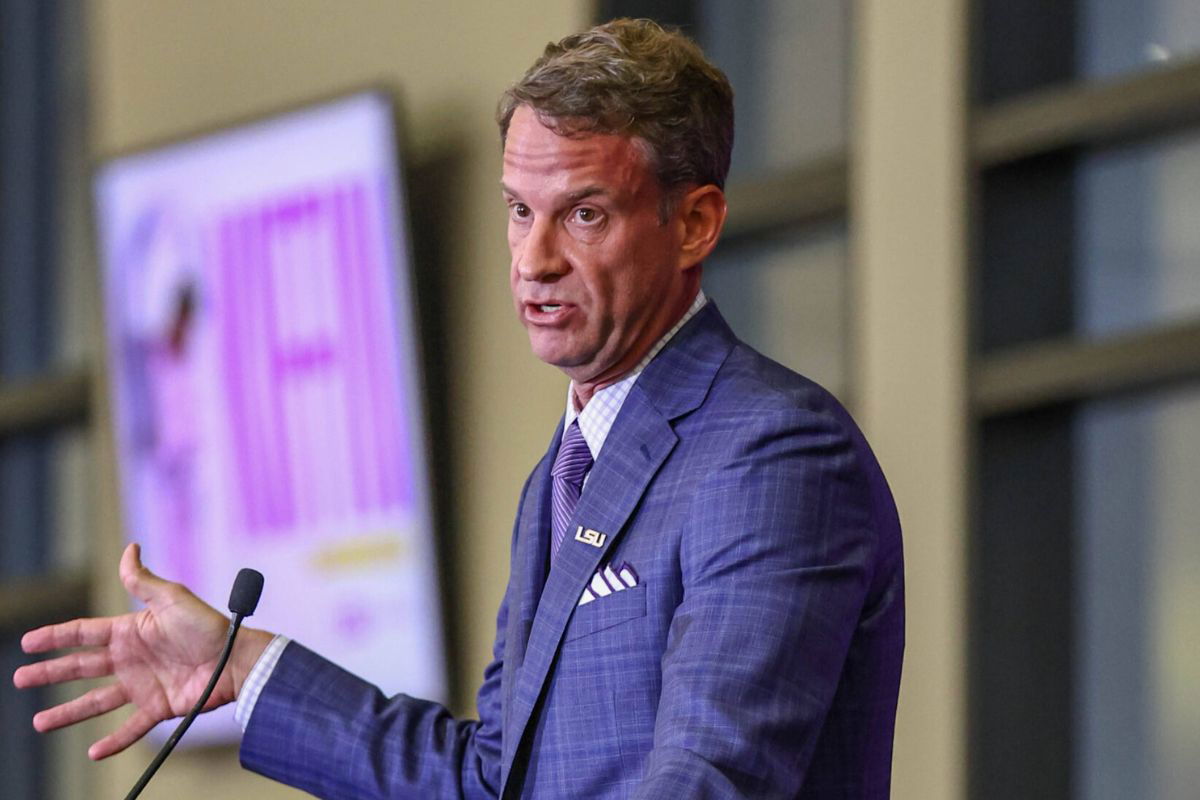
Tracey Ivey-Muhammad did have doubts when her son, Jared Ivey, picked Ole Miss. Mississippi brought its own fear with it. But Oxford gave her a very different experience, and that is why she later pushed back when Lane Kiffin spoke about the place.
Watch What’s Trending Now!
To share her real story, Tracey recently appeared on the Talk of Champions podcast. She wanted to clear the air about the town after Kiffin’s interview. Before explaining how welcoming the people actually were, she honestly admitted her own early doubts about moving to the South.
“My experience with Ole Miss. So when Jared (Ivey) decided to go on the portal, the Ole Miss was the front runner. ‘He says, I’m going to Ole Miss.’ Did I have concerns? It was Mississippi. Of course, I’d be lying if I said I didn’t, it was the South,” Mama Ivey said before revealing the truth about the place. “We’ve lived in the South. I’ve had a great experience at Ole Miss. Everybody was lovely.”
That is why her words carry weight here. She did not hide her fear at the start. She admitted it plainly. But once her son reached Oxford, she said the place felt kinder than the picture many outsiders still carry in their minds. From Tracey’s telling, Oxford left a lasting mark on her family for better reasons. That is why she did not view Kiffin’s remarks as a fair picture of the place her son came to know.

Lane Kiffin talked to Jared Ivey’s mother, @Traceyiv, once over his three-year career. She rejects the Ole Miss narrative he’s trying to push. “Everybody was so lovely. A little piece of my heart is always going to be in Oxford.” 📺 youtu.be/G1Iywcx5xTE
On top of defending the town’s culture, Jared’s mom dropped some serious truth bombs exposing Kiffin’s hands-off coaching style and lack of personal effort with families. She revealed that during her son’s entire three-year college career at Ole Miss, Kiffin only spoke to her once. She pointed out that if Kiffin was struggling to connect with families or close out big recruiting deals, it probably had a lot more to do with his own lack of communication rather than the town itself.
For Tracey, the bigger issue was not the map. It was the distance between a head coach and a family. In college football, parents remember who calls, who checks in, and who makes them feel seen when a life-changing choice is being made.
She explained that if a head coach cannot even bother to build a basic relationship with the family of one of his biggest defensive stars. It is incredibly hypocritical to blame the town’s geography when recruits choose to sign elsewhere. She also cleared up the reality of how her son ended up transferring to Ole Miss from Georgia Tech in the first place.
Tracy credited the assistant coaches, specifically defensive line coach Randall Joyner and Lane’s own brother, defensive analyst Chris Kiffin, as the real reasons her son wore the Rebels jersey. According to her, those assistant coaches who actually put in the long hours are the ones who put in the long hours for Jared’s recruitment. Her point is not that Mississippi has no history. It is that one family’s real experience in Oxford did not match the fear they first felt. That lived reality is what makes her pushback stronger than a simple online reaction.
Then again, if you look at it, Lane Kiffin’s claims about Mississippi’s racial history influencing football recruiting do have valid historical context to some extent. The U.S. Census Bureau confirms a distinct demographic gap. Oxford, Mississippi, is roughly 66% white and 26% black. And LSU’s home of Baton Rouge, Louisiana, is 52% Black and 34% White. While the systemic hurdles are partly true, critics argue that he is using facts to mask his own relational shortcomings.
This call-out is just one piece of a much bigger wave of anger directed at Kiffin right now. Ever since he ditched Ole Miss for its big rival, LSU, current and former players have been coming forward to air their grievances. Several players, including star linebacker Suntarine Perkins, openly called Kiffin a liar on social media, claiming he completely fabricated his version of how his final team meeting went. Kiffin claimed it was an emotional, respectful goodbye; the players countered that he basically gave a rushed, cold speech before turning his back on the team.
Finebaum, who has covered Kiffin since 2009, agreed with Smith’s assessment. Finebaum described the head coach as a unique mix of an introvert and a drama queen. He doubled down on the idea that Kiffin possesses incredible acting abilities that make him the most polarizing figure in college football.
Smith believes that controversial comments about Mississippi’s racial history were a calculated, pragmatic attempt to appeal to elite recruits. According to Smith, Kiffin truly views himself as a pragmatist who leverages his own high-profile personality as an economic tool. Kiffin believes elite Black recruits are drawn to a “cool coach” and a highly diverse city.
At the end of the day, the popular consensus is that he used the Vanity Fair platform to rationalize leaving Ole Miss as a necessary business move to win a national championship.