
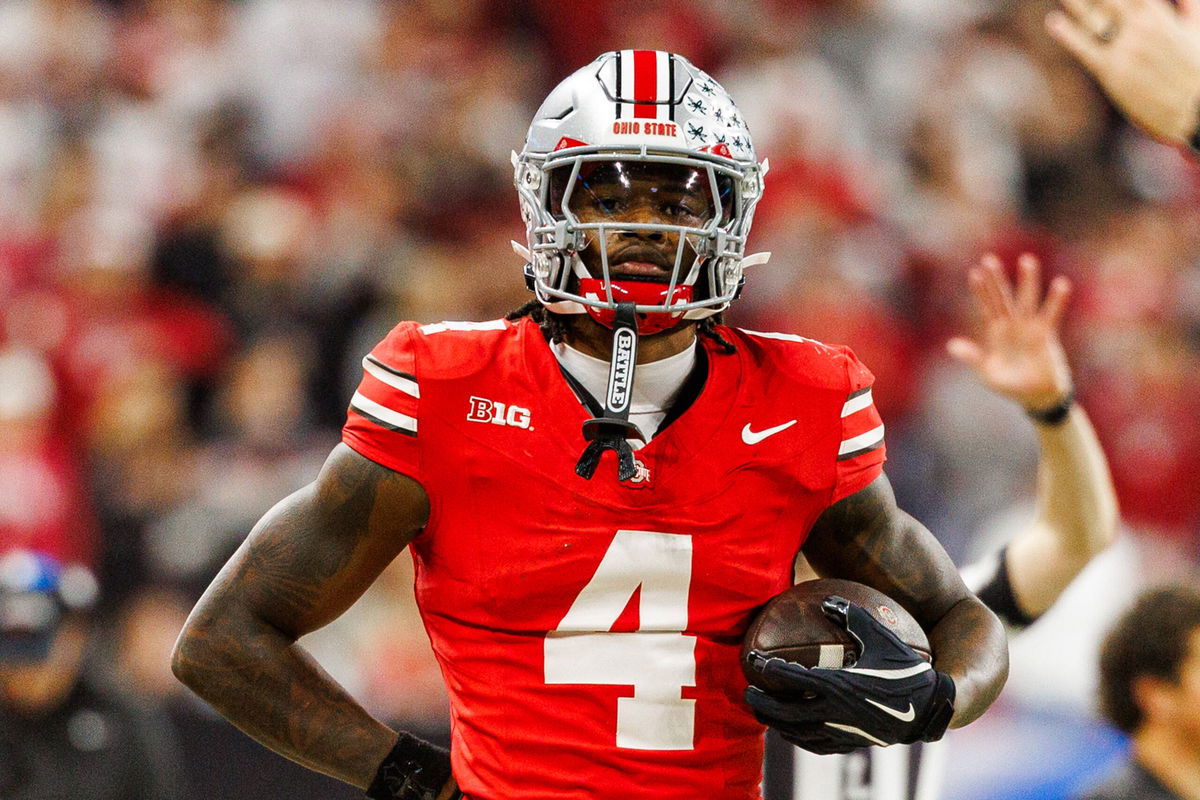
In roughly his first three weeks as a junior, Jeremiah Smith could accomplish what no Ohio State receiver has done in more than 50 years of elite wideouts. He is one short season away from the Buckeyes’ version of a ‘Triple Crown’: career leader in catches, yards, and touchdowns.
Watch What’s Trending Now!
Through two seasons, Smith has already stacked numbers that most Ohio State receivers never approach in four.
No wide receiver in Ohio State history has ever finished his career as the outright leader in catches, receiving yards, and touchdowns. That is the feat now within Smith’s reach. This is a program that has sent a string of first-round receivers to the NFL in recent years, from Chris Olave and Garrett Wilson to Marvin Harrison Jr. and Jaxon Smith-Njigba. None of them left as the career leader in catches, yards, and touchdowns.
Usually, guys have to stick around for four full years to put up numbers that rank at the top of Ohio State’s history books.
Entering 2026, Smith already has 163 career catches, 2,558 receiving yards, and 27 touchdowns through two seasons. To hold all three Ohio State career records outright, he needs 39 more receptions, 341 yards, and nine touchdowns. At his current pace, that is not a multi-year chase. It is a matter of staying healthy and getting through the first part of the schedule.
Each of these marks tells a different story: The yardage record, long held by Michael Jenkins, stood for more than two decades as the benchmark for big-play threats in Columbus. The catches record, now owned by Emeka Egbuka, reflects the modern, high-volume passing game. The touchdown mark, set by Chris Olave, rewards end-zone consistency against top defenses. Owning all three means Smith would have excelled in every measure that matters for a Buckeye receiver.
At his current per-game pace, Smith should clear the career yardage mark early in the season, then move past Emeka Egbuka on catches not long after. The last step is the touchdown record, which falls into range by midseason if he stays healthy and Ohio State keeps feeding him the ball.
The final milestone, his 36th TD, could fall as early as mid-October, completing the triple crown before Halloween.
Smith enters 2026 as the face of EA Sports College Football 26 and one of the few non-quarterbacks in the Heisman conversation. No receiver has won the award since DeVonta Smith at Alabama in 2020. If he secures all three career records while Ohio State makes a deep playoff run, that mix of team success and individual history could push him past the usual quarterback bias
If he breaks all three records and the Buckeyes make the playoffs, that should give him an additional edge for the trophy. Once he pulls off these career records, then the only thing left for him to do is chase Ohio State’s single-season records before declaring for the 2027 NFL Draft, which is 1606 set by JSN back in 2021.
Former Tennessee Titans GM Ran Carthon is already calling him the most polished pro prospect since Calvin Johnson. It’s only a matter of time before he goes top 3 pick in the 2027 NFL Draft.
What if Jeremiah Smith wants to break the all-time NCAA receiving yards record?
First off, let’s look at where Jeremiah stands right now. Coming off his blistering freshman and sophomore campaigns, he has already racked up 2,558 career receiving yards.
So, he’s currently sitting exactly 2,727 yards away from tying Corey Davis at the absolute top of the college football mountain. For that to happen, he essentially has to duplicate his entire career production up to this point, plus a little extra, just to catch up.
If Jeremiah wants to try and pull this off in his upcoming 2026 junior season, he would need to put up a season that defies all logic. That’s not feasible by any means, frankly.
Even if Ohio State plays in the Big Ten Championship and goes all the way to the College Football Playoff title game (roughly 16 total games), he would need to average a mind-boggling 170.5 yards per game. The single-season FBS record is “only” 2,060 yards.
The only actual path to the NCAA crown is for Jeremiah to shock the world and stay for his senior year in 2027. Spreading that number across his junior and senior campaigns makes the math look way more achievable. Obviously, the Buckeye faithful will beg him to stay. The school might even throw record-breaking NIL numbers easily.
Over two seasons (potentially 30 to 32 games with playoff runs), Jeremiah would only need to average around 1,364 yards per season.
If he stays healthy and the Buckeyes keep throwing him the rock, he would likely cross the historic 5,285-yard finish line sometime around November of his senior year.
The real question is whether he’ll forego the 2027 NFL’s top 3 draft picks for a pretty much guaranteed shot at history!?