Imago
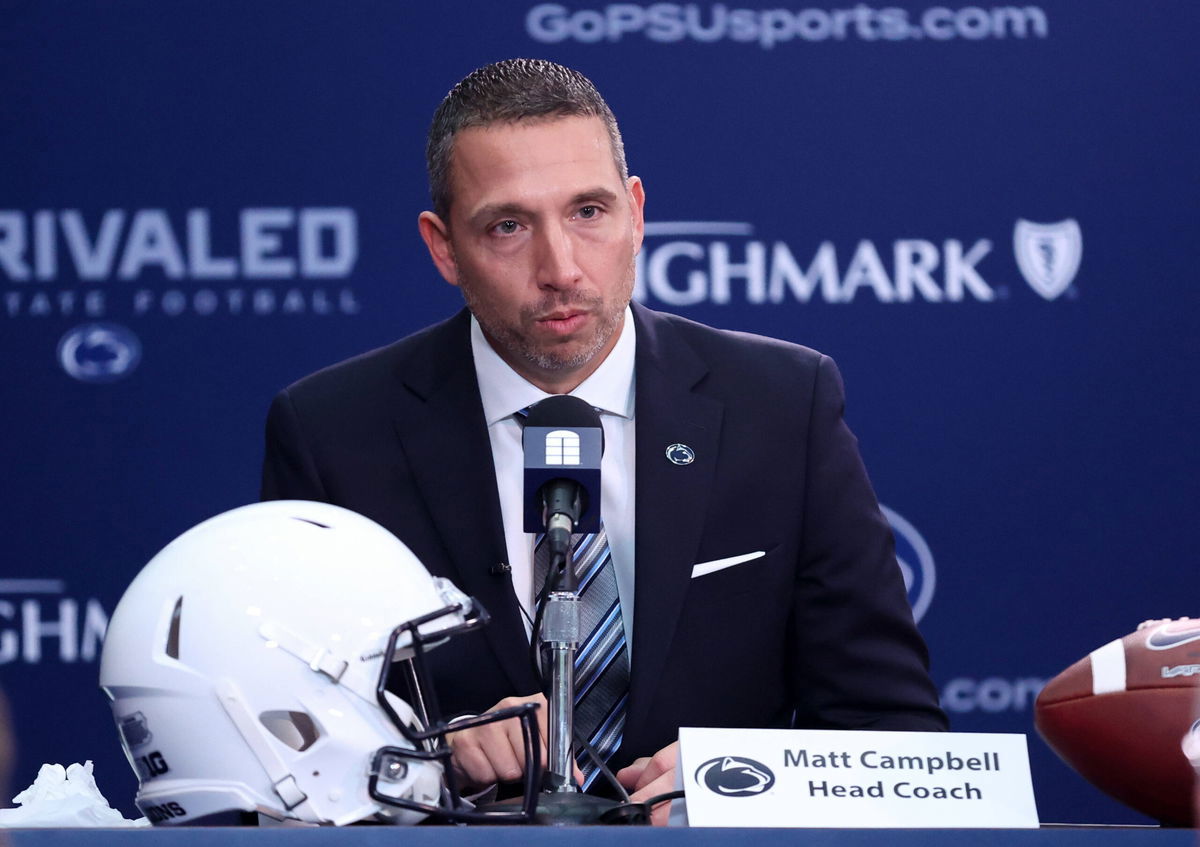
NCAA, College League, USA Football: Penn State Football Head Coach Matt Campbell Introductory press conference, PK, Pressekonferenz Dec 8, 2025 University Park, PA, USA Matt Campbell answers questions from the media after being announced as the Penn State Nittany Lions new head coach during a press conference at the Beaver Stadium Press Room. University Park Beaver Stadium Press Room PA USA, EDITORIAL USE ONLY PUBLICATIONxINxGERxSUIxAUTxONLY Copyright: xMatthewxO Harenx 20251208_jcd_bm2_0025
Imago
NCAA, College League, USA Football: Penn State Football Head Coach Matt Campbell Introductory press conference, PK, Pressekonferenz Dec 8, 2025 University Park, PA, USA Matt Campbell answers questions from the media after being announced as the Penn State Nittany Lions new head coach during a press conference at the Beaver Stadium Press Room. University Park Beaver Stadium Press Room PA USA, EDITORIAL USE ONLY PUBLICATIONxINxGERxSUIxAUTxONLY Copyright: xMatthewxO Harenx 20251208_jcd_bm2_0025
James Franklin might be gone, but the Penn State Nittany Lions are now reaping the fruits of the Franklin era. Just two months into his tenure in Happy Valley, new head coach Matt Campbell has been handed some welcome financial news amidst a sea of debt. Indeed, it is good news for the Nittany Lions program, which is now burdened with massive debt.


“Penn State reported $50,362,976 in ticket sales in the 2024-25 school year,” reported StateCollege.com analyst Joel Haas. “Football: $44,260,703.”
Watch What’s Trending Now!
The financial report underscores football’s dominance in Happy Valley, with its $44.2 million in ticket sales dwarfing the combined revenue of all other sports. For perspective, men’s hockey, the next highest earner, brought in just over $2.2 million, highlighting the immense pressure on Matt Campbell’s program to carry the athletic department’s financial health.
Additionally, the department paid out $4.1 million in postseason compensation and bonuses for Campbell’s predecessor, Franklin, and his staff. On top of that, they spent another $2.5 million to host the first-round game against SMU.
Thankfully, the postseason run paid off financially for the Nittany Lions as they collected $20.5 million from the Big Ten and another $5.3 million in postseason reimbursements. There’s no doubt that ticket revenue remains a critical part of Penn State’s finances, and support hasn’t waned despite recent turbulence. For coach Campbell, it’s a welcome boost, as strong backing and a fan community would help him move forward.
Penn State reported $50,362,976 in ticket sales in the 2024-25 school year.
Football: $44,260,703
M hockey: $2,296,407
MBB: $1,689,643
Wrestling: $1,680,622
W volleyball: $202,374
WBB: $150,530
Baseball: $25,539
W soccer: $3,456
W gymnastics: -$8,953 (?)Not specified: $62,655
— Joel Haas (@Joel_Haas1) February 9, 2026
Likewise, Penn State’s football program received a significant portion of the recruiting budget, with over $2.41 million dedicated to it. In comparison, the men’s and women’s basketball programs received $598K and $160K, respectively. The administration’s bet on football paid off handsomely, as an outstanding season generated a staggering $146.8 million. It’s a $33 million year-over-year increase that proves the program remains the financial engine of the entire athletic department.
Penn State packed the house, averaging over 108,000 fans, the second-highest attendance nationally. Just like Campbell’s Nittany Lions, two other programs led the race in ticket sales revenue. The Michigan Wolverines generated $67.6 million, and the Ohio State Buckeyes generated $67 million in football ticket revenue.
This ticket sales boost comes at a time when there are already too many things on Campbell’s plate. Taking a glimpse at the Nittany Lions’ 2026 schedule, things look manageable in the first four games. They will face off against non-Power 4 schools, including Marshall and Temple. However, the challenging battle will be against Northwestern.
Campbell’s roster might still not be over the 21-22 loss against the Wildcats last season. But this season, the Nittany Lions will take their reinvigorated roar to the new $862 million Ryan Field. While Campbell and his program might feel pressure to prove themselves, a $535 million debt looms over them, raising concerns.
Matt Campbell faces $535 million debt burden
After the program suffered back-to-back upset losses to the UCLA Bruins and the Northwestern Wildcats, Penn State athletic director Pat Kraft fired Franklin. He brought in Campbell to steady a ship already navigating significant financial hardships in the athletic department. They ended FY25 with debt of $534.7 million, more than three times the $163.1 million reported the previous year.
Penn State’s financial picture worsens amid a major capital project. Campbell’s program launched a $700 million Beaver Stadium renovation earlier this year, fully backed by athletics, with the project slated for completion in 2027.
“Beaver Stadium is undergoing the largest renovation in college football history,” said Penn State deputy athletics director for internal operations Vinnie James. “We’re approaching $700 million in renovation right now. We remain on schedule, targeting a completion date of fall of 2027.”
Exploring the engineering marvel, the renovation will reshuffle the west side of Beaver Stadium, adding club seats, luxury suites, and a brand new media hub, creating over 600,000 square feet of space dedicated to fans. While this facelift might mean a slight reduction in capacity by the 2027 season, it’s a positive step toward generating revenue.
While the roaring crowds and massive ticket revenue provide Campbell some breathing room, it’s a double-edged sword: anything less than a spectacular on-field product could jeopardize the very income stream needed to pull the athletic department out of its $535 million hole.
Written by

Edited by

Jacob Gijy