
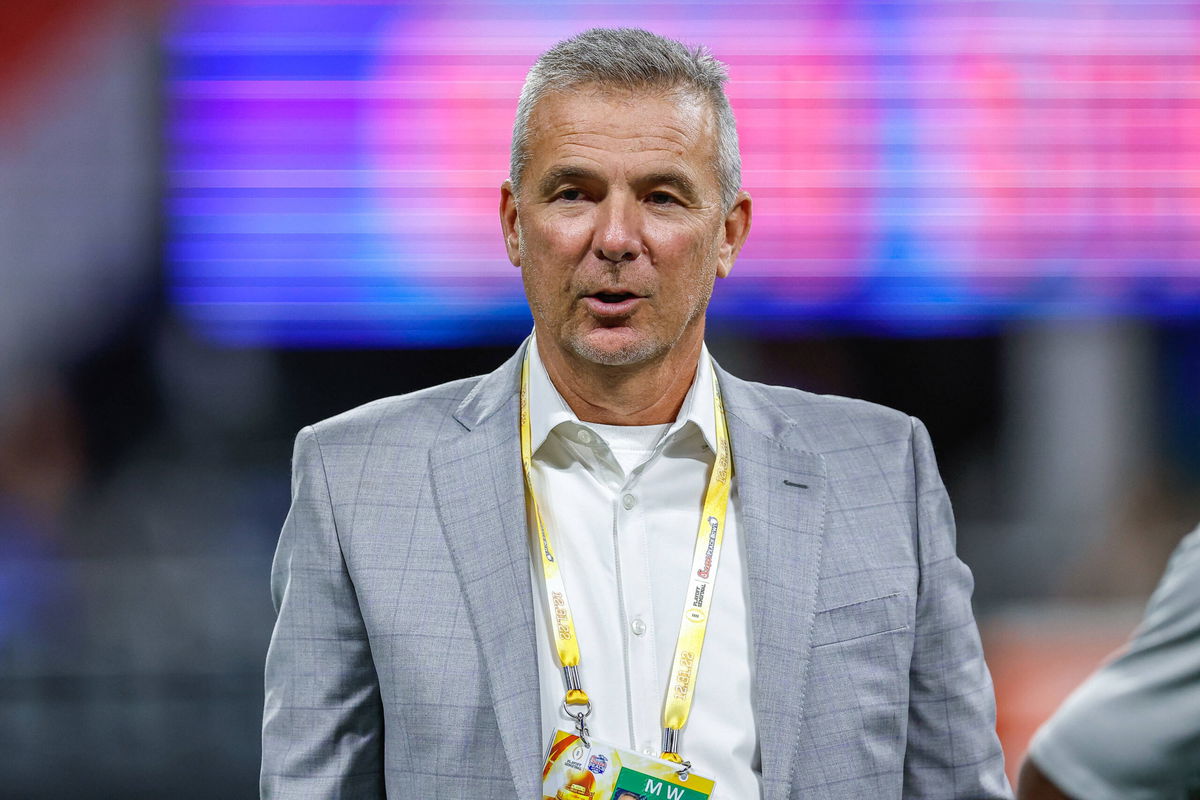
Urban Meyer arrived at Bowling Green in 2001 when the football team was completely terrible. They were coming off a brutal 2–9 season in 2000, and almost nobody went to the games. Meyer knew he couldn’t win alone, so he literally walked around campus to recruit the students. He ate lunch in the normal dining halls, hung out at fraternity houses, and apparently begged kids to come pack the stadium. It worked perfectly until he decided to climb the coaching ladder by taking a HC gig at Utah.
Watch What’s Trending Now!
“Utah wasn’t Utah, it wasn’t Utah then, so people were pissed off,” Urban said on his Triple Option podcast. “I mean, we had a turnaround, I think at the time the number one turnaround in history of college football, and I remember I took the job, the student body, I would go eat lunch with the students all the time, I went to every fraternity, every sorority, talk to them, you know, trying to get people in the stadium, and so I’m thinking, you know, what the cool thing is, we turned around BG, they’re in great shape, and you know, be able to come back.”
After convincing and building a bond with pretty much every student body on campus, it didn’t take much longer for the results to fall into place. They went 8–3 in his first year.
By his second year in 2002, the Falcons won their first 8 games in a row, and the team climbed as high as No. 15 in the entire country. Fans were absolutely loving it. To make things better, Meyer told the local media that he loved Bowling Green and planned on staying there for a long time. The students totally trusted him and thought they were building something special together.

Bowling Green students were pissed when Urban Meyer took the Utah head coaching job 🤣🤣
Then, the betrayal happened in the middle of the night on December 12, 2002. Think of it like this: you invite someone into your home, share your meals, build trust day by day. You believe they’re family. Then one night, while you’re sleeping, they pack their bags and leave without saying goodbye. That’s what the students felt. Meyer didn’t just leave; he slipped away in the dark, like he was afraid to face them.
News broke that Meyer was leaving after a short 17–6 total record over two seasons to take the head coaching job at the University of Utah. At the time, Utah wasn’t a famous football school yet, so students felt like Meyer was just using them as a stepping stone. To make matters worse, he accepted the job in secret and called a sudden 5:00 AM meeting to tell his players he was leaving.
Imagine you’ve been cheering for your coach every Saturday, filling the stands because he asked you personally. You believe he’s staying. Then he’s gone before sunrise, taking the job he won’t tell anyone about until the last minute. That’s exactly what happened. The students didn’t just feel disappointed; they felt used. Like their trust was traded for a better job.
The campus immediately went from pure love to disdain. Students felt lied to and completely heartbroken by the guy they had cheered for all season. They decided to create a giant, very public farewell message for Urban Meyer.
“I’m driving home from emptying out my, you know, put some stuff on my car, and I’m driving home, and kind of emotional, because I love those players, and I love that place, and I look up, you know, I have all these great feelings about the students, and they wrote ‘Fu Urban’ on the sheets hanging down from the dormitory, as I’m driving right by it, Dale,” Urban said.
That moment stuck with Meyer for decades. In later interviews, he said seeing those sheets was the first time he truly understood how fast love turns to anger in college football. Fans don’t just watch the game, but also give their time, their money, their hearts. When a coach leaves without warning, it doesn’t feel like a career move. It feels like a breakup.
Meyer later admitted it was a huge reality check on how fast college sports fans can turn on you. Even though the exit was in the spectrum of betrayal, Bowling Green actually stayed really good after he left.
The next coach took over the amazing roster Meyer built, and the Falcons finished the following 2003 season ranked No. 23 in the country. Today, the legendary bedsheet story is just a funny piece of college football history. It is the perfect example of how fast a campus can go from worshiping a coach to totally kicking him out the door.
Urban Meyer calls out ADs for cutting corners in recruiting
Urban Meyer spoke out about how college football programs are handling NIL money and roster spending in the current system. He says the rules meant to create fairness are not being followed the way they were intended. With the House v NCAA settlement putting a $20.5 million cap on roster spending, many schools are still finding ways around it by using outside funding and business partnerships to boost what they can offer players.
On his Triple Option podcast, Meyer explained what he’s been hearing from people inside the sport, including athletic directors at major programs. He said, “I had about four or five athletic directors I know very well at some really big schools call me and say, ‘There are two ways that this is happening.’ When you’re following rules, it’s called money laundering. They take money that is set aside. I’m just throwing out AT&T and Verizon. They pay the school a certain amount of money, and the higher-ups redirect part of that money towards a roster member.”
The situation becomes clearer when looking at high-profile transfer cases like Cincinnati quarterback Brendan Sorsby.
Schools like LSU and Texas Tech were reportedly involved, and Texas Tech is said to have offered around a $5 million deal. LSU was also linked to a $3.5 million NIL package, which involved different media and marketing partners helping structure the deal. There’s also a rumor that he’s set to receive a share of land profits from an oil company out in West Texas.