
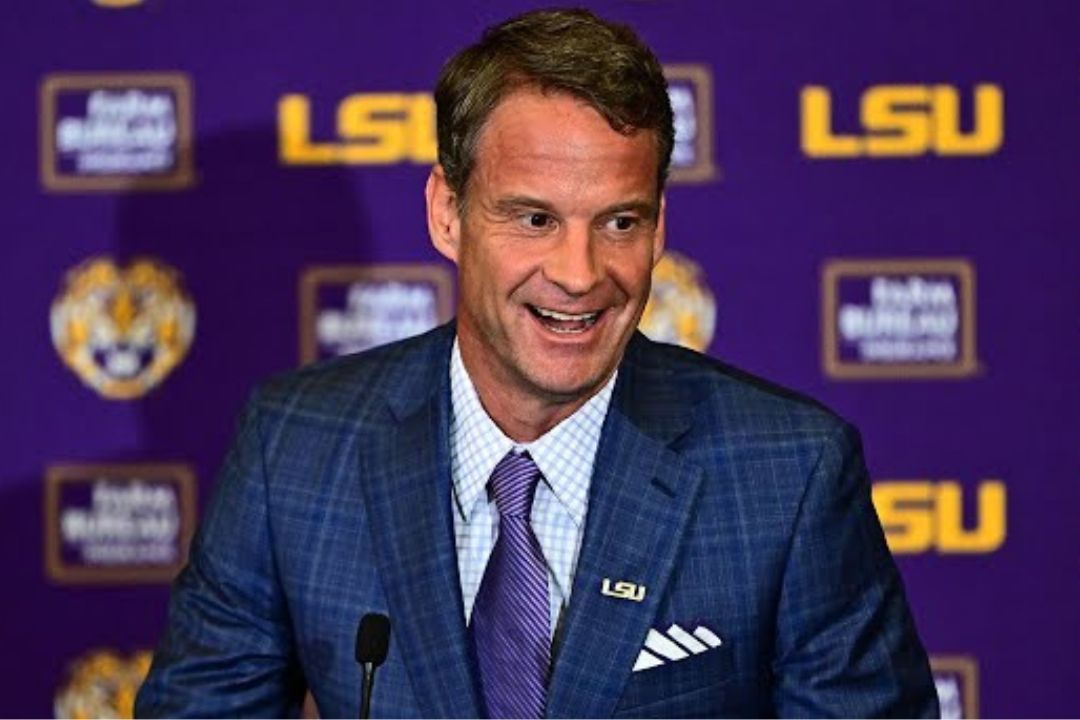
Lane Kiffin is making one thing clear at LSU: if players are getting paid, they must also act like professionals. With a roster worth more than $42 million, he says there is no room for laziness or excuses. Show up, do the work, follow team rules, or face consequences. That is the standard he wants.
Watch What’s Trending Now!
During an appearance on Pardon My Take, Kiffin explained how NIL and player payments have changed the relationship between coaches and athletes. According to Kiffin, players understand that when they are paid large sums of money, they are expected to take on more responsibility. He said this new system has actually made some parts of coaching easier because players know there are consequences if they fail to meet expectations.
Kiffin said, “With NIL and the portal, there’s a lot of problems that have been created. I think with them getting paid, I don’t think that’s as challenging. I don’t think it’s as challenging to get guys to do things because we’re paying you. If you don’t want to do it, there’s a fine system, just like the NFL. I find it’s actually easier.”
The LSU Tigers roster for the 2026 season is valued at about $42.84 million. A large part of that money, around $26.13 million, was spent on players added through the transfer portal. That means about 61% of LSU’s roster value comes from transfer portal additions, which is the highest percentage of any college football team this offseason. LSU heavily relied on the portal to build its team for 2026. When you put together the nation’s most expensive football team, it’s only fair to expect the best return on investment (ROI) from them.

LSU's 2026 roster valuation: $42.84M. $26.13M (61%) attributed to portal additions — the highest portal share of any roster we've valued this cycle. Starters, depth chart, and acquisition breakdown → collegefrontoffice.com/football/insig…

The LSU coach explained that the football program now uses a fine system similar to professional sports teams. Players can lose money if they fail to follow team rules, skip responsibilities, or do not put in the required effort. By fining the players, Kiffin believes this creates accountability because players understand they are being treated more like professionals instead of regular college students playing sports on the side.
Lane Kiffin’s point is simple. If players are being paid like pros, they have to carry themselves like pros. That means showing up, doing the work, and accepting the consequences when they do not. Kiffin also said players themselves have started thinking differently because of NIL money. He explained that many athletes now see themselves as professional athletes before they even reach the NFL. Because of that, the coaching staff talks to them differently and expects them to act more maturely both on and off the field. Film study, workouts, meetings, and practice habits are all taken very seriously inside the program.
He gave another detailed explanation during the interview. Kiffin said: “They kind of, in their mind, think they’re like pros now – which is good. That’s how we talk to them. So you’ve got high expectations. ‘Hey, we expect you do these things. We expect you to do these things in the weight room, in the film room, all these different things. If you want to be a normal student and not really do all those things, that’s fine. Go see the GM and give back half your money, if you want to do half the work.’”

Imago
December 1, 2025: New LSU Head Football Coach Lane Kiffin holds his first press conference, PK, Pressekonferenz and meets with the media for the first time at Tiger Stadium s South Stadium Club in Baton Rouge, LA. /CSM Baton Rouge USA – ZUMAc04_ 20251201_zma_c04_045 Copyright: xJonathanxMailhesx
Kiffin continued by explaining what happens when players fail to meet expectations. He made it clear that the program is focused on accountability and performance. He said: “So that way, I think it’s a little bit easier that way. You bring them in, ‘Hey, this is what you need to do. And if you don’t, there’s a fine system for those things, but also, what’s going to happen at the end of the year? You’re going to get cut.’” His comments show just how much college football has shifted toward a professional model in the NIL era.
Many fans and analysts have pointed out that the line between college football and the NFL continues to get smaller every year.
Some of the top critics argue that the idea of the traditional “student-athlete” no longer truly exists at the highest level of college sports. So, employee-employer treatment seems fair and rational. However, Lane Kiffin is not the first college football coach to talk about using fines during the NIL era.
The coaches around the Power Four that are not afraid to penalize their players!
In 2024, Kirby Smart said the Georgia Bulldogs were fining players through the team’s NIL collective for traffic-related incidents. Later, On3 reporter Pete Nakos reported that the collective had withheld six figures worth of payments from some athletes.
In January 2026, another example came from Deion Sanders and the Colorado Buffaloes. A video from Well Off Media showed Sanders fining players for missing practice, showing up late, or breaking team rules. The fines were part of team discipline and accountability.
Colorado later told ESPN that the fines were not connected to NIL contracts or player performance on the field. Instead, the program said the fines were only tied to behavior and team expectations. This shows how some college football programs are beginning to operate more like professional sports teams.
However, in LSU’s case, since most of the starters and top players are making over $500K, it probably would not hurt them that much to stay disciplined or pay the fines.