

Analysts handed the 49ers’ 2026 draft class no “A” grades, with several selections coming earlier than most public draft boards projected, especially De’Zhaun Stribling at No. 33 and Kaelon Black at No. 90. Black, notably, wasn’t invited to the NFL Combine and wasn’t even a full-time starter at Indiana, yet came off the board in the third round. Inside the building, head coach Kyle Shanahan would have had his reasoning for valuing those players that highly. But from the outside, fans are left asking a simpler question: what exactly is the team seeing that the rest of the league isn’t?
Watch What’s Trending Now!
Traditional evaluation is not just “watching film.” It’s a layered process built over months, sometimes years, combining full-game tape, background intel, and cross-checking across departments. The 49ers head coach, Kyle Shanahan, however, approaches it differently. Instead of relying on full-game study early, Shanahan leans on position-coach cut-ups as his initial filter, something he recently acknowledged.
“I mean, I feel like I’m just always playing catch-up; that’s what John (Lynch) and his whole department do all year,” Shanahan said. “They got a really good idea in January when the season ends. They kind of re-evaluate it after all the pro days, the combine, and everything, but they don’t change that much because we try to base everything off the film.
“But there’s certain things that guys can do that can hurt themselves or help themselves after that. But for me, I pick up that tape for the first time in February. I don’t usually know who the Heisman is or anything like that at that time. I’ve just been a hundred percent NFL ball, and it’s hard to catch up with all those guys.”
It’s normal for a head coach to pick up the tape once the season is over. After all, college football is played on Saturday, which is either a travel day or the Niners have a final walkthrough plus a meeting at night. Their focus is on their job and the game taking place on Sunday.
This is exactly why Shanahan relied on position-coach-prepared highlight cut-ups, putting together clips of NFL-worthy plays that are probably reels of 3-5 minutes, to narrow the prospect pool quickly. But that reliance often comes up with a nuance, considering Shanahan would reject a cut-up if he doesn’t like the highlight tape of the prospects.

“So, you’ve got to depend on a lot of other people,” he added. “One way we do it here is we put all the position coaches, a responsibility to make highlight tapes on everybody and I’d tell them, they got to watch a lot of game tape to make those highlight tapes and then I study their highlight tapes, so I can study, 200 people and I always tell them if I don’t like their highlight tape, then I’m not gonna watch anything after.”
However, the results can be mixed. For instance, position-coach-prepared highlight cut-ups offer massive time efficiency, present only role-specific actions such as routes, throws, blocks, etc., and allow an easier comparison between prospects. But at the same time, it lacks context around game situation, opponent quality, and scheme structure. On top of that, instead of raw samples, those cut-ups provide pre-filtered analysis of a prospect.
That helps explain why San Francisco keeps leaning towards older prospects with defined roles rather than younger projection players. Many of the team’s early selections in recent drafts have been experienced college starters with heavy snap counts and playoff exposure. That same preference showed up again this year.
Entering the draft with only six picks, Shanahan said the priority was adding volume instead of forcing a first-round selection they didn’t fully believe in. The 49ers traded down twice and finished with eight picks. This also explains why they were comfortable taking players like De’Zhaun Stribling at No. 33 and Kaelon Black at No. 90– players widely graded lower by external evaluators.
In fact, ESPN draft analyst MelKiper jr. questioned San Francisco’s decision to open Day 2 with choices as such instead of several receivers ranked higher on most boards.
“I had mixed feelings on the 49ers kicking off Day 2 with Stribling,” Kiper wrote. “He has 4.36 speed and shows burst out of his breaks, and the pick hit on a need. But he was No. 73 on my board and the No. 12 wideout. Denzel Boston? Germie Bernard? Antonio Williams? I had a half-dozen receivers who made more sense in that spot.”
But Shanahan pushed back on the idea that Stribling was a reach internally, saying the player actually climbed their board as evaluation continued.
“We got introduced to him as a late second-round pick when you’re first looking at him,” Shanahan said. “… The more we watch him, it’s not that just we like him because his value’s better later, we actually like him more than some of these guys who will probably be taken at the end of the first round.”
He also suggested that maybe league-wide interest in Stribling may have been stronger than public rankings reflected. But similar questions followed the selection of Kaelon Black.
Since 2021, the 49ers have drafted five running backs between Rounds 3 and 5 who combined for just 707 rushing yards with the team. Their most productive backs during the Shanahan era instead arrived via trade (Christian McCaffrey), late rounds (Elijah Mitchell), or undrafted free agency (Raheem Mostert, Jeff Wilson Jr.). Shanahan nevertheless said the team viewed Black as the second-best running back on its board and expected him to come off the board soon after their pick. So, when San Francisco took him at No. 90, the choice reflected a longer trend. General manager John Lynch addressed that disconnect directly.
“I appreciate that you think that — (it) depends on whose consensus,” Lynch said. “We got consensus in this building. That’s the consensus I care about.”
It’s the philosophy that has shaped the Shanahan-Lynch era. The 49ers front office has repeatedly prioritized projection and scheme fit over consensus rankings. That has sometimes been successful, and sometimes not. The clearest example remains the 2021 trade-up for Trey Lance, which cost three first-round picks and a third before yielding just four starts.
Similar logic drove earlier decisions. Javon Kinlaw was drafted to replace DeForest Buckner’s interior disruption, but never matched his impact. Solomon Thomas, selected third overall in 2017, became a rotational defender while Patrick Mahomes, Deshaun Watson, and T.J. Watt were still available. Oh, and don’t you forget other mid-round misses: Joe Williams, Try Sermin, and Tyrion Davis-Price.
Given this context, the Black pick feels less like a bigger picture move or an isolated gamble but more like an extension of an unresolved equation. But mind you, those misses still haven’t derailed the franchise like one would have expected it to.
Since 2017, the 49ers have reached multiple NFC Championship Games and two Super Bowls. They have stayed competitive through late-round hits, trades, player development, and one of the league’s most adaptable offensive systems. They have also managed to produce players like George Kittle, Talanoa Hufanga, and Brock Purdy outside consensus expectations.
That track record can also explain why the organization continues to trust its internal board. It’s the very process that led them to miss out on Lance but find Purdy at no. 262 overall.
Taken together, criticism of the 2026 class feels different from typical draft-grade frustration. Fans trust Shanahan to design offense and develop quarterbacks. What they are less certain about is whether their evaluation processes identify similarly with the rest of the league. In simpler terms, it’s skepticism about the process, not necessarily the effort.
Furthermore, the criticism surrounding San Francisco’s draft process misses something Shanahan himself emphasized afterward: this class wasn’t built only for 2026. It was built with the next two roster cycles in mind.
Kyle Shanahan’s real concern was roster math across two seasons
Ahead of the draft, Shanahan said his biggest concern wasn’t landing specific players but simply having enough picks.
“We only had six picks,” Shanahan said. “You know, we traded a third for Osa [Odighizuwa] from Dallas. So, we had a first-round pick, a second-round pick, and we had four fourths. So, we had six picks going in there. And we felt the strength of this draft was really the second round to the end of the third and we only had one pick there. And so I was really concerned going into it because I also felt we needed to add more than six players.”
That concern extended beyond this season. Shanahan made clear the front office was drafting with expected roster turnover already in mind.
“All the stuff is tied together on how many free agents you lose and things like that,” he said. “So I was worried if we were going to go get players that we were targeting, we were going to end up using some of our fourth-round picks to come up. And so the way I was looking at it was like, man, we need more than six players over these next two years, and we might only end up with four in this draft.”
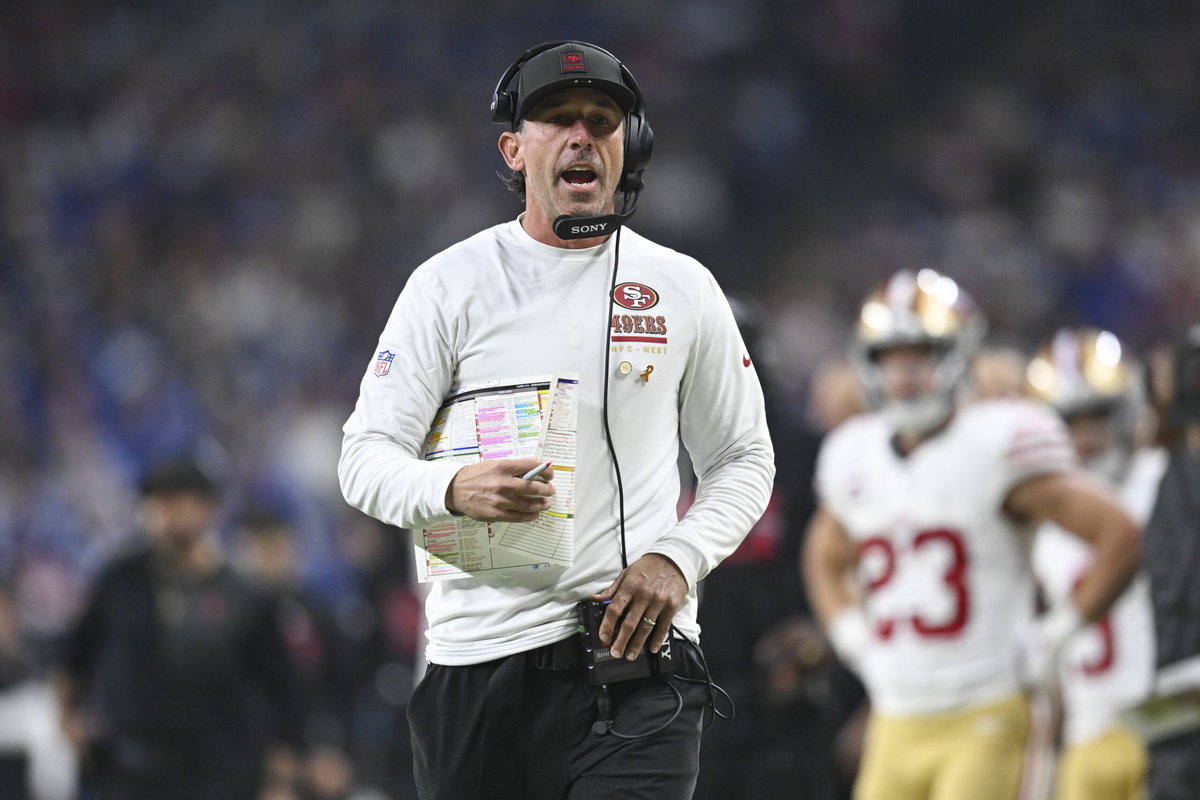
Imago
INDIANAPOLIS, IN – DECEMBER 22: San Francisco 49ers Head Coach Kyle Shanahan jogs down the sideline during the NFL, American Football Herren, USA game between the San Francisco 49ers and the Indianapolis Colts on December 22, 2025, at Lucas Oil Stadium in Indianapolis, Indiana. Photo by Michael Allio/Icon Sportswire NFL: DEC 22 49ers at Colts EDITORIAL USE ONLY Icon116251222071
San Francisco ultimately left the weekend with eight selections and additional future flexibility, a result Shanahan believes gives the class staying power beyond immediate roles. As he put it, all eight rookies have a “very good chance” to make the roster.
Of course, that does not erase the doubts surrounding picks like De’Zhaun Stribling and Kaelon Black. But it does bring clarity to the thinking behind them. The 49ers approached the 2026 draft with a two-year lens. While Kyle Shanahan navigated the limitation of having just six picks, the team also looked ahead to 2027, adding a sixth-round selection after previously not holding one.