
When the San Francisco 49ers selected Kaelon Black in the third round of the 2026 NFL Draft with the 90th overall pick, the reaction was more confusion than anything else. San Francisco already has Christian McCaffrey and a stable running back room, while still carrying needs at other spots, including left guard. Why draft yet another RB?
Watch What’s Trending Now!
Black, on the other hand, came in with a solid résumé, a six-year college career, and a 2025 season where he logged 1,039 yards and 10 touchdowns at Indiana. So while the pushback on drafting another running back is understandable, head coach Kyle Shanahan recently addressed the thinking behind taking Black at No. 90
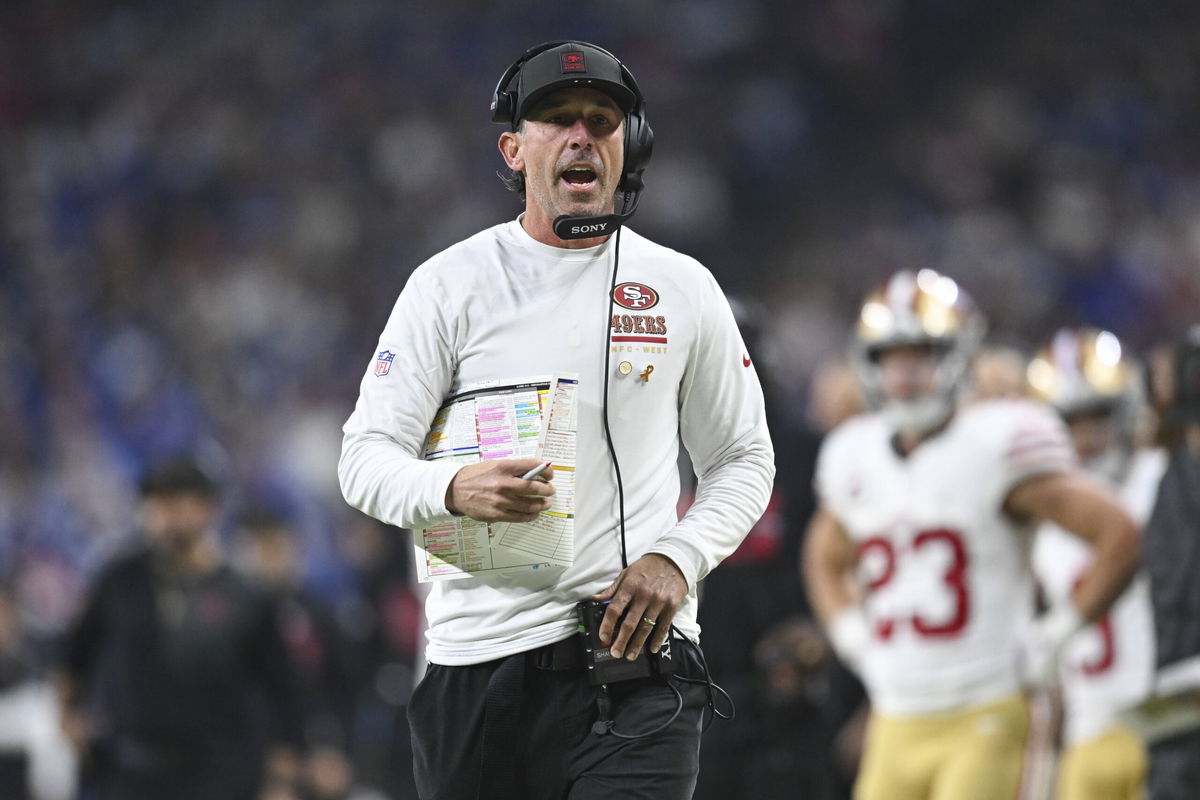
“It always starts with me with just who’s the most natural running back,” Shanahan said of Black, per SB Nation. “I love third-down backs, all the pass game stuff that people can bring, but when it just comes to running the ball, you need to have more than one starter.
“We’ve gone through a number of years here where we’ve been through at least four backs. Last year was one of the abnormal years where, and it was awesome, but our starting back was able to stay healthy.”
The 49ers have selected four running backs in the past five drafts, with Black being the latest addition after the team drafted Jordan James (round 5, 2025), Isaac Guerendo (Round 4, 2024), and Tyrion Davis-Price (Round 3, 2022). But zooming in, the 49ers treat this position as structural depth rather than luxury depth, with their past four backs being picked in the middle rounds.
And it’s easy to understand why. Shanahan’s system is a modern, run-first offensive scheme rooted in the West Coast offense, characterized by wide-zone rushing, heavy play-action passing, and extensive pre-snap motion to create confusion. And besides, Shanahan also needed to manage McCaffrey’s workload.
The veteran will turn 30 in June and is entering the 10th season of his career. He finished the 2025 season with 1202 rushing yards and 10 rushing touchdowns, and his 2,126 scrimmage yards were the most by a 49ers player since Frank Gore in 2006, and were second in the league behind the Atlanta Falcons‘ Bijan Robinson. Black’s arrival in San Francisco means McCaffrey can now spend some time on the sidelines.
“I know that I don’t want Christian to have to take all of that. It was amazing that he did and was able to do that. The reason it’s so hard to get Christian out is because of how much he affects everything in the pass game, even when he’s not getting the ball,” Shanahan said last month. “…But in order for us to be the running team we want to be, in order to have Christian be as good as he can be throughout the whole year, we’ve got to get someone to help him.”
That’s where the 24-year-old former Indiana running back comes in. Black isn’t likely to lead the rushing attack in the 2026 season. In fact, following the draft, Shanahan noted that some of the rookies can be “a big part or have a chance to start two years from now” when the team has some unrestricted free agents that it can lose.
Which naturally makes you wonder: How can Black fit into Shanahan’s scheme? Ahead of the draft, Dane Brugler explained Black’s running abilities and his athleticism. In a report, he noted:
“A short, well-built back, Black runs balanced, low to the ground and consistently finds cracks at the line of scrimmage. Instead of gearing down ahead of impending contact, he bursts to accelerate into flat-footed defenders, and his physical run style helps him maximize each touch. Though mashing the gas pedal helps him produce, he could benefit from added patience to eliminate false-stepping cuts.”
In San Francisco, Black will join a running back room that already has McCaffrey, Isaac Guerendo, Jordan James, and Patrick Taylor Jr. And while backing up his decision to draft Black, Shanahan explained the RB’s traits that made the 49ers want to draft him.
“We’ve gone through four [running backs] a number of times,” Shanahan said. “So, what [Black] could do as a true starting running back is what I liked. If you ever had to give him more carries, could he hit the right hole? Can he move the chains when you only block it for three, can he get five?”
While he impressed with his rushing production in 2025, Black had just eight catches at Indiana. However, his top-tier pass protection also stood out. It stems from his strength; Black can squat 500 pounds and bench press 415 pounds. And the 49ers general manager John Lynch believes the 24-year-old can help the franchise.
Imago
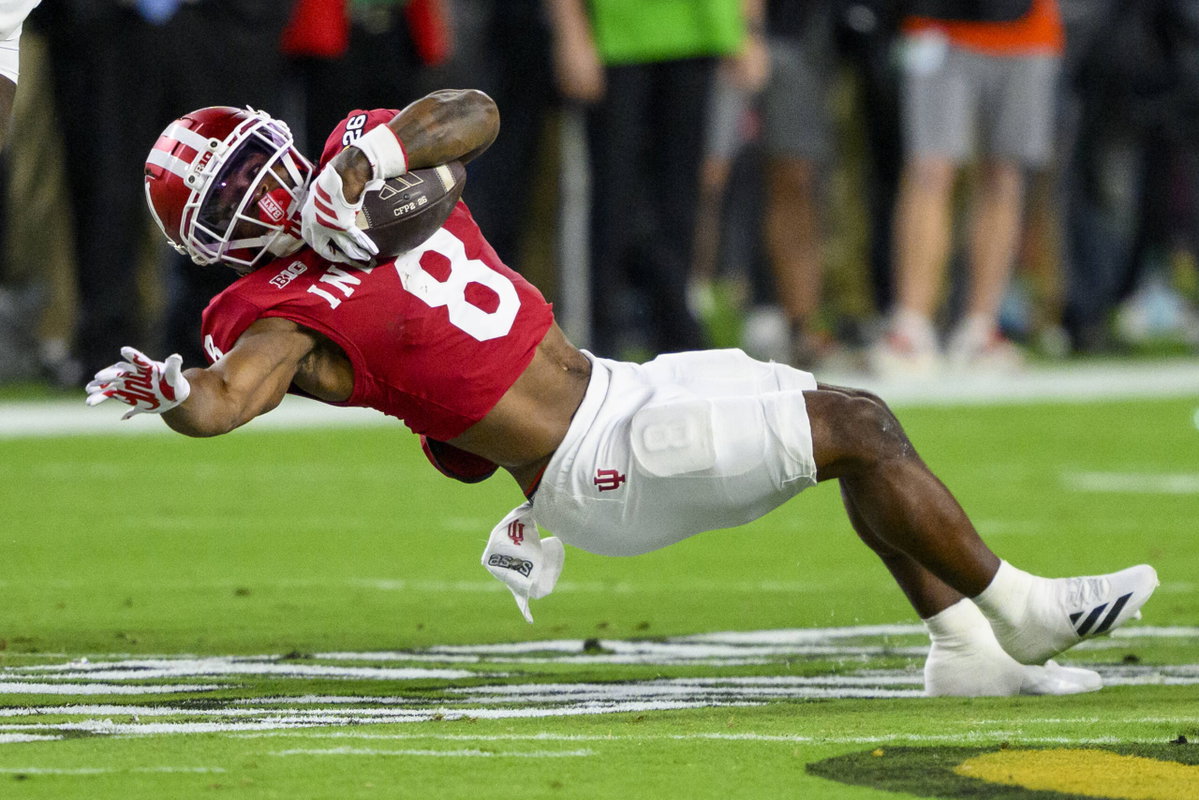
MIAMI GARDENS, FL – JANUARY 19: RB Kaelon Black 8 of the Indiana Hoosiers falls backwards after running with the ball during the Indiana Hoosiers versus the Miami Hurricanes College Football Playoff National Championship Game Presented by AT&T on January 19, 2026, at Hard Rock Stadium in Miami Gardens, FL. Photo by Doug Murray/Icon Sportswire COLLEGE FOOTBALL: JAN 19 College Football Playoff National Championship Presented by AT&T Indiana vs Miami EDITORIAL USE ONLY Icon796260119131
“We really feel like he can help us in a big way,” Lynch said. “We talked a lot about staying true to our board, our convictions. His film speaks for itself. Really hard-running kid, rocked-up kid. You can’t help but love the kid any everything he stands for.”
But at the same time, while John Lynch and Kyle Shanahan have backed their decision to take Kaelon Black in the third round, the move drew mixed reactions, largely due to his projected value and the team’s other roster needs. For context, Black ranked No. 179 on Dane Brugler’s top 300 big board and was the 10th-ranked running back.
The criticism only intensified when the 49ers opted for a running back instead of addressing left guard, where there is no clear starter on the roster. In simple terms, other positions carried more urgency heading into the draft, especially given the team’s recent track record at running back.
Take Trey Sermon, for example. He was selected in the third round of the 2021 NFL Draft at No. 88 overall but was released before the 2022 season and has since moved between teams. Ty Davis-Price followed a similar path after being picked at No. 93 overall a year later and has also struggled to find stability since leaving the team.
Adding to that, Black enters the league after four years at James Madison and two more at Indiana. He is already 24 and will turn 25 during his rookie season. This is why older prospects are often viewed as having limited long-term upside.
At the same time, the 49ers already have depth at the position with Jordan James, Isaac Guerendo, and Patrick Taylor Jr.. While he had a limited role early on, Guerendo still appeared in 16 games and rushed for 420 yards and four touchdowns as a rookie in 2024, providing support when Christian McCaffrey missed most of the season.
And while Lynch stood by the decision, saying, “I think we talked a lot about staying true to our board and our convictions,” the pick has now become part of a wider conversation around the 49ers’ overall draft approach and how this class will ultimately be evaluated.
Mixed early grades add another layer to the reaction around the 49ers’ draft strategy
It may be too early to project how the 49ers’ draft class will perform in the 2026 season. At the same time, though, the early evaluation has not been particularly favorable, with multiple outlets questioning the overall strategy. Bleacher Report’s Kristopher Knox described the class as “inefficient.”
ESPN’s Mel Kiper Jr. went even further, assigning the 49ers the lowest grade in the league, tied with the Jacksonville Jaguars and Minnesota Vikings. Kiper handed out a “C” after pointing to multiple reaches on Days 2 and 3, suggesting that John Lynch consistently selected players well ahead of their projected value.
“There were some really confusing picks in this class,” Kiper wrote. “I like De’Zhuan Stribling, Kaelon Black, and some others, but it seemed like general manager John Lynch went off the board to get the guys he wanted, often way ahead of where they were valued.”
A major part of that criticism centered on Kaelon Black and the broader draft approach. He was widely viewed as a Day 3 prospect but was taken in the third round, reinforcing concerns about value. Reports placed him at No. 197 overall on the consensus big board.
Layer that with the 49ers’ recent history of drafting running backs without consistent long-term returns, and analysts pointed to this as another instance of the team investing earlier than expected at the position.
That said, not every part of the class drew the same reaction. Some selections, particularly Gracen Halton and Romello Height, were viewed much more positively. Halton, in particular, stood out as a strong Day 3 value, with internal evaluations reportedly placing a third-round grade on him before he was ultimately taken in the fourth.
On the defensive side, Height addressed a clear need. San Francisco’s front struggled to generate pressure in 2025. The team finished with just 20 total sacks. And Height’s addition is likely to improve that pass-rush production.
Taken together, the 49ers’ 2026 draft reflects a consistent organizational approach, one that leans heavily on internal evaluations and scheme fit rather than consensus rankings or immediate perception.