
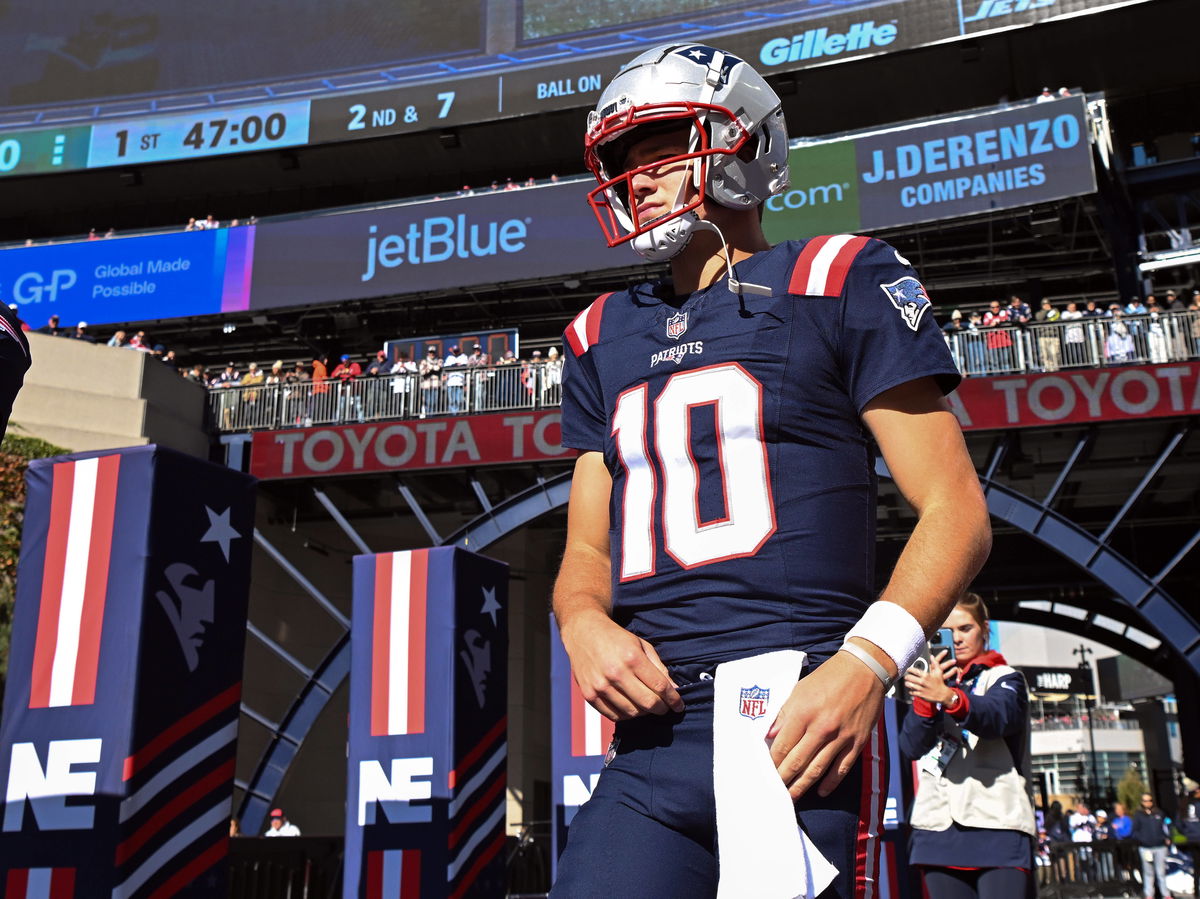
More than a week has passed since the Chicago Bears defeated the New England Patriots 30-24 at Soldier Field for a second consecutive win. But in the NFL’s Week 7 Accountability Report, the team was humbled a tad. At the center of it all is Chicago defensive back Clark Phillips, whose actions went unaccounted for during the game. But the NFL decided to hand him a slip days after his incident involving unnecessary roughness against Patriots quarterback Drake Maye.
Watch What’s Trending Now!
Phillips was fined $11,550 for use of the helmet on a tackle of Maye in the second quarter of the game. The play came with 11:37 remaining in the quarter, as the quarterback scrambled toward the end zone on second-and-goal from the Bears’ 7-yard line.
Phillips attempted to stop Maye near the goal line, making contact as the quarterback stretched out to get the ball across. The officials initially placed Maye at the 1-yard line, but Vrabel challenged the ruling. After reviewing the play, officials determined that Maye had crossed the plane of the goal line with the football before going down, awarding the Patriots a touchdown.
The score brought New England within 10-7 and capped a nine-play, 74-yard scoring drive.
The fact that Phillips went away without a penalty can be attributed to a rule in the NFL rulebook. The reason officials did not throw a flag stems from how the NFL rulebook defines quarterback protection. Rule 12, Section 2, Article 11, limits roughing-the-passer protections to quarterbacks in a traditional passing stance. Since Maye had become a runner, he was no longer covered by those specific protections.
Then what made the NFL throw a fine Phillips’ way? Even when a quarterback is treated as a runner, Article 10’s restrictions on helmet use still apply. Defenders cannot lower their heads to make forcible contact or use the helmet or facemask to target an opponent’s head or neck.
Going through the replay, the Bears defensive back is seen lowering his head and striking Maye’s helmet, grabbing it to stop the quarterback and pin him down to the ground.
There were eight instances of “Use of helmet” fines in Week 7, including that of Detroit Lions defensive back Brian Branch, who was fined $23,882 for unnecessary roughness (use of helmet) against Green Bay Packers tight end Tucker Kraft.
During a fourth-down situation in the first quarter, Branch made helmet-to-helmet contact with Kraft, striking the front of the tight end’s helmet with the crown of his own as he came flying in for a tackle. Kraft lost his helmet on the way down, but no penalty was called.
Meanwhile, the referees sleeping on Phillips’ action put the league on the hot seat.
Boomer Esiason Calls Out NFL Officials for Being Overly Cautious
Calls were already mounting against the league officials for their laid-back attitude to take immediate action on the field whenever any illegal hit took place. Out of the eight “Use of helmet” violations, officials threw a flag on just one of those plays.
Among the players fined without being penalized on the field, besides Clark Phillips, were Brandon Jones, Alex Singleton, Brian Branch, Brandon Smith, Cam Taylor-Britt, and Jordan James. Only Cam Skattebo’s violation resulted in an in-game flag.
This lack of required action led former NFL quarterback Boomer Esiason to drop a blunt take.
“I thought it was close, especially after yesterday’s games watching these flags come out and Tom Brady almost coming out of the box twice yesterday because of roughing the passer penalties in the game that he was doing, I think the officials are just told to try to keep the quarterbacks as protected as they possibly can,” he said on The Greg Hill Show. “While I appreciate it and I understand it. We want these guys.
“These are the guys that we want to see on Sundays. We don’t want to see backups. I think the officials have taken it to a whole new level of just being over-cautious and throwing these flags. Now that one on Thursday night, that definitely deserved a flag.”
Although the league is ensuring players face consequences for their actions, its delayed response has brought renewed scrutiny to NFL officiating.