
Imago
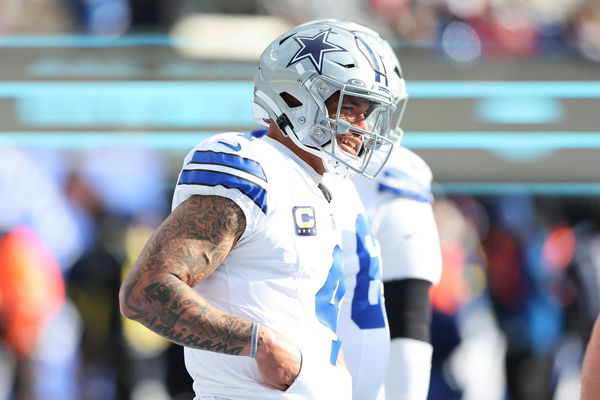
OXNARD, CA – JULY 25: Dallas Cowboys quarterback Dak Prescott 4 speaks with reporters during the team s training camp at River Ridge Playing Fields on July 25, 2024 in Oxnard, CA. Photo by Brandon Sloter/Icon Sportswire NFL, American Football Herren, USA JUL 25 Cowboys Training Camp EDITORIAL USE ONLY Icon240725059
Imago
OXNARD, CA – JULY 25: Dallas Cowboys quarterback Dak Prescott 4 speaks with reporters during the team s training camp at River Ridge Playing Fields on July 25, 2024 in Oxnard, CA. Photo by Brandon Sloter/Icon Sportswire NFL, American Football Herren, USA JUL 25 Cowboys Training Camp EDITORIAL USE ONLY Icon240725059
Essentials Inside The Story
- Former head coach doubted whether the rookie quarterback would adapt
- Early preseason addressed concerns about operating under center
- Rising stock could be a sign of 2026 MVP buzz
For years, Jason Garrett was the voice shaping how the Dallas Cowboys evaluated and developed quarterbacks, and few decisions mattered more than the one involving Dak Prescott. When the rookie arrived from Mississippi State Bulldogs, his college background raised real concerns about how quickly he could adapt to an NFL offense, shaping expectations inside the building. Now, nearly a decade later, with Prescott now being projected as an MVP candidate, Garrett is finally pulling back the curtain on that early assessment and why it missed the mark in ways no one in Dallas anticipated.
Watch What’s Trending Now!
“I’ve often said this that I felt like I got the evaluation on Dak Prescott wrong because I felt like he was a quarterback who could be the starting quarterback for the Dallas Cowboys for 15 years,” Garrett said. “My biggest thing was I thought his transition was going to take longer because he was a gun quarterback in college.
“We were going to play under center, and he was going to have to be able to do that as well as do the stuff that we’re asking him to do in the gun. And I had seen other quarterbacks struggle with that transition. Well, you know the story. He loses his first game and then rattles off 11 straight wins. I don’t know that I ever saw him being able to do that.”
One could understand Garrett’s skepticism about Prescott’s development during his rookie year. Prescott came into the NFL from Dan Mullen’s offense at Mississippi State, a system built heavily around shotgun and read-option concepts. Prescott was the centerpiece of that offense.

Tony's Top Prospects For QB For COWBOYS
Prescott redshirted as a freshman. Then, he backed up Tyler Russell through parts of his sophomore season, and then took over as the full-time QB1. In his final three years, he rushed for 829, 986, and 588 yards while scoring 37 rushing touchdowns. His game was built around space, tempo, and the gun.
View this post on Instagram
What made the transition feel even riskier at the time was how scouts viewed Prescott coming out of college. While his production jumped each season, including a sharp drop in interceptions and improved accuracy as a senior, evaluators still questioned his footwork, timing, and ability to work through full-field progressions in a pro-style system. Many labeled him a developmental quarterback whose mechanics would need refinement before he could run an NFL offense efficiently.
So when Dallas selected him in the fourth round, Garrett (then the head coach) had a fair concern. Could Prescott smoothly transition from that comfort zone to operate consistently under center?
Around the league, quarterbacks coming from spread-heavy shotgun systems were often downgraded on draft boards, with teams worried about how quickly they could adjust to traditional dropbacks, play-action timing, and tighter throwing windows. Prescott’s average athletic measurables and reputation as a system quarterback only reinforced the idea that he would need time.
By June 2016, former Cowboys executive Gil Brandt noted that even though Prescott wasn’t getting consistent first- and second-team reps, he looked natural taking snaps under center. That became more visible in the preseason opener against the Los Angeles Rams. Despite Jameill Showers reportedly outperforming him in camp, the staff gave Prescott the start.
He logged 31 snaps: 18 under center and 13 in shotgun, which led to two touchdown passes to Dez Bryant and Terrance Williams. That’s exactly the balance Garrett wanted to see.
For the coaching staff, the takeaway wasn’t just the scores, it was that Prescott was already executing full-field reads, handling footwork-heavy play designs, and operating comfortably in the structure Garrett believed would take much longer to master.
Prescott’s flashes translated quickly once the games counted. After Tony Romo suffered a vertebral compression fracture in Week 3 of the preseason, Prescott was named the starter. He threw for 227 yards in his debut. The Cowboys lost that game. Then they didn’t lose again for a while.
Dallas rattled off 11 straight wins and finished 13-3. That run effectively erased Garrett’s early doubts. After all, he had seen quarterbacks struggle with similar transitions. Think of Alabama’s Blake Sims and Oregon State’s Sean Mannion during the 2015 Senior Bowl. But Prescott proved to be the exception.
What was once viewed as a multi-year developmental process unfolded in a matter of weeks. Prescott not only adjusted mechanically but showed poise, processing speed, and command of the offense far ahead of the curve most teams had projected for him on draft day.
Now, heading into 2026 after one of the best seasons of his career, Prescott has tied Romo for the most 30-plus-touchdown seasons in franchise history, with four. The same quarterback, once projected for a slower transition, is now entering the year with legitimate MVP buzz.
Dak Prescott has been predicted to win the MVP next year
Winning a first MVP in your 30s isn’t common, but it’s hardly out of reach. We’ve just seen Matthew Stafford doing it in his late 30s. Meanwhile, Dak Prescott just delivered one of the strongest statistical seasons of his tenure.
Still, defensive shortcomings kept Dallas out of the playoffs. With continuity on offense and a retooled roster, though, analyst Matt Bowen believes Prescott could finally break through next season.
“Dak Prescott, QB, Cowboys,” Bowen noted when asked about his pick for next season’s MVP. “Prescott had more than 4,500 passing yards and threw 30 touchdowns this past season. With the Cowboys expected to retain wide receiver George Pickens, look for Prescott to produce high-level numbers again for a team that could challenge for the NFC East title in 2026 with an improved defense.”
Imago
EAST RUTHERFORD, NJ – JANUARY 04: Dak Prescott 4 of the Dallas Cowboys during the game against the New York Giants on January 4, 2026 at MetLife Stadium in East Rutherford, New Jersey. Photo by Rich Graessle/Icon Sportswire NFL, American Football Herren, USA JAN 04 Cowboys at Giants EDITORIAL USE ONLY Icon26010422153
In fact, Prescott closed the 2025 season with 4,552 passing yards, completing 67.3% of his throws. He totaled 30 touchdowns (ranking 4th in the NFL) against just 10 interceptions. Despite this production, what wasn’t there was enough support on the other side of the ball.
That’s where the offseason becomes pivotal. CeeDee Lamb remains a centerpiece, and the expectation is that Dallas retains George Pickens after his career year. Beyond that, the front office is looking to recalibrate key areas of the roster. If those adjustments translate, Prescott won’t just be chasing numbers. He’ll be competing with the league’s top players for an MVP.
Written by

Edited by

Aadesh D