
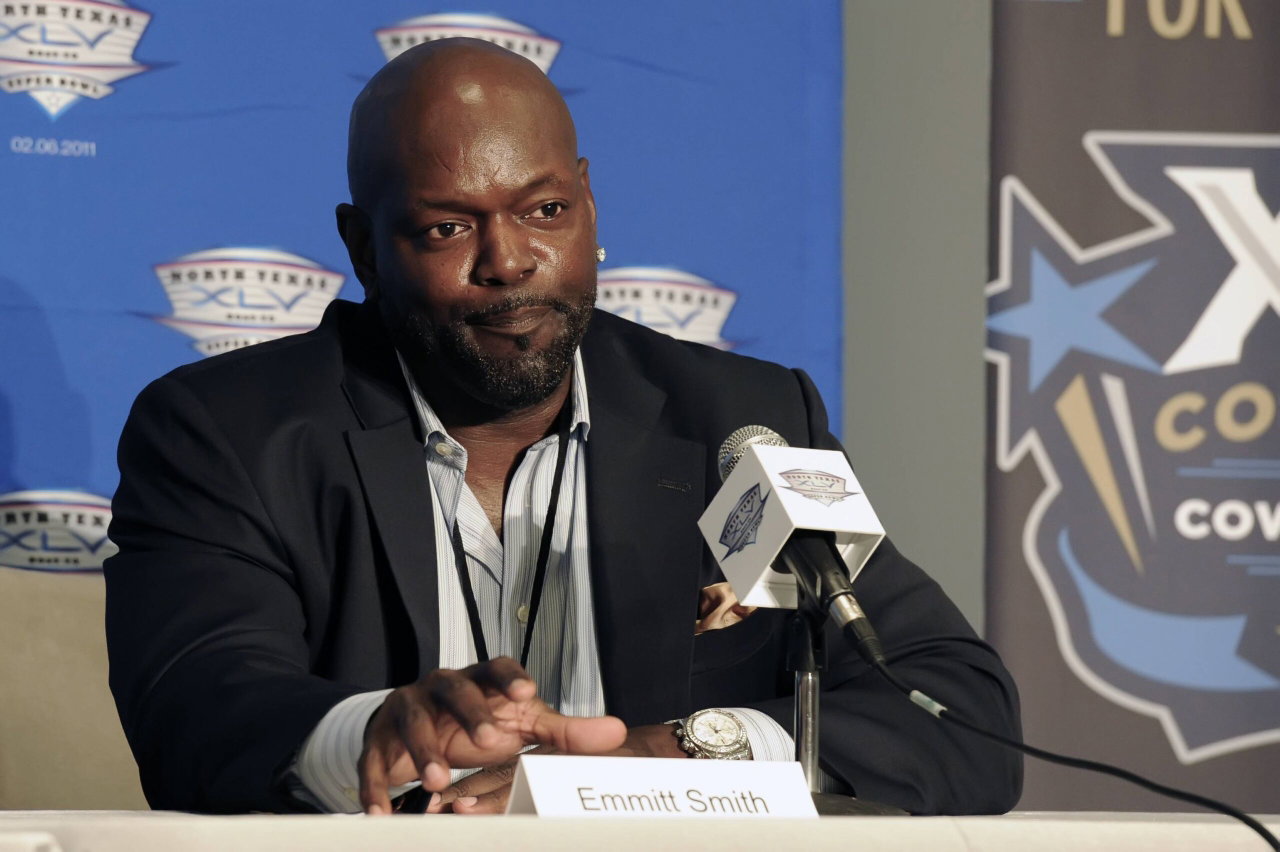
Essentials Inside The Story
- Years after he was a victim of a Ponzi scheme, the Dallas Cowboys legend will face the court but on a different bench.
- Emmitt Smith allegedly pushed an investor with promising advantages.
- The investor gave Smith and the other defedants a chance but were ignored.
Not eleven months ago, Dallas Cowboys legend Emmitt Smith was embroiled in a legal battle in Dallas County. Apparently, he and another person had been defrauded of $500,000 in an alleged Ponzi scheme. Now, he has swapped sides with the plaintiffs after a lawsuit was filed against him for a much larger sum.
Watch What’s Trending Now!
In 2023, Smith and many others allegedly influenced Kituwah Energy—a business entity owned by the Eastern Band of Cherokee Indians— to invest $2.5 million in a project. With promises not met in almost three years and the contract breached, the Native American economic development agency filed a lawsuit in Delaware Chancery Court on Monday for the fraudulent scheme and more. As it turns out, the defendants were given a reasonable offer to make things right, but they “ignored” it and are now in deeper muddy waters.
According to the lawsuit filed August 31, Monday, in Delaware’s Chancery Court, Kituwah LLC (Plaintiff) filed a Verified Direct and Derivative Complaint against the former Cowboys running back Smith, his longtime business partner David Mosley, and their commercial real estate company, 4 13 Solutions Inc., Wilson Holdings of North America, LLC, and Jabez 4 10, LLC (Defendants) “to exploit Plaintiff for $2.5 million” for a solar project.
Kituwah says it has “not recovered a penny” despite the loan being more than two years past due and numerous requests for repayment. The case only grows more interesting…
How it all started:
In early 2023, Smith and Mosley came across a potential investment opportunity through 4 13 Solutions with a renewable energy developer named Genesis Consolidated Industries (GCI) to develop a solar farm in Texas called “Project Exodus.” At the time, GCI was in the process of purchasing the land for the same from owners Walton Texas LP (“Walton”) and RUC Holdings LLC (“RUC”). However, the developer could not match the amount required. As such, they started looking to raise funds from outside.
Smith’s 4 13 Solutions identified the opportunity and planned to take a loan from the Department of Energy (DOE) but also required another investor with them. Walks in Kituwah Energy.
The formula was simple: The entity will primarily be governed by both Kituwah and 4 13 Solutions. Wilson Holdings would also hold a minority investment and participation. The promises made to Kituwah also looked achievable.
They were told the solar farm would be up and running by the end of 2024 and generate millions in profits. By then, the Department of Energy would also be funding the project. While Kituwah was playing safe, Smith and others assured them they should get their invested money “within the next three months.” The defendants finally pushed another claim that got the ball in their court for good.
“4 13 Solutions invented false offers from other investors and claimed that GCI was ready to walk away and that Kituwah needed to invest quickly to help 4 13 Solutions close the deal,” the lawsuit states.
As such, Kituwah formed a Delaware LLC with 4 13 Solutions, and Wilson Holdings called Jabez 4 10, LLC. The plaintiffs took Smith and Mosley at their word. However, nothing came of it.
Kituwah made a friendly offer, but was forced to file a lawsuit in the end
By the end of 2024, Kituwah realized that 4 13 Solutions had made no progress in obtaining the DOE loan, the project land, or the rights to the GCI PSA. Despite the loan coming to an end on February 1, 2024, Kituwah continued to send repayment notices to 4 13 Solutions, but they were never addressed. They launched an investigation and came to a brutal realization:
“It has determined that 4 13 Solutions’ representations were part of Smith’s and Mosley’s scheme to cheat Kituwah out of $2.5 million,” states the lawsuit.
Turned out 4 13 Solutions never used the $2.5 million to acquire Project Exodus but used it to pay Wilson Holdings, with which they were already involved in a prior investment. Hence, the Ponzi scheme. But Kituwah Energy had more to learn.
A ‘Side Letter’ with Wilson Holdings says that they will be paid a sum of $2.5 million once 4 13 Solutions had acquired permanent financing for Project Exodus. But despite the condition not being met, the payment was made — to the surprise of Darrell Wilson himself.
“Although Wilson Holdings accepted the money, Darrel Wilson admitted he did not know what triggered the payment. In other words, Darrel Wilson conceded that the payment was in breach of the Wilson Side Letter, since the condition for the payment was never satisfied,” the lawsuit also states.
What’s interesting is that Kituwah still did not file any charges. Instead, they extended an offer to quash the increased interest on their loan to 4 13 Solutions.
With over a year since the loan had reached its time limit, Kituwah informed that about $600,000 in interest has accrued on the loan. By calculation, the current amount to be repaid is over $3 million. But they made an offer to ease the difficulties for 4 13 Solutions.
Apparently, they had mentioned that if the loan was repaid by August 31, 2025, they would waive any interest on it. However, that effort also went in vain.
What the lawsuit seeks
Smith, Mosley, and the other defendants face six causes of action, including fraudulent inducement, breach of fiduciary duty, and breach of contract. Kituwah now seeks at least $2.5 million, plus interest, costs, and expenses, as well as additional damages to be determined at trial.
Considering that Kituwah had other charges related to this entire process, they are also looking for attorneys’ fees and other costs associated with bringing the lawsuit. Additionally, they are also seeking “further relief as the court deems just and proper.”
“Kituwah poured substantial time, efforts, and resources in the purported joint venture,” the suit says. “Not only has Kituwah not seen any returns on its investment, Kituwah has been forced to expend additional costs in efforts to reclaim the amounts it is still owed pursuant to its investment, including to investigate what happened to its money.”
Interestingly, this is not the first time that Smith found himself embroiled in a lawsuit.
Emmitt Smith has faced legal charges before
This time, last year, Smith had to close his restaurant in Las Vegas, named Emmitt’s, when he failed to pay the building’s landlord the due rent. It reportedly piled up to $400,000. But years ago, he was also a victim of a similar Ponzi scheme.
Smith fell prey to a three-year legal dispute when he was taken into confidence to invest $500,000 in Traders’ Domain FX, a foreign investment firm and trading platform.
Smith’s lawsuit dates back to 2022, when Johnny Wimbrey, a Southlake entrepreneur, Secap Holdings LLC, and residents Frederick Safranko, of Austin, and Tin Quoc Tran, of Katy, sought $500,000 from Smith. However, the former Cowboys player was promised that he could withdraw the amount upon request.
Court filings allege that the defendants channeled the funds into bank accounts under their control, denying the plaintiffs access to the money. The filings also state that Smith was unaware that the company was not registered with the SEC or CFTC to offer foreign currency trading.
Years later, the tables turned, and Smith got sued over allegedly running a Ponzi-like scheme. None of the defendants have responded to the allegations and lawsuit by Kituwah as of yet.