
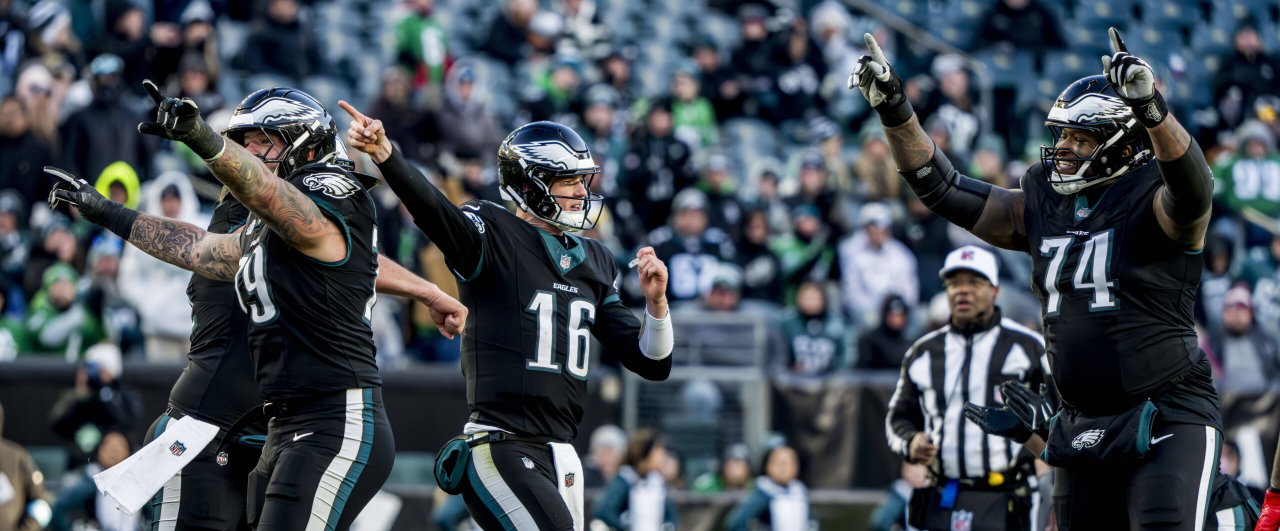
A controversial roughing the passer call against rookie edge rusher LT Overton handed the Philadelphia Eagles a free touchdown, highlighting the ongoing penalty issues for Dallas’s struggling defense. While backup quarterback Tanner McKee got the start for an injured Jalen Hurts, the officials’ decision to penalize Overton quickly became the game’s biggest talking point.
Watch What’s Trending Now!
The Cowboys selected the Alabama Crimson Tide product as the No. 137 pick in the 2026 NFL Draft. Seven games into the season, the rookie is already smelling a hefty fine coming his way. For now, he had to pay on the field itself.
“Horrible roughing the passer penalty on lt overton,” reported Cowboys writer Clarence Hill Jr.
There was clear frustration in the booth.
“But he comes in, you know what, he gets the face mask,” Troy Aikman said while broadcasting.
“But Troy, I’ll play devil’s advocate there,” Joe Buck added. “I mean, it is an open hand going, he’s matching the hand of the quarterback. To me, that’s not something the league usually wants called as a foul.”
A facemask penalty is assessed when an NFL player grabs an opponent’s facemask or helmet opening and uses the grip to twist, turn, push, or pull them. The penalty carries a 15-yard loss, while a defensive foul also gives the offense an automatic first down.
What Buck here defended is the fact that, going by the clip, Overton appeared to mirror the quarterback’s hand movement with an open hand rather than make a forceful hit.
When it comes to distinctions in facemask penalties, what matters is whether the defender merely touches the facemask or actually grips and controls it. Sliding a hand across the bars is different from closing the fingers around them and redirecting the helmet. A brief grip can be enough to draw a penalty; a violent neck snap or prolonged pull is not necessary.
The rule also applies to the helmet opening. Hooking that opening and pulling the helmet is treated the same way, even if the defender never grabs the front bars. For example, grabbing a runner’s facemask and turning the runner’s head during a tackle is a foul. Merely brushing the facemask without gripping or controlling it, however, does not automatically make the play illegal. Going by the clip, Overton’s movement falls in the last category.
A facemask foul that meets the NFL’s criteria results in a 15-yard penalty. The rules do not allow officials to downgrade it to five yards based on the severity of the contact.
After Overton made contact with Tanner McKee’s helmet on third down, the officials called roughing the passer, giving Philadelphia a penalty advantage. On the very next play, Eagles running back Dameon Pierce ran the ball five yards into the end zone for a touchdown. Philadelphia took a 14-10 lead with 13 minutes and 25 seconds remaining in the second quarter.
Already the calls are dropping in against the NFL for being too protective of the quarterbacks.
“I understand that LT Overton got Tanner McKee’s facemask,” SB Nation writer RJ Ochoa wrote on X while the game was still on. “But just feels like the expectation for defenders is impossible.”
For the Cowboys, this is the second time that a facemask penalty cost them this season. During their face-off against the Tampa Bay Buccaneers, Dallas defensive tackle Otito Ogbonnia was fined after officials called a facemask penalty on Tampa Bay running back Bucky Irving with 9:13 remaining in the second quarter. But back then, Ogbonnia grabbed Irving’s facemask while attempting a tackle and was immediately flagged.
The NFL reviewed the incident and ruled that Ogbonnia had violated the facemask rule, resulting in an $11,111 fine. The league’s official fine schedule lists $17,911 for a repeat offense.
While the NFL has not yet announced any official disciplinary action, a first-time facemask violation typically carries a fine of around $11,941. However, the call drew instant criticism from broadcasters and analysts, who argued that Overton’s contact was minimal and did not warrant a flag.
Meanwhile, he was not the only player on the Cowboys’ defense who got into trouble against the Eagles.
Cowboys Defense Continues to Struggle Amid Costly Mistakes
The Eagles faced fourth-and-1 at their own 44-yard line when an aborted snap appeared to give the Cowboys a stop. However, defensive tackle Quinnen Williams was penalized for offsides, allowing Philadelphia to retain possession with a fresh set of downs. It marked Williams’ second offsides infraction of the opening quarter.
“Quinnen Williams with two really silly penalties for the Cowboys defense so far, the second of which killed a turnover on downs/turnover/whatever,” Ochoa wrote. “From the best player on that side of the ball. Unacceptable.”
Overton’s penalty and Williams’ offsides are not isolated mistakes. They fit a frustrating pattern for a Dallas defense that ranks No. 30 in the league, giving up 382.5 total yards per game. When a unit is already struggling to stop opponents, unforced flags only make matters worse.
Patience ran thin as Williams’ penalty came at a time when the Cowboys had a chance to benefit from a fumble.
Already, the Cowboys’ defense had been struggling hard to find their rhythm. According to FOX Sports’ 2026 NFL Defense Rankings: Team Pass and Rush Stats, the Dallas defense ranks at No. 30, averaging 382.5 yards as they allowed 232.7 passing yards.
It’ll be interesting to see how all these blunders add up to the Cowboys’ fate at the end of the game.