
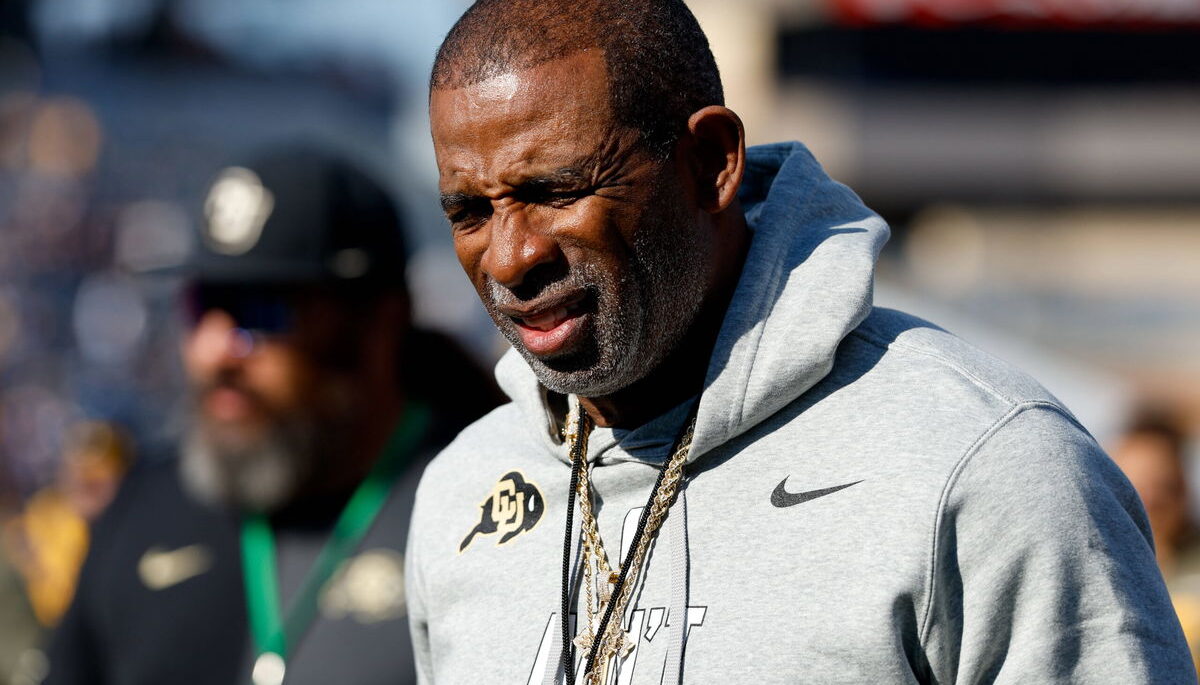
In August 1997, Deion Sanders arrived at Cowboys practice wearing a diamond-encrusted gold cross, talking about football, baseball and the divorce that had turned his life upside down. Yet, he spoke about it with surprising calm, calling the divorce “a blessing” because it forced him to look in the mirror and change. Just weeks later, he was still moving between two worlds, playing baseball for the Cincinnati Reds before heading back to Dallas for the Cowboys. It was the kind of schedule only Prime could make look normal. Yet, away from the cameras, his priorities were beginning to change.
Watch What’s Trending Now!
As Sanders went through the divorce and a custody fight over Deiondra and Deion Jr., he said he needed to be in a “stable place,” a concern that weighed on his decision to leave baseball. From the outside, he was still the same Deion who could command a room and switch sports without missing a beat. Years later, however, Sanders would reveal just how difficult it had become to keep that version of himself going.
“I was on the side of the highway trying to kill myself,” he once shared on the All The Smoke podcast. “I was trying to get that stuff together and I couldn’t. And I was playing baseball at the time, man. And going through my first divorce. So now your kids are taken from you. And you know, that’s the only thing you feel like love you. So I’m like, dang, my kid’s gone.”
The time Deion referred to in the podcast was in 1997.
He married Carolyn Chambers in 1989. Their divorce was finalized in 1998, and by then, they were parents to Deiondra Sanders (born in 1992) and Deion Sanders Jr. (born in 1993). Contemporary reporting from September 1997 also shows how seriously the custody issue was weighing on Sanders. The Reds had allowed him to leave baseball early and return to the Cowboys full-time, and Sanders said his need to be “in a stable place” for his children “carries a lot of weight.”
Both their children have spoken about what it was like to live with divorced parents.
“I think just as I got older, I got to see people in the same home, and I just always wanted to experience that,” Deiondra Sanders said on a podcast with Lecrae. “Like, I grew up great. Like my mom, great mom, dad, great dad. But it’s like, what would it have been like if I was in the same home?”
Even the eldest son of Coach Prime shared his experience while giving his father some credit.
“But my dad was always there, though,” Deion Jr. said on Mr. Organik’s YouTube channel. “He always showed up to everything, every game, every this, every that. He still was a present father, so I don’t want people thinking he wasn’t. He was always there.”
Those later reflections also matter because Sanders’ fear in 1997 was not simply about the end of his marriage. He had very young children, and he has repeatedly described their love as the one thing in his life he believed was genuine. That helps explain why the custody fight carried such a heavy emotional weight for him.
Sanders did not wait decades to tell people about the crisis. In 1998, he spoke publicly about the car incident and described it as a suicide attempt. He said he had been driving around 65–70 mph when the car went down a roughly 30–40-foot drop, yet he emerged without a scratch. “I attempted suicide, but God had his hands on me,” Sanders said.
What came afterward became just as important to the story.
Sanders said the life he had built before the crisis was packed with things that looked like success but gave him no peace. In 2019, while speaking on Journeys of Faith with Paula Faris, he called having 10 cars, hundreds of suits and a 14,000-square-foot house part of his “rock bottom.” The house was enormous, he said, but he “never” felt at home.
That interview also gave a name to something Sanders believed had made his suffering difficult for others to see: “Prime.” He said people were crying out to him but could not hear him because they saw the character he had created rather than the man underneath it. “They saw Prime,” he said. “They saw my character. The character I created, not the character of a man.”
By 2021, Sanders was even more direct about the mental state behind that period. Appearing on I Am Athlete, he said, “Yeah, I was suicidal,” while recalling that he was at the top of his career, with fame and endorsements, even as his divorce and separation from his children were tearing him apart.
His most detailed explanation came in 2024 on The Ed Mylett Show. Sanders said he had become “lost trying to satisfy you all with the persona” and that this was when he became suicidal. He described having a 15,000-square-foot house but never feeling at home, hundreds of suits that could not cover his pain and hundreds of pairs of shoes that could not help him take a step forward. At one point, he said, he could go 3-for-4 in a baseball game and still be thinking about killing himself afterward. “I just didn’t have peace and I didn’t have joy,” he said.
That distinction is central to Sanders’ own account. He has never suggested that the divorce, by itself, explains everything. The custody fight was a major part of the crisis, but he has also described feeling unknown, emotionally empty and trapped inside a persona that had become bigger than the person wearing it. His money, career and celebrity had not disappeared; they simply could not give him what he was looking for.
Eventually, Sanders said, he stopped trying to fix himself on his own terms and surrendered his life to God. He has consistently credited his Christian faith with changing the direction of his life after the attempt. In his later retellings, that moment became less about surviving one car crash and more about finding a reason to keep living.
There was even a strange detail attached to the night itself. When Sanders revisited the incident on All The Smoke in 2024, he recalled driving through Cincinnati while Kirk Franklin’s “Conqueror” was playing. He later described the irony of listening to a song about overcoming while sitting in a car he believed he was about to use to end his life.
The experience did not simply disappear after Sanders found faith. In 2024, he said the attempt still affects him and that he thinks about the night in Cincinnati. More importantly, he has carried that experience into his work with athletes, telling players about his own struggles because he knows someone in a locker room can be hurting without anyone else realizing it.
That concern was visible when Sanders pushed back against the NCAA after Colorado offensive lineman Tyler Brown was denied immediate eligibility following his transfer from Jackson State. Brown, Sanders said, was dealing with serious personal issues and was seeing specialists. Sanders questioned whether the NCAA truly cared about mental health when it denied an athlete something he believed gave him peace.
“Do you really care (about mental health), or are you saying you care? Are you caring when it’s convenient?” Coach Prime said. “Or when it’s profitable?” His comments came from a coach who had spent decades learning that an athlete can look completely fine from the outside while fighting something nobody else can see.
What Sanders has done is make his own story part of the conversation. The man who once felt that nobody could see past “Prime” now talks openly about the period when he did not want to be here, particularly with athletes who may be hiding their own struggles. And nearly three decades after that night in Cincinnati, he still treats surviving it as one of the defining moments of his life.