
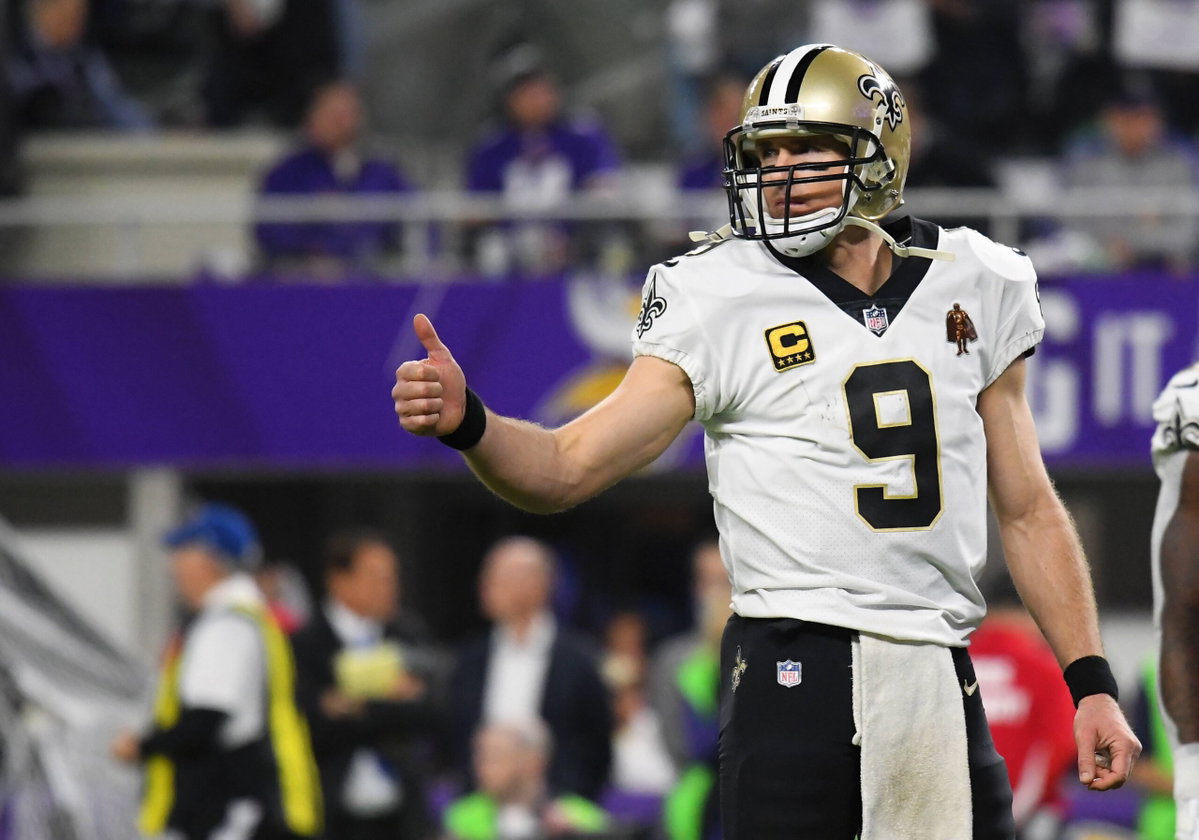
The first quarterback in NFL history to cross 80,000 career passing yards, Drew Brees retired in 2021 with 80,358 yards before Tom Brady eventually surpassed him. Yet five years after walking away from football, the same record-breaking quarterback seriously considered putting the pads back on at 47 and making an improbable return with the Denver Broncos. Denver was desperate enough to call, Brees was serious enough to work out, and suddenly that legend was flirting with an NFL return.
Watch What’s Trending Now!
Who would have thought the Broncos and Drew Brees would ever appear in the same sentence? His only real Denver connection was through his former Saints coaches. Still, Brees considered suiting up for a team he had never played for until his wrist killed the comeback.
“After the Denver Broncos lost starting quarterback Bo Nix to a fractured ankle in their overtime playoff victory against the Buffalo Bills, Denver’s then-offensive coordinator Joe Lombardi and offensive assistant Pete Carmichael had discussions with Brees about the former star quarterback coming out of retirement to be ready for the AFC Championship Game, sources told ESPN,” reported Adam Schefter on September 14.
And Nix had been delivering when Denver needed him most. Against Buffalo, he completed 26 of 46 passes for 279 yards and three touchdowns, while adding 29 yards on the ground in the overtime win. Losing him was not simply a depth-chart problem. Denver had just lost the quarterback who had driven its offense through one of the biggest games of the season.
That is what made Brees such an intriguing emergency option. With Nix out, Denver had to turn to Jarrett Stidham for a win-or-go-home AFC Championship Game. The experience gap was massive, as Stidham had made just four career regular-season starts and had never started a playoff game.
Against New England, Stidham completed 17 of 31 passes for 133 yards, one touchdown and one interception, while also losing a fumble. Denver managed only seven points in the 10-7 loss, making the Brees what-if even harder to ignore.
Brees offered something Denver could not manufacture in a week: two decades of NFL experience and deep familiarity with the offensive principles used by Sean Payton, Lombardi and Carmichael.
That could have helped Denver preserve more of its offense instead of heavily adjusting around an emergency starter. Courtland Sutton and Marvin Mims Jr. also would have gained a quarterback whose career was built on anticipation, timing and quick decisions.
Denver did not need Brees to suddenly become his prime self either. With a defense capable of keeping the game tight, the Broncos may have only needed him to protect possessions, sustain drives and make a few important throws.
Before the matchup, Brees spoke with Lombardi and Carmichael and told them he first wanted to test his body in a workout. The possibility was serious enough for him to find out whether he could still physically handle NFL football.
“I would say I’ve had some conversations and I’ve had some moments,” Brees shared during a February appearance on the New Heights podcast. “I’ve had some moments, like my body feels great. My mind sharp as ever. Yeah. Shoulder, wrist, not having it.”
That workout gave him the answer. Wrist discomfort ended the possibility before Denver ever had to decide whether Brees or Stidham would start.
Perhaps the strangest part was that Sean Payton reportedly knew nothing about the initial discussions. Brees had spent more than a decade playing under Payton in New Orleans, yet Lombardi and Carmichael first explored the idea without involving him.
They wanted to determine whether Brees was genuinely interested and physically capable of returning before taking the possibility to Payton. By the time Payton learned about it in the offseason, the opportunity had already passed.
Denver turned to Stidham and fell three points short of the Super Bowl. Brees never got his comeback. Another quarterback who once replaced him did.
Philip Rivers Got the Comeback Drew Brees Never Got
Brees was picked by the San Diego Chargers with the 32nd overall selection in the 2001 NFL Draft. But after the Chargers went 4-12 in 2003, they held the No. 1 pick in 2004 and had an opportunity to find another franchise quarterback. San Diego selected Eli Manning despite Manning making it clear before the draft that he did not want to play for the Chargers. They then pulled off a massive draft-day trade with the New York Giants, sending Manning to New York in exchange for Philip Rivers, whom the Giants had selected fourth overall, and additional draft compensation.
But Rivers held out during training camp over a contract dispute, falling behind on the depth chart that season. Brees took control of the situation and flipped the script, 12-4. Yet then, in 2005, they placed Brees on the franchise tag. Things shifted on New Year’s Eve during the final game of the 2005 regular season against the Broncos, when Brees took a hit. It dislocated his right throwing shoulder and tore his labrum that required complex surgery in 2006.
Because of the uncertainty surrounding Brees’ health and their existing investment in Rivers, the Chargers made Brees an incentive-based offer with limited guaranteed money. Brees passed on it, later signing a richer contract with the Saints in free agency. Rivers was then handed the reins in San Diego.
Years later, their paths briefly mirrored each other. At 44, Rivers came out of retirement to join the Indianapolis Colts in December. In three late-season games, he completed 63% of his passes, going 58-for-92 for 544 yards, four touchdowns and three interceptions. The difference was simple: Rivers actually made it back onto an NFL field. Brees never did.