Imago
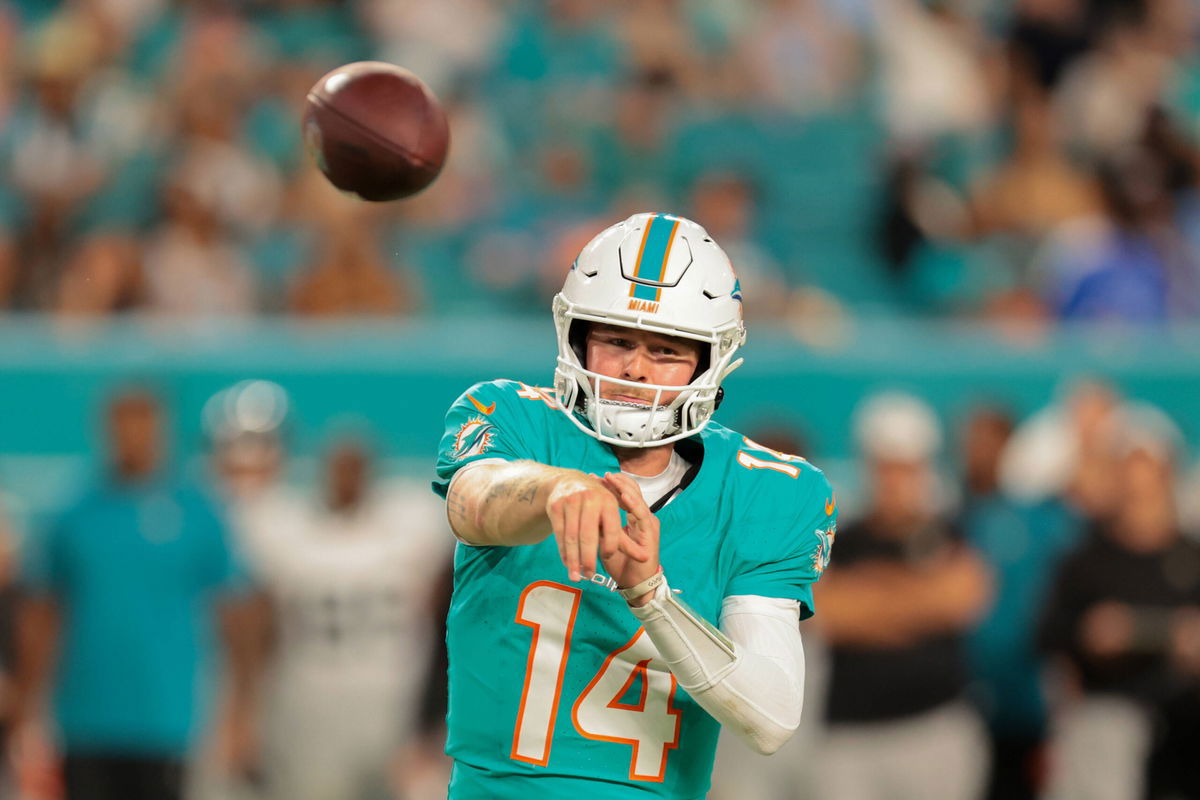
NFL, American Football Herren, USA Jacksonville Jaguars at Miami Dolphins Aug 23, 2025 Miami Gardens, Florida, USA Miami Dolphins quarterback Quinn Ewers 14 passes the football against the Jacksonville Jaguars during the fourth quarter at Hard Rock Stadium. Miami Gardens Hard Rock Stadium Florida USA, EDITORIAL USE ONLY PUBLICATIONxINxGERxSUIxAUTxONLY Copyright: xSamxNavarrox 20250823_SN_na2_0156
Imago
NFL, American Football Herren, USA Jacksonville Jaguars at Miami Dolphins Aug 23, 2025 Miami Gardens, Florida, USA Miami Dolphins quarterback Quinn Ewers 14 passes the football against the Jacksonville Jaguars during the fourth quarter at Hard Rock Stadium. Miami Gardens Hard Rock Stadium Florida USA, EDITORIAL USE ONLY PUBLICATIONxINxGERxSUIxAUTxONLY Copyright: xSamxNavarrox 20250823_SN_na2_0156
Essentials Inside The Story
- Quinn Ewers steps into an offense built long before his arrival.
- Data explains why this system once maximized Tua Tagovailoa.
- Miami’s late-season choices quietly shape the quarterback's future.
The Miami Dolphins host the Cincinnati Bengals in Week 16. Only this time, it won’t be Tua Tagovailoa under center. It’ll be rookie Quinn Ewers, who takes over after Tua was benched following the Week 15 loss to the Pittsburgh Steelers. And naturally, that leads to the obvious question: will Miami tweak the offense for the rookie, or will they stick with what they ran for Tua?
Watch What’s Trending Now!
According to offensive coordinator Frank Smith, the answer is mostly the latter.
“Overall, he (Ewers) is such a good grass school we’re trying to do,” Smith said. “He’s a great communicator. He’s a great model with his teammates. So, he has the confidence to him. So yeah, there’s certain things you wrinkle here and there, but ultimately, we’re not going to completely change what we do with the way we operate and what we want to play. That’s what we think would be effective.”
Mike McDaniel has also been clear about the mindset here. He wants the quarterback who gives the Dolphins the best chance to win right now. Which brings us to the bigger discussion: can Quinn Ewers actually win games in this offense? To answer that, you have to understand both what Ewers is and what Miami’s offense has been built to do.

Where Does Dolphins Still Lack Elite Talent?
Let Tony do the scouting, you just make the pick.
Pick your positions. Get Tony’s top 5:
Back in 2022, McDaniel designed a highly structured offensive system around Tua. Short throws. Heavy motion. Lots of yards after catch (YAC). And RPOs and play-action were designed to stress defenses horizontally. Deep shots were minimized, the ball came out fast, and the playmakers (Tyreek Hill and Jaylen Waddle) did most of the damage.
OC Frank Smith on whether offense must be made more Ewers friendly & what they’re ultimately looking for w/Ewers pic.twitter.com/ssZTWb5uu0
— Chris Perkins (@chrisperk) December 18, 2025
Tua excelled at quick decisions and accuracy in the short game. But he was never a quarterback who consistently dropped back, worked full-field progressions, and attacked tight windows. And the numbers reflected that. In 2022, he threw for 3,548 yards, but over 1,200 came after the catch, and 1,431 came off play-action. In 2023, the production jumped past 4,600 yards, yet more than 2,100 came via YAC and another 1,100 from play-action.
The mistake Miami made was confusing “this offense works” with “our quarterback is irreplaceable.” They paid Tua like an elite centerpiece, and once defenses adjusted, the cracks showed. In 2024, linebackers started sitting in passing lanes, flat routes were taken away, and YAC production collapsed. By 2025, with Hill sidelined by a season-ending injury and the RPO game fading, Tua was asked to play traditional quarterback football. That’s when everything unraveled, leading to the benching.
Now enter Ewers, and this is where things get interesting. On paper, his profile actually mirrors the structure of Miami’s offense. He leans heavily on short, quick throws. In his final college season, 28% of his passes traveled two air yards or less. Those throws accounted for 39% of his completions and 23% of his total yards. His downfield aggression steadily declined over time:
- 2022: 10.5 yards per attempt
- 2023: 8.4
- 2024: 6.1
That trend points to conservative decision-making and limited trust in pushing the ball downfield. And when he did throw deep, the results weren’t great. Ewers completed just 47% of his passes beyond 10 air yards, with a 25.8% off-target rate. It was the worst number among the top QB prospects in his class. That lack of downfield consistency, combined with modest arm strength, is a big reason he slipped to the seventh round.
So when you put it all together, Miami’s offense, including short-pass-oriented, timing-based, and built-around-YAC, can work in Ewers’ favor. But the difference between him and Tua still matters. Tua processed faster, anticipated windows better, and had years of NFL experience reading defenses. Ewers is slower through progressions, less accurate downfield, and largely untested under real NFL pressure.
The final takeaway is pretty straightforward. Ewers can survive in this offense, especially since Miami has no intention of overhauling it. Elevating it, though, is a different conversation, which can be bad news for the rookie. For that to happen, McDaniel will need to simplify reads, lean heavily on screens and quick throws, and let the system do most of the work. And if Ewers shows growth and steadiness down the stretch, the door could open for him to compete for QB1 next season.
Will Quinn Ewers start next year for the Dolphins?
With the Dolphins officially benching Tua Tagovailoa, the future of Miami’s franchise quarterback suddenly feels a lot less certain. And with McDaniel opting for rookie Quinn Ewers over Zach Wilson, the obvious question follows: Is this a short-term move for the final three games of 2025 or a glimpse into what the Dolphins might look like in 2026? Offensive coordinator Frank Smith addressed that directly.
“I don’t think it’s necessarily like we’re looking for in the three games,” Smith said when asked what he’s looking for in the final three games with Ewers. “It’s like we’re trying to right now what puts us in the best position to beat Cincinnati. I think that’s what we’re trying to really focus on.”
After the 28–15 loss to the Steelers, Miami is officially out of the playoff race. Cincinnati is in the same boat, coming off a shutout loss to the Baltimore Ravens. Sitting at 6–8 and 4–10, both teams are playing out the string with nothing left to lose. That context matters. For Smith and the Dolphins, these final three games aren’t about long-term declarations or quarterback hierarchies.
They’re about salvaging momentum and building confidence across the roster. That said, the quarterback situation remains unresolved. Will Ewers keep the job? Could Tua get another look? For now, Miami’s approach is simple: focus on winning the next game and worry about 2026 later. Everything else remains very much up in the air.
Written by

Edited by

Shrabana Sengupta