
Imago
NFL, American Football Herren, USA Super Bowl LVII-Kansas City Chiefs vs Philadelphia Eagles Feb 12, 2023 Glendale, AZ, USA A general view of the NFL shield logo on the field before Super Bowl LVII between the Kansas City Chiefs and Philadelphia Eagles at State Farm Stadium. Glendale Arizona USA, EDITORIAL USE ONLY PUBLICATIONxINxGERxSUIxAUTxONLY Copyright: xKirbyxLeex 20230212_jla_al2_012
Imago
NFL, American Football Herren, USA Super Bowl LVII-Kansas City Chiefs vs Philadelphia Eagles Feb 12, 2023 Glendale, AZ, USA A general view of the NFL shield logo on the field before Super Bowl LVII between the Kansas City Chiefs and Philadelphia Eagles at State Farm Stadium. Glendale Arizona USA, EDITORIAL USE ONLY PUBLICATIONxINxGERxSUIxAUTxONLY Copyright: xKirbyxLeex 20230212_jla_al2_012
Change the rule, change the game. That idea shows up in the NFL almost every year around the league meetings. This time, the Cleveland Browns have proposed something that could reshape how teams build for the future. The proposal would allow franchises to trade draft picks up to five years ahead instead of the current three.


The rule is set to be reviewed at the annual league meeting, alongside the Pittsburgh Steelers‘ proposal regarding player contact during the free agency negotiating window. While there is still time before anything becomes official, the league has already seen several rule changes over the years that have completely altered how the game is played.
Watch What’s Trending Now!
With that in mind, it is worth looking back at the five most impactful rule changes in NFL history. And that is where the conversation begins.
Five important rule changes the NFL has implemented
5. The two-point conversion
Imagine the clock winding down in the fourth quarter. Just seconds remain. The offense finally breaks through and scores a touchdown. The stadium erupts. But then reality hits. They are still down by one. Today, teams have a choice. Go for two and take the lead. Or play it safe and tie the game. Back then, that option did not exist.
The two-point conversion was already part of football, just not the NFL. The NCAA adopted it in 1958, and it became a key feature in the AFL. However, after the merger in 1970, the NFL chose not to bring it over.
Imago
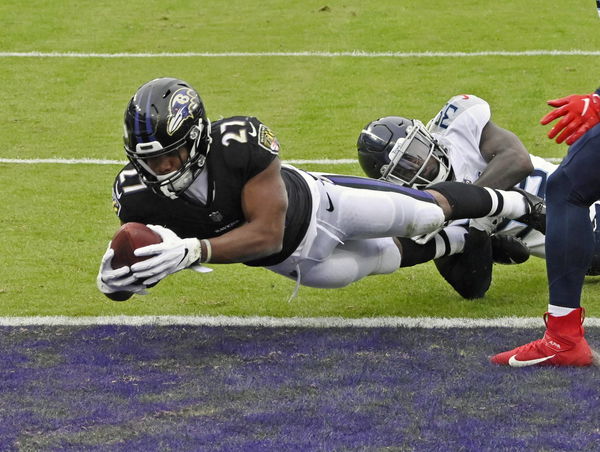
November 22, 2020, Baltimore, MD, USA: Baltimore Ravens J.K. Dobbins 27 dives for the end zone on a two-point conversion against the Tennessee Titans Breon Borders in the second quarter on Sunday, Nov. 22, 2020 at M&T Bank Stadium in Baltimore, Maryland. Baltimore USA – ZUMAm67_ 20201122_zaf_m67_002 Copyright: xKennethxK.xLamx
That finally changed in 1994. The league introduced the two-point conversion, adding a new layer of decision-making after touchdowns. Teams now had a real choice between tying the game or taking the lead.
The Browns punter, Tom Tupa, became the first player to score a two-point conversion in an NFL game. Today, that rule can decide outcomes in the final seconds, and in some cases, eliminate the need for overtime.
4. The Inception of Overtime
In most sports, you either win or you lose. Fans of the winning team celebrate, while the losing side walks away disappointed. There is, however, another outcome that exists, even if no one really enjoys it: a tie.
For a long time, that was a common sight in the NFL. Games would go on for hours and still end without a winner, something that never quite sat well with fans. That led the league to make a change.
In 1974, the NFL introduced overtime just before the start of the season, giving teams a chance to decide games that were previously ending in ties. While ties can still happen in the regular season (we’ve seen a couple of them this past season), they have become far less frequent since overtime was put in place.
3. Playoff Expansion
The NFL postseason did not always look the way it does today. In its early days, the season essentially built up to just one game, the NFL Championship. That format began to evolve in 1967 when the league introduced a small playoff bracket with four teams.
From there, expansion became a steady trend. After the AFL-NFL merger in 1970, the postseason grew to eight teams, with division winners earning spots. The next major shift came in 1978, when the league introduced Wild Card entries to include top teams that did not win their divisions.
That number continued to rise over time, with the league expanding the wild-card games. For a broader context, the playoff field expanded to 12 teams in 1990 and later to 14 teams in 2020, shaping the modern postseason structure we see today.
2. The Hash Marks
For a long time, NFL rules dictated that if a play ended near the sideline, the next snap would take place right there. That might sound simple, but it created real problems.
Offenses would often get stuck operating from one side of the field. Field goal attempts became tougher because of awkward angles. And teams frequently had to waste a down just to reposition the ball closer to the middle. To fix that, the league introduced hash marks. The idea was to standardize ball placement and improve flow on offense.

Imago
NFL, American Football Herren, USA Combine Mar 3, 2023 Indianapolis, IN, USA The Indianapolis Colts helmet logo at midfield at Lucas Oil Stadium. Indianapolis Lucas Oil Stadium Indiana United States, EDITORIAL USE ONLY PUBLICATIONxINxGERxSUIxAUTxONLY Copyright: xKirbyxLeex 20230304_jcd_al2_0019
Credits: Imago
The change dates back to 1933, when the NFL first implemented hash marks, originally placing them 10 yards from each sideline. That spacing was later adjusted, and by 1972, the marks were moved to their current position, 70 feet and nine inches from each sideline.
With that system in place, the ball is now spotted on the nearest hash instead of the sideline. The result is a more balanced field, cleaner kicking angles, and far fewer wasted plays just to reset positioning.
- The Mel Blount Rule (The Bump-and-Run Rule)
The Steelers legend Mel Blount played a direct role in shaping one of the most important rules for passing offenses. Before this change, cornerbacks relied heavily on the bump and run technique, using constant physical contact to disrupt receivers all the way down the field.
Blount, in particular, took that physical style to another level. His ability to overpower receivers forced the league to step in and rethink how much contact should be allowed.
That led to what became known as the Mel Blount Rule. Introduced in 1978, it limited defensive contact with receivers to within five yards of the line of scrimmage, fundamentally changing how the passing game operates in the NFL.
That said, the NFL has consistently introduced rule changes over the years that have reshaped the game in significant ways. Many of those changes have already left a lasting impact on how football is played today. And now, with the Browns proposing another adjustment, the league could be on the verge of yet another shift.
A look at the Browns’ new proposed draft rule
Last year, the Green Bay Packers pushed for a rule to ban the infamous Tush Push. That proposal narrowly failed, and this time around, no team has brought it back to the table. Instead, the Browns have proposed a different kind of idea, one that could significantly impact how teams approach rebuilding.
The proposal would allow teams to trade draft picks up to five years into the future, extending the current limit of three years. In simple terms, it gives franchises a longer runway to manage assets, something closer to the NBA’s seven-year trading window.
This comes at a time when teams are already aggressive with draft capital. Ahead of the 2026 NFL Draft, six first-round picks have already been traded, per ESPN, including the Denver Broncos sending theirs to Miami in the deal for Jaylen Waddle. For the rule to pass, at least 24 of the 32 teams need to approve it. Whether that happens or not will be considered at the upcoming league meeting.
