
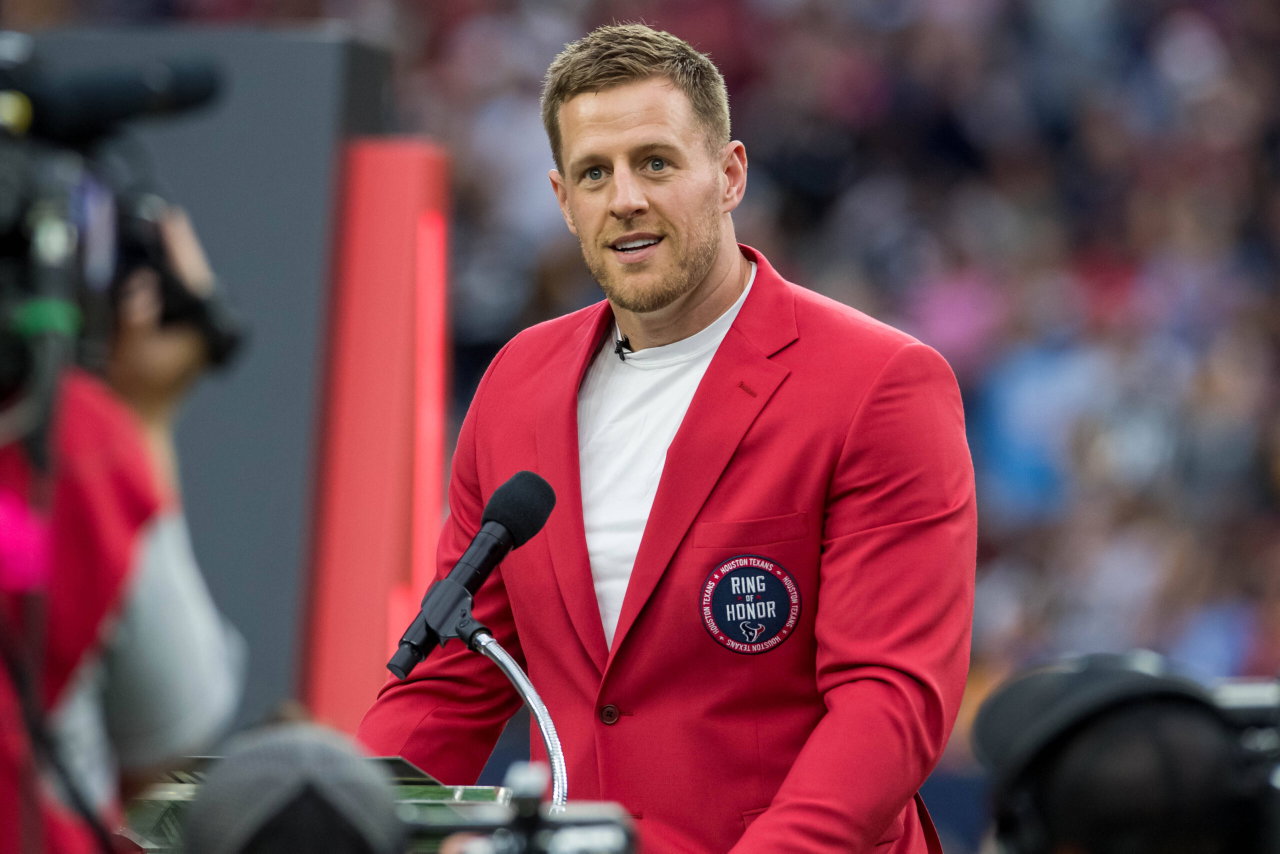
You might not realize it, but NFL broadcast media is going through a firestorm right now. ESPN is still dealing with backlash after firing notable figures Ryan Clark, Cam Newton, Karl Ravech, and others, while CBS is dealing with the Tony Romo controversy. However, a bigger battle is yet to be fought by the industry, according to former ESPN host Dan Le Batard.
Watch What’s Trending Now!
“I just wonder if you guys notice that the sport is disproportionately black, and the broadcasters who get hired are disproportionately white, and it’s on purpose … it’s to make it palatable to the broadest section of people,” he said on his show. “There aren’t that many white stars in football. There are plenty of Black stars. Why are the white ones the only ones who get the broadcasting jobs? It’s always J.J. Watt, it’s always Luke Kuechly, as if there aren’t a bunch of Jonathan Vilmas out there that are available.”
Watt was recently promoted to CBS’ No. 1 crew in the wake of Romo’s absence from the network, who is facing legal trouble due to his OWI arrest. Watt is stepping into some big shoes, considering the latter is one of the biggest names in football media. But Le Batard believes there are plenty of Black media personalities in the NFL who could contend for a similar role.
Imago
Illustration – Micros with TV Logos At Rolex Paris Masters Finals Day Illustration picture shows a microphone or micro with the logo of the television channel ESPN during the Rolex Paris Masters 1000 ATP tennis tournament at the La Defense Arena on November 2, 2025 in Paris, France. Photo by Victor Joly/ABACAPRESS.COM Paris France PUBLICATIONxNOTxINxFRAxUK Copyright: xJolyxVictor/ABACAx
“Luke Kuechly is now the up-and-coming broadcasting star that people like. When they look at Tony Romo and they put him on the bench for a while, they replace him with J.J. Watt. Gronk has a job, even though Gronk is a notoriously bad talker.”
The Guardian’s Andrew Lawrence pointed out the gap in representation in 2019. According to a study conducted by the publication, for the 2018 season, of the 251 national and regional NFL broadcasters, only 19% of them were black. There were only two black announcers (CBS’s Greg Gumbel and Fox’s Brian Custer) who covered the play-by-play for network telecasts. Lawrence also brought up another distressing reality: back in the day, Black footballers were often stereotyped by White broadcasters.
The situation is not as troubling today. But the lack of representation remains clear as day. For a league that is dominated by Black players (at least 70%), it barely has anyone to represent them in the booth. Perhaps NBC’s Mike Tirico is the only notable play-by-play announcer who is not white. (Tirico claims he comes from a mixed-race background.)
This is not the first time Le Batard commented on the issue. In July, he called out ESPN over what he viewed as a lack of Black representation in leadership roles.
“You’re gonna have a network run by [Pat] McAfee and all of the white people now in charge there,” Le Batard said about ESPN after they fired Ryan Clark.
McAfee, whose fame has skyrocketed in a matter of years, now threatens to dethrone Stephen A. Smith as the face of ESPN. He is reportedly negotiating for a contract that would give him more than $60 million, per The Athletic, making him the network’s richest employee. He’s been in the sports media landscape for less than a decade, while Smith has been with the network since 2003.
Ryan Clark, however, believed he wasn’t allowed to express his identity fully on ESPN.
Ryan Clark couldn’t be “too black” at ESPN
Clark has had plenty to say about how ESPN fired him, even shed some tears about what he could have done better to be on the higher-ups’ good books. However, the one comment that stood out was this:
“You know, man, like this show for three years, bro, we never shied away from any topic,” Clark said on The Pivot. “We never shied away from tackling anything. We did this year because I knew I couldn’t have no beef. I knew I couldn’t respond to disrespect. I knew, for lack of a better word, I knew I couldn’t be too Black.”
He was reportedly warned by Stephen A. Smith the year before that there was an ESPN executive who didn’t like him. However, Clark often found himself at the center of controversy, particularly related to race-related matters.
“What makes me sad is even in trying to adjust to be at least more of what certain people wanted, they still fired me. And so I think that that that is difficult.”
Who ESPN replaces Clark with will have a domino effect on the show and the network.