
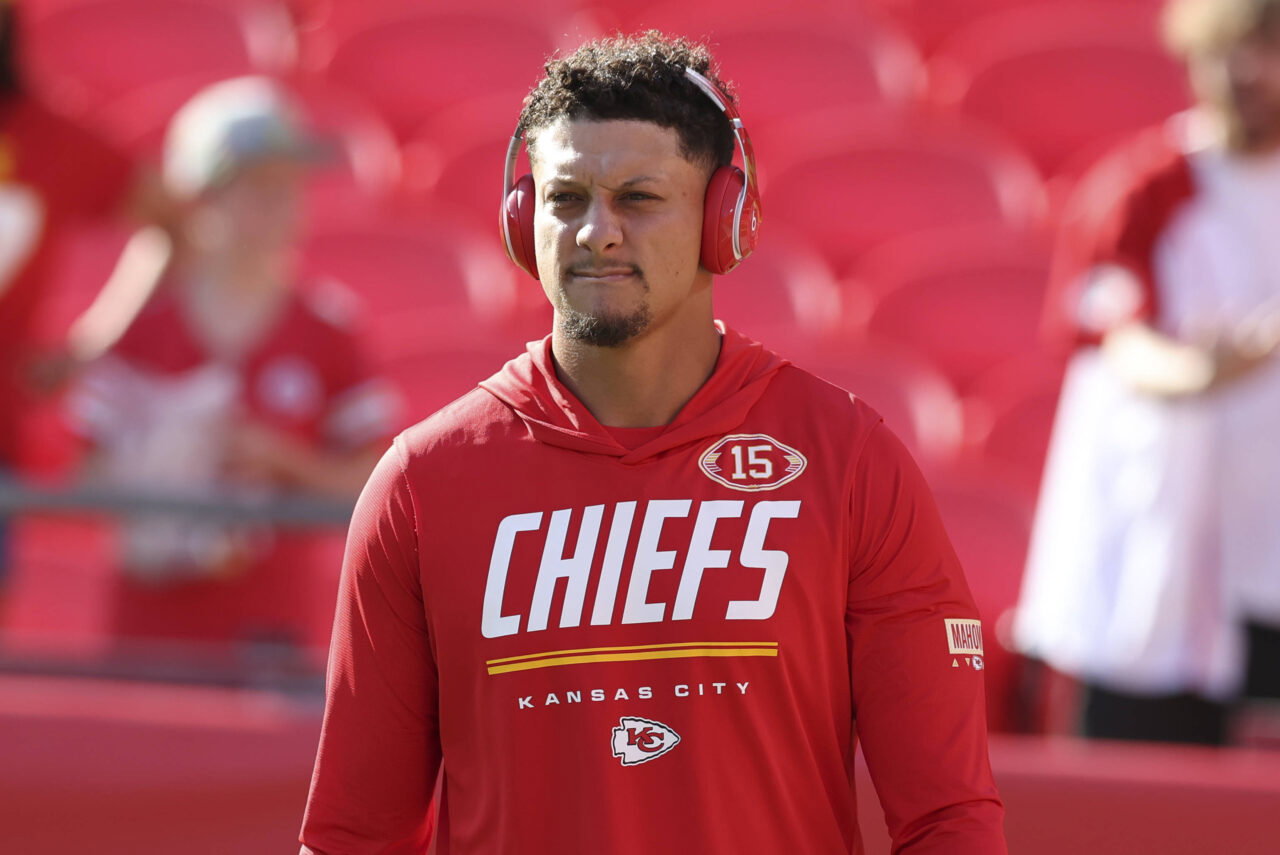
The Kansas City Chiefs quarterback Patrick Mahomes found himself dragged into college football drama. It happened as the U.S. Congress is on its way to cast a vote in favor of the Protect College Sports Act. There remain many loopholes. The fact that Mahomes remains silent about them is what left ex-ESPN analyst Dan Le Batard upset.
“What’s happening in Major League Baseball and football? You’ve got yellow unions,” Le Batard said on his podcast. “This is not leadership that is the past leadership of (Domonique) Foxworth and (Jeff) Saturday and (Drew) Brees and (Tom Brady). It’s very quiet in football. What’s being supported publicly by the TV arms is, can football keep the minor leagues free? Can the NFL, through an antitrust extended to its minor league outfit, can we keep it free, with [Nick] Saban’s help on television?
“Patrick Mahomes, get your helmet out of your a**. Do some leading here, as [Drew] Brees and Brady did and Jeff Saturday did. You’ve got a lot of power. You made the commissioner of the league stand down on [Colin] Kaepernick and racism the moment that you said anything. Do you want to participate in the adult games, or do you just want to play football?”
The Senate has passed the Protect College Sports Act of 2026 (S. 4668), which proposes a trade-off between federal protections for athletes and targeted antitrust safeguards for the NCAA.
The proposed bill would give the NCAA an antitrust exemption, allowing it to restrict athletes to one transfer without penalty. It would also establish a uniform five-year eligibility system based on age, raise the revenue-sharing limit to nearly $50 million, and strengthen oversight to ensure schools follow the cap. Other provisions include setting up an agent registry with fees capped at 5% and allowing schools to combine their media rights, among other changes.
The current system gives college athletes a degree of mobility that was once unthinkable under the NCAA’s old model. Star quarterbacks and basketball players can switch schools, land new NIL deals, and influence the fortunes of major programs. The Protect College Sports Act would keep transfers possible while significantly limiting that flexibility.
Restrictions on salaries, free agency, and player movement in professional leagues such as the NFL and NBA are generally established through agreements negotiated with players’ unions. College athletes do not have an equivalent nationwide bargaining representative. Labor groups and lawmakers have criticized the act. They argue it restricts athlete earnings and transfers without providing collective bargaining protections.
What upset Batard was how Mahomes is staying quiet when he is one of the NFL’s most influential players and has a leadership position within the players’ union to put forward his opinion to make a difference about athletes’ rights.
In September, putting an end to all the negotiations, the Senate passed the PCSA by an overwhelming 77-22 vote. But there are still many loopholes that Batard urges Mahomes to raise his voice against.
Earlier, under it, college athletes can transfer once during their undergraduate careers without losing eligibility. A second transfer would trigger a mandatory year on the sidelines, although exceptions apply when a coach leaves, an athlete pursues graduate studies, a sport is discontinued, or sexual assault or harassment is involved.
However, under current NCAA rules, college athletes are permitted to transfer multiple times during their undergraduate careers without losing eligibility. As long as they enter the transfer portal during designated sport-specific windows and remain in good academic standing, they are immediately eligible to play at their new school, eliminating the old mandatory year on the sidelines.
The key concern is the proposed antitrust exemption for the NCAA, which would allow the organization to enforce transfer rules without the risk of being sued under antitrust law. Although this could discourage frequent transfers, it would also give the NCAA employer-like control over athletes’ movement without obligating it to recognize them as employees for other purposes.
But PCSA is receiving support. For instance, former Alabama Crimson Tide head coach Nick Saban has endorsed the act.
“College sports are built on tradition,” Saban said in a new commercial for the legislation. “Our pride in our schools, the rivalries we pass down, and the way they develop the character of tomorrow’s leaders. That tradition is worth defending. The Protect College Sports Act ends the NIL chaos in college athletics by protecting our student athletes and teams, and safeguarding women’s sports and olympic programs. Join the winning team today, and help congress protect this winning tradition.”
Deion Sanders too voiced his opinions in support of it.
“It gives student-athletes a chance to shine on and off the field; strengthens Historically Black Colleges and Universities; and keeps both men’s and women’s sports strong. Help student-athletes get their Prime Time moment, baby,” said Coach Prime.
The fact that Mahomes sits with his lips zipped up is what upsets Batard. In June 2020, Mahomes joined prominent NFL stars in a video calling on the NFL to admit it was wrong for silencing players who peacefully protested and to condemn racism. After that, NFL Commissioner Roger Goodell released a video.
“We, the National Football League, admit we were wrong for not listening to NFL players earlier, and encourage all to speak out and peacefully protest,” Goodell said in a video. “We, the National Football League, believe black lives matter.”
The fact that college football athletes are now in danger under the PCSA, Mahomes was expected to break his silence.