
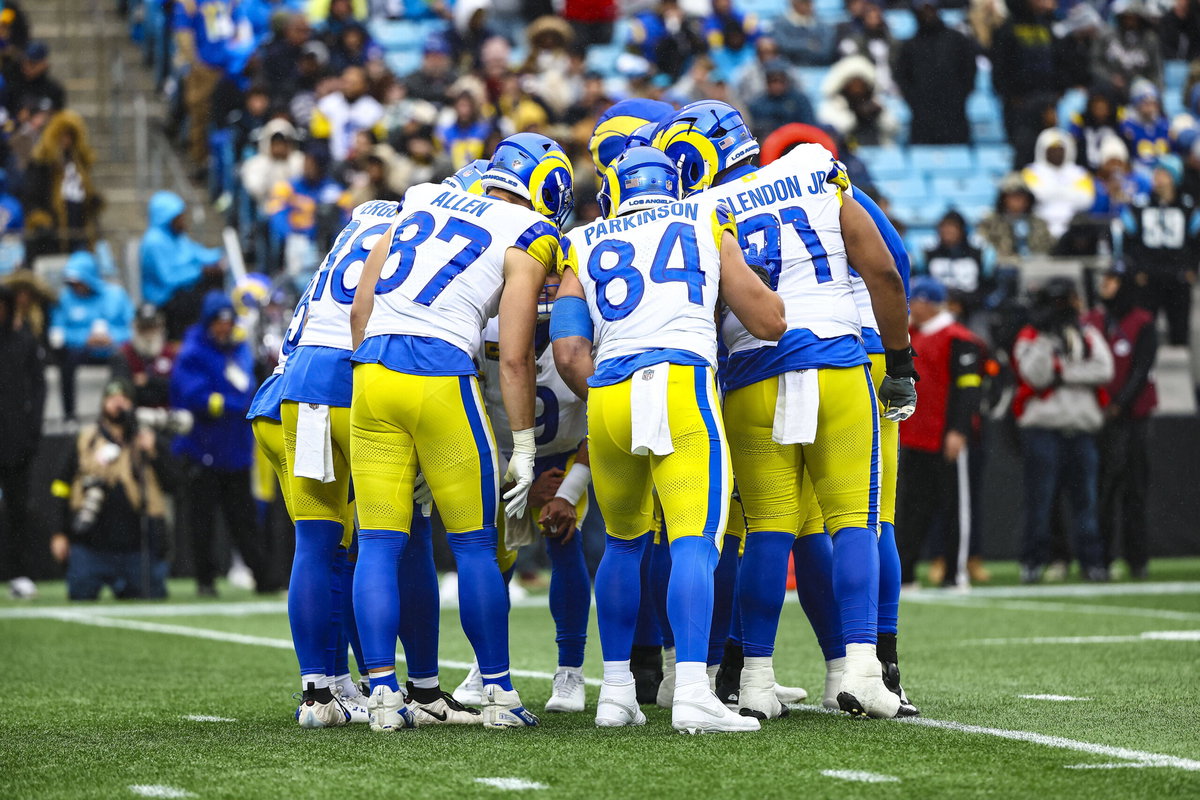
Whenever a dispute arises involving an NFL team or the league, the NFL’s Constitution says the Commissioner has broad power to arbitrate certain disputes. Instead of going directly to a normal court, the league can argue that the dispute belongs in its internal arbitration process. Over the past few years, however, the league has been losing control in its in-house arbitration procedure.
Watch What’s Trending Now!
The latest case involving the Los Angeles Rams and the team’s former employee Brittany Todd only reinforced it. Per Mike Florio of Pro Football Talk, the Superior Court of California, County of Los Angeles, found that an arbitration clause used by the Rams was ‘unconscionable and, in turn, unenforceable.’ The development gained momentum after Todd filed a lawsuit against the Rams, alleging that she was terminated on March 10, 2026.
According to Florio, he wrote:
“She claims that her March 10, 2026 termination happened after she complained that her immediate supervisors were consuming alcohol during work hours ‘to the point of extreme intoxication,’ that they coerced subordinate employees to consume alcohol, that they berated employees ‘to an abusive level’ after becoming intoxicated, and that they berated employees for their religious views.”
As that went down, the Rams didn’t want the case to go through the normal court system. Instead, the team filed a motion to compel arbitration. The court, however, rejected that motion. For broader context, the Rams’ arbitration agreement allowed the NFL commissioner or someone chosen by the commissioner to have the exclusive power to resolve the dispute.
The court, meanwhile, found the agreement unconscionable because it relied on an arbitrator employed by the NFL, an organization that represents all 32 member teams, including the Rams.
“We are happy that our client will be able to have her day in court,” Todd’s lawyer Mike Caspino said in a statement. “We are also happy that all of the employees of the 49ers, Chargers and Rams will no longer be subjected to the NFL’s biased arbitration system.”
Back in October 2021, Jon Gruden resigned as head coach of the Las Vegas Raiders after emails containing offensive language became public. The emails, written between 2011 and 2018 while Gruden worked for ESPN, surfaced during the NFL’s investigation into workplace misconduct within the Washington Football Team organization. Gruden and the Raiders later reached a confidential agreement concerning his contract, but the matter subsequently moved into court.
In November 2021, Gruden sued the NFL and Commissioner Roger Goodell, alleging that the league selectively leaked the emails and caused damage to his reputation and employment. His lawsuit included claims of interference with his Raiders contract, negligence, and civil conspiracy. The NFL has denied the allegations, setting up a dispute over where the claims should be resolved.
The NFL sought to send the case to its internal arbitration process, which grants the commissioner broad authority in certain disputes. Because Goodell was also named as a defendant, Gruden’s case raised questions about whether that process could serve as the appropriate forum for the litigation.
Now, Brian Flores also challenged the NFL’s effort to move his employment-discrimination claims into the league’s internal arbitration process. In August 2025, the U.S. Court of Appeals for the Second Circuit upheld a lower-court ruling that denied arbitration for Flores’ claims against the NFL, the New York Giants, Denver Broncos and Houston Texans. The court found that the commissioner-controlled framework did not provide the type of independent arbitration process required under federal law.
The NFL later asked the U.S. Supreme Court to review that decision. On May 26, 2026, the Supreme Court declined to hear the appeal, leaving the Second Circuit’s ruling in place. The Court did not issue a decision on the merits of the NFL’s arbitration system, but Flores’ relevant claims against the NFL and the three teams remained in federal court.
In July, U.S. District Judge Valerie Caproni denied another NFL request to reconsider arbitration in the Flores case. That ruling kept the litigation on track for court proceedings.
Todd’s case differed from the Gruden and Flores matters because she sued the Rams rather than the NFL. The Los Angeles court nevertheless denied the Rams’ motion to compel arbitration, citing the NFL’s role in selecting or providing the arbitrator.
The ruling applies to Todd’s dispute with the Rams. It follows court decisions in the Gruden and Flores cases that also declined to require the plaintiffs to use the NFL’s commissioner-centered arbitration process.
For now, the next steps in Todd’s case, including whether the Rams will seek further review of the ruling, remain to be seen.