Imago
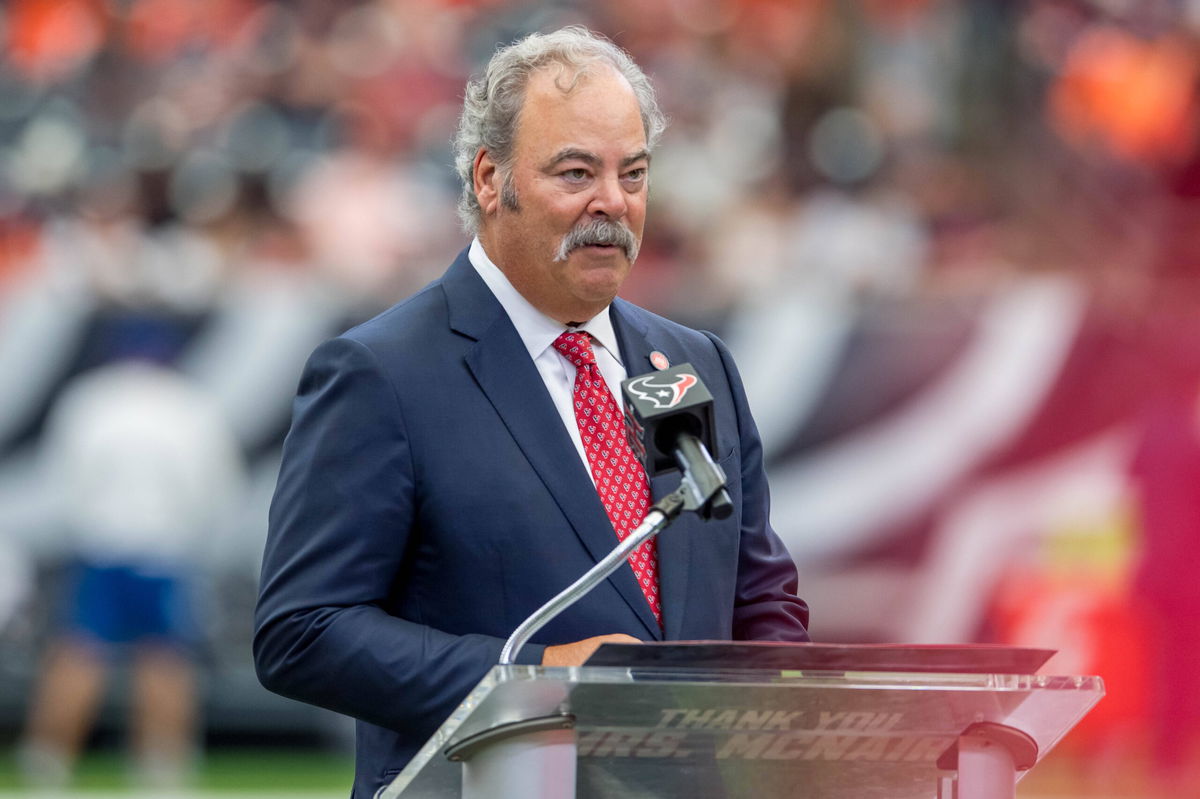
November 2, 2025: Houston Texans owner Cal McNair speaks at halftime during a game between the Denver Broncos and the Houston Texans in Houston, TX. .. /CSM – ZUMAc04_ 20251102_zma_c04_769 Copyright: xTraskxSmithx
Imago
November 2, 2025: Houston Texans owner Cal McNair speaks at halftime during a game between the Denver Broncos and the Houston Texans in Houston, TX. .. /CSM – ZUMAc04_ 20251102_zma_c04_769 Copyright: xTraskxSmithx
Imago
November 2, 2025: Houston Texans owner Cal McNair speaks at halftime during a game between the Denver Broncos and the Houston Texans in Houston, TX. .. /CSM – ZUMAc04_ 20251102_zma_c04_769 Copyright: xTraskxSmithx
Imago
November 2, 2025: Houston Texans owner Cal McNair speaks at halftime during a game between the Denver Broncos and the Houston Texans in Houston, TX. .. /CSM – ZUMAc04_ 20251102_zma_c04_769 Copyright: xTraskxSmithx
Essentials Inside The Story
- FIFA will have exclusive control of the NRG stadium in June and July 2026
- To comply with FIFA’s strict anti-ambush marketing rules, the venue will be temporarily renamed Houston Stadium
- Houston will host seven matches, including five group-stage games and two knockout rounds
Before Houston Texans fans return to NRG Stadium for kickoff, the building will belong to soccer first. The 2026 FIFA World Cup is set to bring multiple matches to the Texans’ home turf, turning the venue into an international stage for a few weeks. It won’t touch the regular-season schedule, but things could get trickier for the Texans in the offseason, and team owner Cal McNair hasn’t shied away from acknowledging exactly that.
Watch What’s Trending Now!
“So, we’re moving a lot of our activities out and trying to plan our way around it, and we’ll do our best, and we’ll still have the team ready to play, but it’ll be a challenge. But we’re glad FIFA’s here. It’s wonderful for the city, we totally embrace it, and we will figure it out, but it’s going to be challenging,” McNair said.
The Texans will vacate NRG Stadium in June and July while FIFA stages seven World Cup games at the venue. And considering that part isn’t negotiable, several team activities will have to move elsewhere during that stretch.
Start with football operations. The Texans traditionally hold mandatory minicamp in June, which means those sessions can’t be held at NRG during FIFA’s exclusive control window. The same applies to portions of the Offseason Conditioning Program and OTAs that use stadium space.
The Texans will be forced to relocate a bit out of NRG while FIFA takes over NRG Stadium for the World Cup this summer.
Cal McNair calls it a “challenge.” pic.twitter.com/3KLAKszAKW
— Will Kunkel (@WillKunkelV) February 25, 2026
But this isn’t just about practices; it’s also about logistics. The Texans are one of only three NFL teams whose headquarters and training facilities are housed in the same building where they play home games, NRG Stadium.


That setup, usually convenient, becomes complicated under FIFA’s exclusive-use period. Portions of the team’s day-to-day operations tied to NRG access will need to be relocated or adjusted. McNair acknowledged that even basic functions could temporarily shift. “It’s going to be challenging to move into another site for those days, like maybe the gym,” he said. “I don’t know that we have all those plans worked out yet.”
During the tournament, NRG Stadium won’t go by its usual name. Under FIFA policy prohibiting non-sponsor corporate branding, it will temporarily be called “Houston Stadium.”
Beyond the name change, signage, private suites, and various internal areas fall under FIFA’s control. The Texans cannot conduct normal stadium operations (events, branding, or access) during that period. As the FIFA World Cup 26 Houston Host City Committee president, Chris Canetti explained:
“FIFA has its own plans on how it wants to overlay the branding and provide the right imagery across the stadium. Then the host committee—that’s us—has to come and cover other portions of the stadium to do the brand protection piece. It’s a little bit different in that it’s FIFA and they’ve got their own brand guidelines and they’re very, very strict about them. But, honestly, this is out of all the items that we have to concern ourselves with… We see this as just sort of a normal course of operation.”
Houston will host seven matches during the exclusive period, including five group-stage games and two knockout rounds. For fans, that means a rare opportunity to see global stars, including Cristiano Ronaldo. He is expected to be playing in his final World Cup and is scheduled to appear in Houston twice. The match slate includes:
- Germany v Curaçao | Group E | Sunday, 14 June
- Portugal v Congo DR/Jamaica/New Caledonia | Group K | Wednesday, 17 June
- Netherlands v Albania/Poland/Sweden/Ukraine | Group F | Saturday, 20 June
- Portugal v Uzbekistan | Group K | Tuesday, 23 June
- Cabo Verde v Saudi Arabia | Group Stage | Friday, 26 June
- Match 76 | Round of 32 | Monday, 29 June
- Match 90 | Round of 16 | Saturday, 4 July
Portugal’s presence in two Houston matches ensures Ronaldo’s participation after FIFA reduced a prior three-match suspension, clearing him to appear in both scheduled games. FIFA stated that if Ronaldo commits another infringement “of a similar nature and gravity” during the probationary period, the remaining suspended matches would automatically be reinstated.
To accommodate those matches, the soon-to-be “Houston Stadium” is undergoing substantial upgrades. Building equipment and controls are being modernized, alongside water conservation and life-safety systems.
LED lighting retrofits are underway, and new chillers and air handlers are being installed. NRG signed an agreement with Johnson Controls to fund the full cost of those upgrades. The retractable PTFE roof panels are also being replaced with more durable material, with Birdair awarded the contract and work already in progress ahead of the tournament.
Additionally, the Harris County Sports and Convention Corp. approved a $55 million Capital Improvement Project. It’ll cover infrastructure improvements across NRG Stadium, NRG Center, and NRG Arena, along with an additional $2.5 million for design proposals tied to priority projects.
For Cal McNair and the Texans, the offseason will require flexibility. But the expectation remains that preseason and regular-season football will proceed smoothly starting in August 2026.
And in a twist of timing, the franchise itself is preparing for change. The Texans are moving toward having their own separate headquarters and training facility away from the stadium. A shift that, in the long run, may make summers like this one far less complicated.
Cal McNair announced the Texans’ new HQ and training facility
Along with the Cincinnati Bengals and the Carolina Panthers, the Texans are one of the few NFL teams that operate their headquarters and training facility inside the same building where they play.
That setup, though, is nearing its end. Just weeks ago, Cal McNair confirmed that the organization will relocate its headquarters and football operations away from NRG.
“Today is a historic day for the Houston Texans, our fans, and the Greater Houston area as we partner with Howard Hughes and Harris County on a world-class sports and entertainment destination, including our new headquarters and training facility,” McNair said in a statement.
Imago
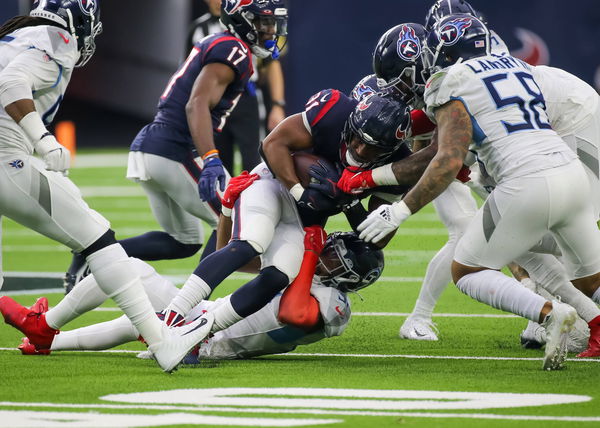
Sport Bilder des Tages HOUSTON, TX – JANUARY 09: Houston Texans running back David Johnson 31 carries the ball in the fourth quarter during the NFL, American Football Herren, USA game between the Tennessee Titans and Houston Texans on January 9, 2022 at NRG Stadium in Houston, Texas. Photo by Leslie Plaza Johnson/Icon Sportswire NFL: JAN 09 Titans at Texans Icon220109035
The Texans are partnering with Harris County and private equity firm Howard Hughes to move operations to an 83-acre parcel in the planned Bridgeland community.
The master plan covers all 83 acres, with 22 acres specifically allocated to Texans-controlled facilities. It’ll include the new headquarters, practice fields, and core football operations infrastructure. While the framework of the deal is official, the detailed financial terms have yet to be finalized publicly.
Reports indicate the county’s contribution would be supported through a tax increment reinvestment zone (TIRZ). Construction is expected to begin in 2026, with a projected opening in 2029. If that timeline holds, the Texans will finally operate from a standalone headquarters and training complex separate from their home stadium.
The move also ends years of operational friction tied to sharing NRG with large-scale events. Former defensive tackle Chris Clark described the disruption bluntly: “It was difficult, man. We’d have to change where we’d park, we’d have to deal with the rodeo. I couldn’t find my family sometimes when the rodeo was here.” Former safety Glover Quin echoed that sentiment, noting the steady rotation of events, from the Houston Livestock Show and Rodeo to Monster Jam, often complicated routines.
The new facility is expected to feature expanded training and recovery areas, modernized weight rooms, and consolidated football operations space. Hall of Fame receiver Andre Johnson believes proximity will matter: “Guys love to not be too far from their facilities. To be able to train, to get their treatments quickly and stuff like that.”
For now, though, the Texans must navigate a transitional summer in 2026, one where soccer takes center stage, operations shift temporarily, and the organization balances short-term disruption with long-term transformation.
Related Newsletters