
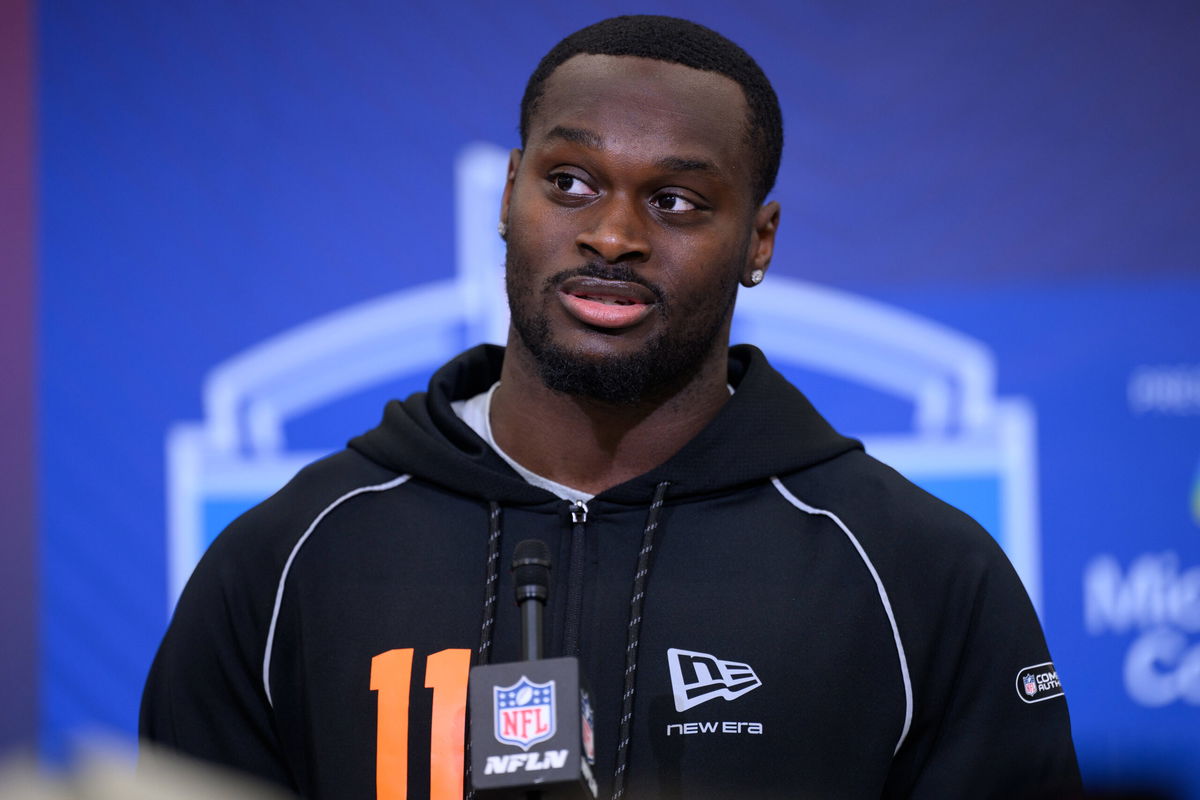
The NFL teams have steadily moved away from taking running backs early in the first round. Jeremiyah Love, though, was an exception. The former Notre Dame back entered the draft off consecutive elite seasons, positioning himself as one of the most complete players at the position and carrying clear expectations.
Watch What’s Trending Now!
That context made the Arizona Cardinals‘ decision at No. 3 overall less surprising. Once that happened, the comparisons followed. And it did not take long for Michael Irvin to step in, drawing parallels between Love and his former teammate Emmitt Smith.
“You can see an offensive line and then say, ‘Oh, that offensive line is not that good.’ You bring in a running back, and you put them with a certain offensive line, all of a sudden, it takes off. I saw that too in Emmitt (Smith). All of these jokers that people started saying was the greatest offensive line ever, and all of them were about to get cut until Emmitt got there,” Irvin said.
“Great running backs changed that offensive line, and what I saw in him, I see in Jeremiyah Love. They put him in a game on the goal line with a bad knee. I saw a run that told me his heart, not a skill set, not as fast as he could run, not a high jump, his heart.”
View this post on Instagram
That comparison taps into a long-running narrative around Smith. Despite his production, his legacy has often been framed through the lens of the Dallas Cowboys‘ offensive line, featuring names like John Gesek, Kevin Gogan, Mark Stepnoski, Mark Tuinei, Nate Newton, and Erik Williams. The assumption has always been that the system elevated him.
But the timeline complicates that idea. Gesek and Gogan were gone by 1994, Stepnoski left in 1995, Tuinei retired in 1997, Newton departed in 1998, and Williams exited in 2001. Even through that turnover, Smith still posted 11 straight 1,000-yard seasons from 1991 to 2001. From Irvin’s perspective, that consistency speaks for itself.
That is where the parallel to Love starts to make more sense. He entered the draft after putting up 1,125 yards and 17 touchdowns in 2024, highlighted by a 98-yard run against Indiana University in the College Football Playoff, a moment that stood out even more given he was playing through illness and a sore knee.
The back followed that with 1,372 yards and 18 touchdowns in 2025, earning recognition as a finalist for the Heisman Trophy, the Maxwell Award, the Walter Camp Award, the Pony Express Award, and the Capital One Orange Bowl-FWAA Courage Award. He also won the Doak Walker Award, becoming the first in Notre Dame history, along with the Disney’s Wide World of Sports Spirit Award.
The production stands on its own, but the context matters just as much. In 2024, starting center Ashton Craig tore his ACL early in the season, guard Billy Schrauth missed time with an ankle injury, and Charles Jagusah was out for the year with a torn pectoral.
Then in 2025, the offensive line saw further turnover, with Sam Pendleton, Rocco Spindler, and Pat Coogan transferring out, while Jagusah suffered another injury after fracturing his arm. Despite that instability up front, Love still delivered back-to-back elite seasons.
So when Irvin draws that connection to Smith, it is less about hype and more about pattern recognition. Production without ideal conditions tends to stand out. And in that sense, Love’s profile aligns with what Irvin saw years ago, a running back capable of elevating what is around him as he steps into the Cardinals’ system in 2026.
Jeremiyah Love addresses how he can be crucial to the Cardinals’ success
Jeremiyah Love became the earliest running back taken in the first round since the New York Giants selected Saquon Barkley at No. 2 overall in 2018. And during his introductory press conference, Love made it clear how he plans to approach his rookie year in Arizona, drawing from the league’s top backs.
“You’ve got to be able to score those touchdowns,” he said. “Guys like Saquon, guys like Bijan (Robinson), guys like Ashton Jeanty, all those guys can do that. I’m no different. I’m going to come into this league, and I’m going to put a lot of emphasis on making sure we can extend drives. A running back is very crucial for team success.”
Imago
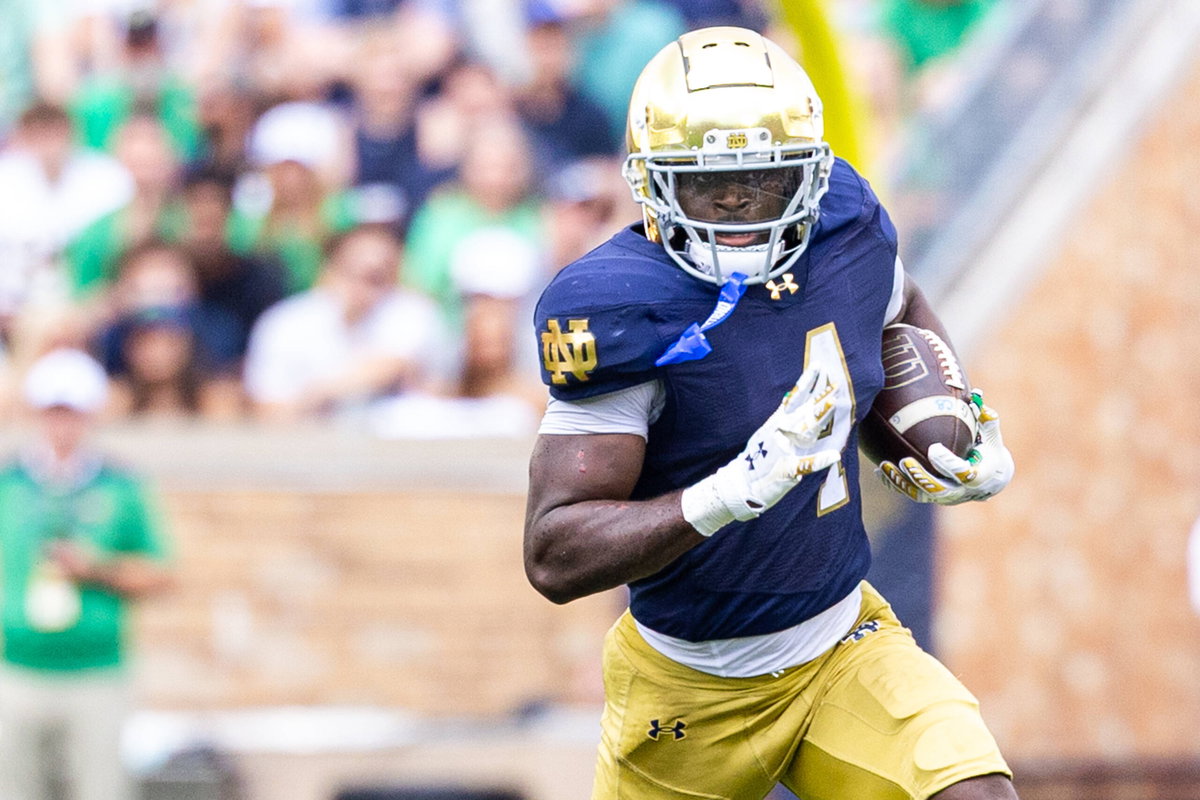
September 20, 2025: Notre Dame running back Jeremiyah Love 4 runs with the ball during NCAA, College League, USA football game action between the Purdue Boilermakers and the Notre Dame Fighting Irish at Notre Dame Stadium in South Bend, Indiana. /CSM South Bend United States of America – ZUMAc04_ 20250920_zma_c04_269 Copyright: xJohnxMersitsx
The Cardinals would likely agree. Michael Carter led the team in rushing last season with just 333 yards and one touchdown, followed by Emari Demercado with 312 yards and no scores. Neither remains on the roster heading into 2026.
Beyond that, Arizona finished with 1,583 total rushing yards and averaged 93.1 per game, ranking 31st in the league during the 2025 season. In that context, using the third overall pick on Love aligns with the need, as he now joins a backfield that includes James Conner, Tyler Allgeier, and Trey Benson.