Imago
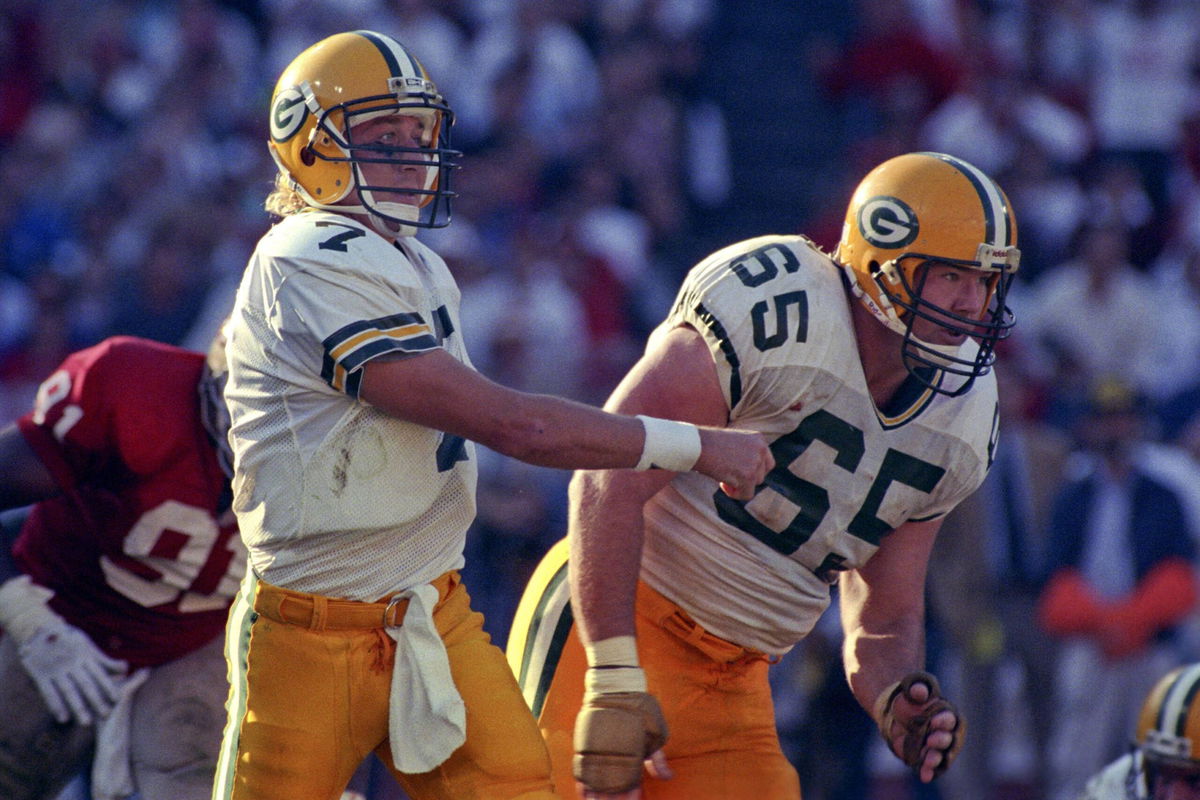
November 19, 1989 – San Francisco, California, U.S – San Francisco 49ers vs Green Bay Packers at Candlestick Park Sunday, November 19, 1989. Packers beat 49ers 21-17. Packer quarterback Don Majkowski (7) and Guard Ron Hallstrom NFL American Football Herren USA 1989: 49ers 21:17 Packers – ZUMAg52_ 19891119_zap_g52_006 Copyright: xAlxGolubx
Imago
November 19, 1989 – San Francisco, California, U.S – San Francisco 49ers vs Green Bay Packers at Candlestick Park Sunday, November 19, 1989. Packers beat 49ers 21-17. Packer quarterback Don Majkowski (7) and Guard Ron Hallstrom NFL American Football Herren USA 1989: 49ers 21:17 Packers – ZUMAg52_ 19891119_zap_g52_006 Copyright: xAlxGolubx
Essentials Inside The Story
- Former Packers quarterback adds another lumbar fusion surgery to his list
- The permanent damage to the QB was extensive and spread across multiple body parts
- When the NFL and the NFLPA signed a new CBA that cut huge chunk of payments for the retirees, the Majik Man stood up for the right thing
A decade-long NFL career can leave two different legacies for a quarterback: a cherishable memory or unending medical records. Former Green Bay Packers quarterback Don Majkowski falls firmly into the latter. His playing days were marred by injuries. Three decades after retirement, the physical toll has only deepened. And after multiple surgeries that have more or less defined his retirement, he shared another update on his 29th surgery.
Watch What’s Trending Now!
“Surgery updates 2023-2026: R Glute. Hip Replacement. 3 rotator cuff surgeries. Today Surgery #29: L3-L4 lumbar fusion. 💪🏼💪🏼💪🏼,” Majkowski shared via his X handle with a picture of himself from a hospital bed, with his wife, Kelly, holding his hand.
That latest procedure, an L3-L4 lumbar fusion, ties back to the spine issues that have followed him for years. And to understand how he got here, you have to rewind all the way to his college years with the Virginia Cavaliers.
Even before the 1987 NFL Draft, when the Green Bay Packers selected him as the 255th overall pick, Majkowski’s body had started absorbing punishment. Four games into his senior season in 1986, he injured his throwing shoulder. Instead of resting, he rushed back into the lineup with minimal rehab after missing only three games. The toughness was unquestioned, and the long-term cost wasn’t fully understood.

Where Does Packers Still Lack Elite Talent?
Let Tony do the scouting, you just make the pick.
Pick your positions. Get Tony’s top 5:
In the NFL, his first two seasons in Green Bay were quiet, with him splitting time with Randy Wright. Then came 1989.
Majkowski led the league with 4,318 passing yards and threw 27 touchdowns, earning a Pro Bowl nod out of the blue. San Francisco 49ers head coach George Seifert compared him to Joe Montana, who Majkowski lost the 1989 MVP honor to. For a moment, he looked like the franchise quarterback the Packers had been searching for. However, things unraveled quickly from here on.
Surgery updates 2023-2026:
R Glute.
Hip Replacement.
3 rotator cuff surgeries.Today Surgery #29:
L3-L4 lumbar fusion.💪🏼💪🏼💪🏼 pic.twitter.com/irU2i2S9Bo
— Don Majkowski (@Dmajik7) February 11, 2026
In 1990, after signing a one-year contract, his season ended in the tenth game when Freddie Joe Nunn upended him onto his shoulder, tearing his rotator cuff. What many initially thought was a bruise turned into the injury that altered his trajectory.
“That 1990 shoulder injury killed my career,” he said a few years back. “I played six more years, but it was through incredible pain in that shoulder. My shoulder never came back to its normal shape like it was before then. I had to keep everything to myself because I wanted to continue to play.”
From there, stability was hard to find.
He was benched early in 1991 before reclaiming the starting job. Then, on September 20, 1992, against the Cincinnati Bengals, he tore a ligament in his ankle in the first quarter. That was the day Brett Favre stepped in and eventually became the Packers’ long-term answer for the next 15 years. Majkowski, meanwhile, battled lingering issues.
After Green Bay committed to Favre, Majkowski spent the final four seasons of his career with the Indianapolis Colts and Detroit Lions, fully aware his Pro Bowl peak was behind him. And the injuries kept coming.
In 1994, with the Colts, after completing a pass, defensive end Terry Wooden came in unblocked and drove his head into the unforgiving Kingdome turf, causing a concussion, adding to the wear and tear on his body.
A couple of years later, his ankle complications returned, knocking on his window, as it deteriorated further with the Lions in 1996. He underwent surgery by Dr. James Andrews in June and was told recovery would take three months. That timeline meant missing preseason. However, he chose to play anyway, a decision he still reflects on.
“My ankle was 60 percent, and they (Lions) need me to start a preseason game in Detroit,” he said. “They asked if I could be dependable. I went out there and played and it numbed up. I tore it up, and it’s affected me the rest of my life. That was the start of the nightmare with my ankle.”
If not for the ankle, he could’ve played for at least a few more seasons. Instead, that was the last chapter of his NFL life. But whenever asked if it was all worth it, he only has one answer:
“Ask any guy, and they’re all going to say the same thing: that they’d do it all again. And once you play in the NFL, you’re living the dream, and it was pretty special. So I don’t regret anything.”
But his life hasn’t been easy.
Majkowski’s life under the needle
The damage from all the hits in the NFL was permanent, and he retired after 1996. By then, however, his shoulder and ankle had already required multiple procedures, including 11 ankle surgeries over time and several shoulder operations. But the toll didn’t stop there. Majkowski later developed severe back and neck complications.
His lower back was fused and required an artificial disc. He described his back surgery as being “gutted” like a fish. Surgeons had to go through his chest cavity to access his spine, with a vascular surgeon assisting because of the complexity. His organs were temporarily moved aside to reach the damaged vertebrae.
Then, in 2020, he underwent two neck surgeries within six months. First, a posterior procedure. When that failed, surgeons operated from the front, leaving a visible scar near his jugular and inserting two plates and eight screws.
Today, Majkowski can barely stand, sit, or turn his head. But his biggest problem is his back.
“It’s the back issues. I can’t sit for prolonged periods of time, I can’t stand for prolonged periods of time,” he had said years ago.
Add in chronic concussion effects and degenerative hip damage that led to a hip replacement, and the picture becomes clear. The list of injuries was extensive: shoulder, ankle, back, neck, hip, and concussion. And now, at 61, an L3-L4 lumbar fusion.
Through it all, Majkowski has become the face of the NFLPA-retiree disability standoff.
The Majic Man continues to fight on the paper for his health
Having multiple surgeries and living with pain has already been the malady of Majkowski’s life. However, the worst is him having had to fight for his health and other retirees against the league and the NFLPA.
In March 2020, a new collective bargaining agreement cut payments by 25 percent to more than 400 retirees. Of course, NFL players often face significant health challenges after retirement due to the physical demands of the sport. For a quarterback, that toll is only bigger.
Many, Majkowski included, were not happy.
“What they’re taking away from us to give to the current players as a bargaining chip, or whatever you want to call it is, it’s embarrassing,” Majkowski said. “It’s just, it’s ethically, it’s just wrong. And I would say, please do the right thing and just take care of the old guys.”
After hearings, the league and NFLPA agreed to allow Social Security’s determination of disability to count. Today, they can have substantial support with the Former Player Life Improvement Plan, the Pension Plan, and other incentives. The current plans are active through the 2030 NFL year.
Many changes have occurred because of what Majkowski believed in. It’s always been about resilience and believing better days are ahead. The game once defined him. Now, it’s the community that stands beside him.
Written by

Edited by

Antra Koul