
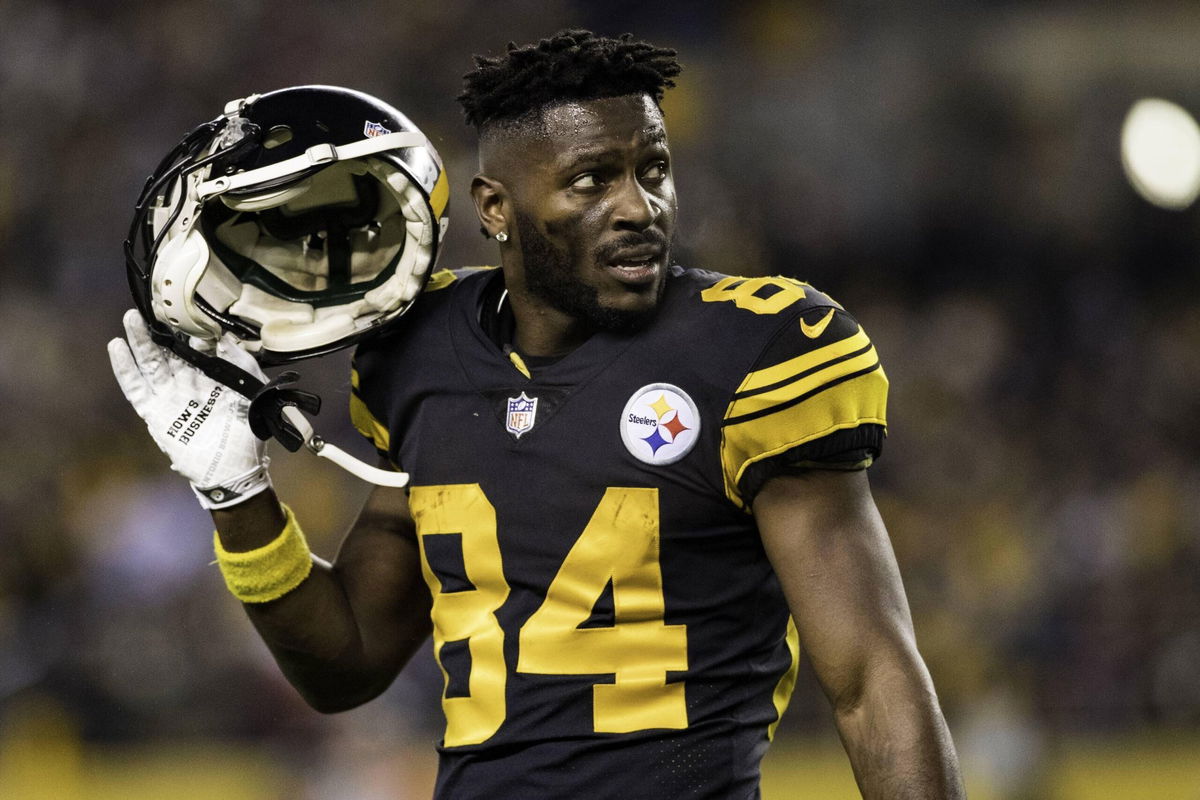
When the former general manager of the Carolina Panthers, Marty Hurney, saw the Baltimore Ravens double up on wide receivers and tight ends in the 2026 NFL draft, it brought him back to 2010. That year, despite heavy scouting and strong interest, Hurney and the Panthers passed on Antonio Brown in the draft. More than a decade later, that miss still lingers with Hurney and drives him crazy.
Watch What’s Trending Now!
“The year Antonio Brown came out, I went to Central Michigan three times,” Hurney said during his appearance on The Daily Flock Show. “We went to the bowl game, saw him live. Jeff Davidson, our offensive coordinator, and myself went up and met with him individually for two hours, watching tape. Love him.
“We also liked Armanti Edwards from (Appalachian) State. We took Armanti in the second round. Antonio Brown didn’t go till the sixth. Doubling up on Antonio Brown in the third, the fourth. I mean, if you look at the players we took, we should’ve doubled up. I thought I have lost my mind there for two hours during the draft, because when I look back at it, it just drives me crazy.”

Should teams always "double dip" in the draft? 🫣 Former GM Marty Hurney admits he regrets passing on Antonio Brown and applauds the Ravens for doubling up on WR and TE this year to get "their guys." Do you agree that this is the best way to draft? #RavensFlock
If the Panthers had taken Brown, he might have caught passes from Jimmy Clausen instead of Ben Roethlisberger. But even in that what-if scenario, the question remains whether doubling down at the position would have made sense at the time.
For context, Carolina selected Clausen with the 48th overall pick in 2010. They then chose wide receiver Brandon LaFell at No. 78, followed by Armanti Edwards at No. 89. Brown was still available later, but drafting him would have meant adding a third receiver in the same class.
That said, the Panthers were not opposed to that idea. Just three picks after the Pittsburgh Steelers selected Brown at No. 195, Carolina drafted David Gettis in the sixth round.
Looking back, it becomes clearer why Hurney still revisits that decision. Brown remained on the board far longer than expected, even as Carolina had already invested in the position. And the gap in career outcomes only amplifies the regret.
Edwards spent four seasons with the Panthers, never started a game, and was out of the league by 2013. Gettis showed promise as a rookie with 37 catches for 508 yards and three touchdowns, but injuries cut his career short, and he was also out by 2013.
LaFell carved out a solid career, appearing in 125 games with 90 starts over nine seasons across four teams, finishing with 406 receptions for 5,398 yards and 31 touchdowns, and winning a Super Bowl with the New England Patriots in Super Bowl XLIX.
Even so, Brown’s trajectory stands apart.
Over a decade-long career, he became a four-time All-Pro and one of the most productive receivers of his era in Pittsburgh. That is why, despite the scouting work done by Hurney and Davidson, the miss still resonates. But during Hurney’s tenure as the Panthers’ GM, the 2010 NFL Draft was not the only one that still comes up. The 2008 class is part of that conversation as well.
Ignoring Antonio Brown wasn’t the only unfortunate move by the Panthers
A couple of years before the Panthers passed on Antonio Brown in 2010, Marty Hurney and the franchise made a major move in the 2008 NFL Draft, trading up to select offensive tackle Jeff Otah with the 19th overall pick. That decision, however, eventually turned into one of the more unfortunate draft-day outcomes in team history.
ESPN’s Katherine Terrell recently revisited that moment while highlighting each franchise’s most impactful draft decisions.
“After selecting running back Jonathan Stewart at No. 13, the Panthers weren’t done. Otah started 25 games in his first two seasons, but knee issues ended his career early — he missed the 2010 season, and an attempt to trade him to the Jets in 2012 didn’t work out because of a failed physical,” Terrell writes.
“Otah played only 29 games in the NFL, and the Panthers, who didn’t have a first-round pick in 2009 or 2010 due to a different trade, did not have a winning season between 2009 and 2012.”
To move up for Otah, Carolina gave up first-, second-, and fourth-round picks, the kind of capital typically associated with landing a top-five talent. The belief in Otah was clear at the time. The outcome, though, went the other way. Injuries limited him to just three seasons and 29 starts, cutting short what was expected to be a long-term piece on the offensive line.
Looking back, it adds another layer to Hurney’s draft history. Between the Otah trade in 2008 and the decision to pass on Brown in 2010, the Panthers had moments where the process made sense in real time, but the results did not follow.