
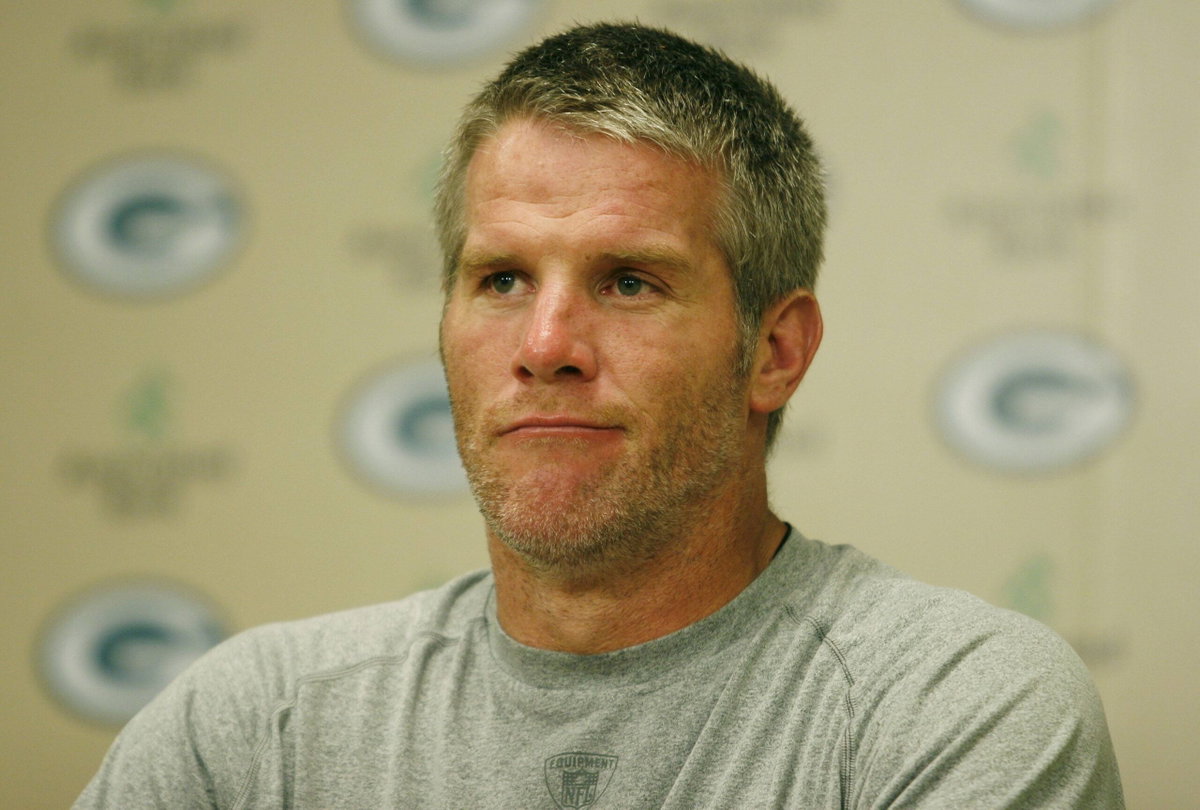
During a 2022 radio show appearance, former Green Bay Packers quarterback Brett Favre revealed that he may have suffered thousands of concussions throughout his NFL career. And then two years later, Favre publicly disclosed his Parkinson’s disease diagnosis. He also revealed that doctors had suggested head trauma could be a possible factor in his condition if there were no family history of the disease.
Watch What’s Trending Now!
“Well, hell, I wrote the book on head trauma,” said Favre at that time.
However, repeated head injuries and concussions can also raise concerns about chronic traumatic encephalopathy (CTE), a neurodegenerative disease that can currently be confirmed only after death. Over the years, several former NFL players have been diagnosed with CTE through postmortem brain examinations.
Now, a new study published in JAMA Network Open has shed further light on the prevalence of CTE among deceased NFL players. As the findings came to light, Brett Favre shared a concerning social media post, urging people to pay attention to the issue.
“A new study in JAMA Network Open estimates that 3 in 4 former NFL players who died between 2008 and 2023 had CTE. Researchers at Boston University and Mass General Brigham call it the first comprehensive look at CTE among players who have passed,” Favre wrote in an Instagram post. “It can’t predict what happens to those of us still living, but that number should get everybody’s attention. I played 20 seasons and took more hits than I can count. I love this game, and that’s exactly why I can’t ignore this.”
The study, titled “Bias-Adjusted Prevalence of Chronic Traumatic Encephalopathy Among Deceased National Football League Players,” was published in JAMA Network Open and conducted by researchers from Boston University, Mass General Brigham, and the Concussion & CTE Foundation.
The study analyzed 2,362 former NFL players who died between 2008 and 2023. Per the study, 74.5% of the players analyzed had CTE. Among the 387 brain donors with available CTE findings, 362 were confirmed to have the disease, representing 93.5% of that group.
In his Instagram post, however, Favre used former New York Giants star Tyler Sash’s reference, who died young and was later confirmed to have been diagnosed with CTE.
“Tyler Sash won a Super Bowl as a Giants rookie before concussions cut his career short. He was gone at 27, and doctors later found CTE in his brain,” added Favre, while also writing, “Tyler’s story is one of many stories and why we made Concussed: The American Dream. To tell his story, along with mine, and to give players, parents and coaches real information about CTE. It just passed its 3rd year on streaming platforms so I encourage you to watch it, and share it with somebody with parents, players or coaches.”
The Giants selected Sash in the sixth round of the NFL Draft. He won Super Bowl XLVI with the team during his rookie season. However, the team released him in 2013 after he suffered a concussion in the preseason finale against the New England Patriots. A couple of years later, in September 2015, Sash died at the age of 27 in his hometown. In 2016, his CTE diagnosis was confirmed after his family donated his brain for examination.
Brett Favre, meanwhile, disclosed his Parkinson’s disease diagnosis in September 2024, while testifying before the U.S. House Committee on Ways and Means. He was discussing a failed investment in Prevacus, a company that had been developing a potential concussion treatment. Favre acknowledged that the diagnosis made the issue personally meaningful to him.
During an interview with TMZ, Favre revealed that the problems persisted for about a year before he sought medical attention and was diagnosed with Parkinson’s in early 2024. He said his right arm would sometimes remain raised and feel as though it was stuck. He would lower it and carry on with his day, but the problem would return when he stopped thinking about it.
At the same time, the former NFL quarterback revealed his struggles while holding a screwdriver with his right hand. He ultimately had to use his left hand to guide his right hand. He also revealed difficulties he faced when he tried to put his right arm through the sleeve of a long-sleeved shirt or jacket.
Eventually, he consulted with multiple doctors, and after finding out that Parkinson’s disease does not run in his family, Favre considered his history of head trauma as a possible factor.
For Favre, the findings are a reminder that the consequences of football-related head trauma deserve attention long after a player leaves the field. While his Parkinson’s diagnosis does not establish a link to CTE, his decision to highlight Tyler Sash’s story shows why he wants the conversation to continue.