
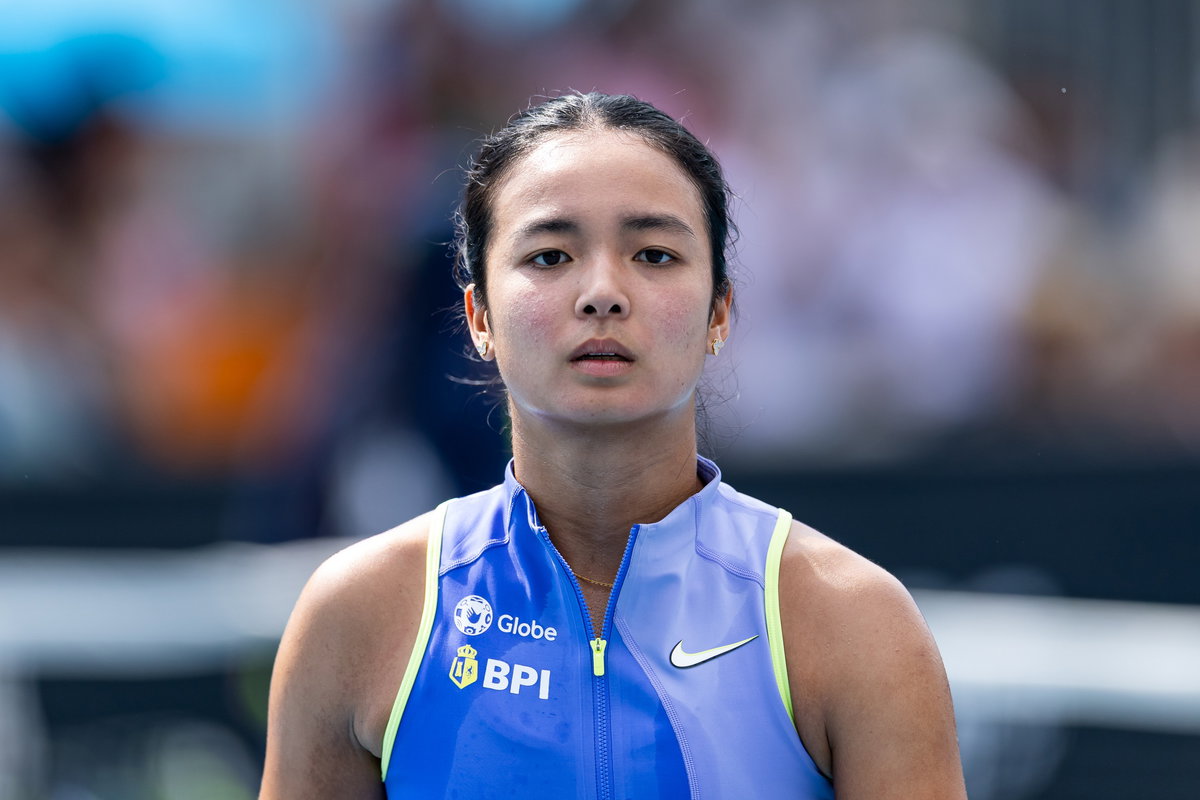
Every successful athlete has a turning point, the moment they choose to leave comfort behind in pursuit of something extraordinary. For Alexandra Eala, that moment came at just 13 years old when she packed her bags, left the Philippines, and moved to Spain alone to chase a dream that few believed was possible. In a nation where basketball reigns supreme, and tennis has long struggled for attention, Eala set out to rewrite history.
Watch What’s Trending Now!
The road was anything but glamorous. Homesickness, grueling training sessions, and the pressure of representing an entire nation became part of her daily life. Yet, through every setback, one thing remained constant: the support of her family and the values they instilled in her. Rooted in the Filipino spirit of resilience and bayanihan, the belief in lifting one another up, those lessons became the foundation of Eala’s remarkable rise from a promising junior to one of the brightest stars in world tennis. Here’s a closer look at Alexandra Eala’s heritage, her family, and the journey that shaped the player she is today.
Where is Alexandra Eala from?
Alexandra Eala was born on May 23, 2005, in Quezon City and spent her early years growing up in Metro Manila, attending school in San Juan and Makati. Although the Philippines is her home, Eala made the life-changing decision to move to Manacor at just 13 years old to train at the renowned Rafa Nadal Academy and pursue her dream of becoming a professional tennis player.
Sports were part of Eala’s life long before she stepped onto the international stage. She was born into a family with a rich athletic background. Her mother, Rizza Maniego-Eala, won a bronze medal in swimming at the 1985 Southeast Asian Games, while her brother, Miko Eala, played collegiate tennis for Penn State University. Her uncle, Noli Eala, is also a well-known figure in Philippine sports administration.
Tennis entered Alexandra’s life almost as soon as she could hold a racket. She started playing at the age of four on the shell courts of Valle Verde Country Club, where her maternal grandfather, Roberto ‘Bobby’ Maniego, introduced her to the sport and became her first coach.
By the age of six, she was already competing in local tournaments, spending countless hours on the practice court while most children her age were enjoying school trips and other childhood activities. Those early sacrifices laid the foundation for what would become one of the most promising careers in Philippine tennis history.
What is Alexandra Eala’s nationality?
Alexandra is from the Philippines, so her nationality is Filipino. After winning the prestigious Les Petits As junior tournament in France, she earned a scholarship to the elite Rafa Nadal Academy in Mallorca, Spain. She moved across the world completely alone and graduated from the academy in 2023.
Luckily, the strong family-oriented sense of community in Spain was very similar to that of her own Filipino culture. This is why adjusting to life away from home was much more comfortable than she had imagined. Living in Spain for nearly a decade also allowed her to learn the language and pick up a valuable 3rd language, in addition to English and her mother’s native language.
What is Alexandra Eala’s ethnicity?
Alexandra is of Filipino ethnicity and was born and raised in Quezon City, Philippines. She proudly identifies as Filipina, frequently expressing her deep cultural ties to her home country despite having been trained internationally. Her father, Michael, is a Filipino business executive, and through his side, she is the niece of Noli Eala (a famous Philippine sports official and former PBA commissioner). Her mother, Rosemarie “Rizza” Maniego-Eala, is a former corporate executive and a Filipina national athlete who won a bronze medal in swimming at the 1985 Southeast Asian Games.
In fact, in keeping with standard Filipino naming customs, her full legal name is Alexandra Maniego Eala, which incorporates her mother’s maiden name as her middle name. She also speaks fluent Tagalog and has publicly stated that maintaining her native language is very important to her. She actively seeks out a sense of “kapwa” (a core Filipino essence meaning togetherness or shared identity) and loves connecting with the Filipino community while traveling on the WTA Tour.
What is Alexandra Eala’s religion? Is Alexandra Eala Christian?
Yes, Alexandra Eala is a Christian and practices Roman Catholicism. Raised in the Philippines, a country with one of the world’s largest Catholic populations, she has kept her faith an important part of her life, even after moving to Spain as a teenager to pursue her tennis career.
Before joining the Rafa Nadal Academy, Eala studied at Catholic schools in Metro Manila, including Immaculate Conception Academy and Colegio San Agustin. The values she learned there have continued to shape her approach both on and off the court.
Eala has also spoken openly about how her faith helps her cope with the pressures of professional tennis. In an interview with One Sports, she revealed that she often recites the “Our Father” and “Hail Mary” prayers to calm herself before and during matches.
Reflecting on the role faith plays in her life, she said, “I think faith, belief, and self-esteem, they all come as a pack. That’s what’s going to get you through the tough times, and belief is what will push you through the good moments like this week.” For Eala, faith has helped her navigate the challenges of leaving home at a young age and competing on the biggest stages in tennis.
As her career continues to flourish, Alexandra Eala remains a proud representative of the Philippines, carrying with her not only the hopes of a tennis-loving nation but also the values of faith, perseverance, and community that have guided her journey from the very beginning.