

Fans would likely welcome Dana White and his team clarifying what the UFC stands for—entertainment or sports—and putting the confusion to rest for everyone else.
Watch What’s Trending Now!
The UFC’s growing difficulty in distinguishing between the two is becoming more apparent as fighters, even those with unbeaten records, are sidelined if they lack the ability to entertain fans. The ambiguity is increasingly frustrating, and following the controversy surrounding the UFC’s release of unbeaten fighter Farid Basharat, Ariel Helwani put the spotlight on the direction the promotion is taking.
“Sometimes we get confused with the UFC being a league,” Helwani said on his show. “The UFC is not a league. The UFC is a sports franchise that is in the business of selling tickets, of generating revenue, and they are more sports entertainment than they are simply sport. DJ (Demetrious Johnson) explained it very well last week. They are sports entertainment.
“They are closer to pro-wrestling in that regard. They’re not in the business of finding out anymore who is the best. They are in the business of finding out who is the most exciting, who can sell the most, who can sell the most tickets, sell the most subscriptions? That’s what they’re in the business of. And so if you’re dominant, if you’re winning, you’re not good enough anymore. That’s not me trying to defend it. Farid Basharat is a UFC fighter. He deserves to be in the UFC. He has clearly shown that he is UFC caliber.”
Despite winning seven consecutive fights and being undefeated, Basharat was released last week. Helwani suggested that the fighter may have lacked the highlight-reel appeal the UFC increasingly seeks.
Helwani’s comments center on the awkward situation that has developed since Basharat’s exit from the promotion. It has prompted debate about how the promotion evaluates fighters beyond their results. The undefeated bantamweight left with a 16-0 professional record, including seven UFC wins. Still, he was reportedly not offered a new contract.
In his video, Basharat claimed UFC viewed his performance as less entertaining.
Imago
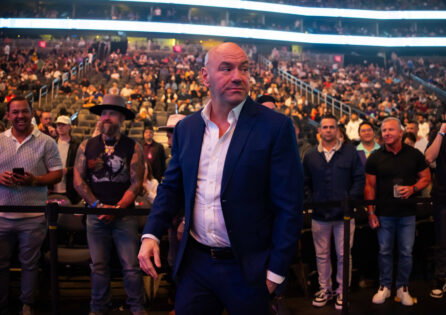
MMA: UFC 300 – Pereira vs Hill Apr 13, 2024 Las Vegas, Nevada, USA UFC president Dana White in attendance during UFC 300 at T-Mobile Arena. Las Vegas T-Mobile Arena Nevada USA, EDITORIAL USE ONLY PUBLICATIONxINxGERxSUIxAUTxONLY Copyright: xMarkxJ.xRebilasx 20240414_mjr_su5_008
“I think the company, the UFC, is manufacturing a fan base that doesn’t appreciate good quality fighting. Even if it’s a mismatch, even if it’s a low-level fight, as long as there’s blood, as long as it’s a first-round finish, we’re happy,” he said.
Dana White’s response to questions about Basharat’s exit added to the confusion. He alluded to possible issues involving matchmakers and fighters declining bouts without clearly identifying the reason for Basharat’s departure.
As Helwani pointed out, Basharat reportedly waited roughly three months after his July fight to receive his release notice in October. Communicating the decision earlier would have been fairer to the fighter.
Helwani is not the only person to have fueled the debate about whether the UFC values commercial appeal over sporting achievement.
Dana White faces tough questions after UFC parts ways with undefeated fighter
Former champion and icon Demetrious Johnson has also questioned the promotion’s approach to matchmaking, arguing that popularity and entertainment value can outweigh competitive rankings.
Basharat’s situation has revived comparisons with Michael Venom Page’s UFC exit. Those comparisons stem from the British fighter’s separation despite his four-fight winning streak. Unlike Basharat, Page suffered one defeat during his UFC run. Still, the two share a notable similarity: most of their UFC victories came by decision.
Page’s exit adds another dimension to the debate because, unlike Basharat, he was an established name who appeared on high-profile UFC cards.
Other notable UFC departures that invite comparison with Basharat include Muhammad Mokaev, Jon Fitch, Yushin Okami, Jake Shields, and Elias Theodorou. Despite their strong records or established contender status, each eventually left the promotion, although their departure occurred under different circumstances.
Tai Tuivasa presents a contrasting case. The UFC continues to feature him despite his eight consecutive defeats. Some believe his continued presence on UFC cards reflects his knockout-heavy record and distinctive personality, which have helped him build a recognizable public profile.
The UFC’s broader evolution has also fueled the argument that entertainment is playing a growing role in its business.
The promotion’s business model increasingly combines competitive MMA with entertainment and commercial strategy. Its 2023 merger with WWE under TKO Group Holdings strengthened the corporate connection between the two promotions, although it does not prove their sporting practices are identical.
Unlike traditional sports leagues or promotions, the UFC controls matchmaking and title opportunities, allowing popularity and promotional appeal to influence decisions alongside rankings. The BMF championship further illustrates its use of marketable attractions beyond conventional divisional titles. Media rights agreements, sponsorships, and live events remain central revenue sources.
Still, these factors alone do not prove that commercial priorities have undermined sporting merit.
Dana White has acknowledged that entertainment is a part of the UFC’s product while distinguishing the promotion from WWE. He has also defended a competitive model in which elite fighters face each other and earn their way towards championship opportunities.
White’s position has done little to ease fans’ concerns. Basharat’s case has renewed questions about how the UFC balances sporting results with entertainment value.
The contrast between fighters who leave despite strong records and those who continue to receive opportunities after extended losing streaks has led fans to question whether marketability carries more weight than technical achievement.