

Dana White and the UFC appear caught between two priorities: rewarding fighters for winning and expecting them to deliver exciting performances, even if that means favoring finishes over decisions. The debate once again gained attention after Joe Rogan and his latest guest, former middleweight champion Robert Whittaker, discussed the circumstances surrounding the UFC’s decision not to renew Farid Basharat‘s contract.
Watch What’s Trending Now!
“It’s like people want everything to be chaos and blood,” Rogan said. “Like, you know that dude who just got cut, Farid Basharat. Undefeated. Undefeated. Got cut. And the last time I talked to him was inside the octagon. It was the last fight of his career. He’s like, you know, when I was like, I’m sure you got to get another contract.
“Like I think I said that to him in the octagon cuz he was saying it’s his last fight. He’s undefeated. I don’t like that. I don’t like that thinking that you have to be uber excited … the guy’s very skillful. Obviously, he’s undefeated, and they just decided that they didn’t like his style…. I don’t know what happened. I don’t know. But I didn’t like it.
“I don’t like when a guy gets cut that wants to keep fighting in the UFC. He’s undefeated just because you think he’s boring. Well, put him in with someone who’s f**king exciting. Put him in with someone who pushes him and makes it a crazy fight.”
To support his argument, Rogan pointed to Khamzat Chimaev’s win over Dricus Du Plessis last year. Many viewers considered the fight as boring because Chimaev relied heavily on wrestling to control Du Plessis throughout their middleweight title bout, ultimately earning a unanimous decision victory.
Rogan argued that winning remains the primary objective in every UFC fight. However, fights involve complex, constantly changing situations that don’t follow a predictable pattern. To overcome an opponent who is equally well trained and capable of inflicting damage, a fighter must rely on his skills.
If a fighter ignores those skills and relies purely on guts and instincts, he could limit his career and risk long-term physical and mental damage.
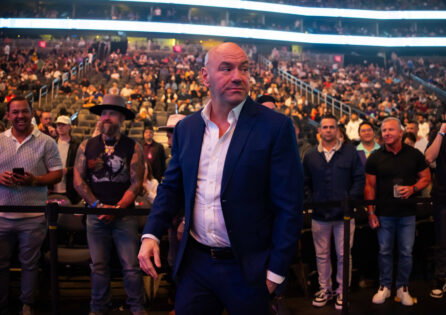
Imago
MMA: UFC 300 – Pereira vs Hill Apr 13, 2024 Las Vegas, Nevada, USA UFC president Dana White in attendance during UFC 300 at T-Mobile Arena. Las Vegas T-Mobile Arena Nevada USA, EDITORIAL USE ONLY PUBLICATIONxINxGERxSUIxAUTxONLY Copyright: xMarkxJ.xRebilasx 20240414_mjr_su5_008
Whittaker offered another perspective by pointing to the UFC’s pay structure, under which a fighter receives money and an additional bonus if they win. Repeated victories can lead to greater earnings. When winning is the primary goal, Whittaker argued, how a fighter achieves that result should not matter.
Rogan and Whittaker’s views echo concerns raised by Ariel Helwani and Demetrious Johnson about Basharat’s departure from the UFC.
Helwani argued that the UFC’s focus on ticket sales, revenue generation, and entertainment has brought its business model closer to that of its sister company, WWE. In such an environment, even a dominant fighter with a winning record could be deemed “not good enough anymore,” Helwani suggested, if his performance fails to attract sufficient attention.
Win the fight, lose the spotlight? Dana White’s dilemma
Johnson has similarly highlighted the tension between the UFC’s commitment to showcasing elite talent and commercial interests. While accepting entertainment as part of the business, Johnson felt the promotion should be more candid about its priorities.
Basharat also criticized what he sees as the promotion’s influence on audience expectations. Reflecting on his situation, he said, “I think the company, the UFC, is manufacturing a fan base that doesn’t appreciate good-quality fighting. Even if it’s a mismatch, even if it’s a low-level fight, as long as there’s blood, as long as it’s a first-round finish, we’re happy.”
White’s comments about the UFC’s decision not to renew Basharat’s contract added to the controversy. He noted that the promotion had previously parted ways with fighters who had winning records and suggested that matchmaking difficulties could sometimes contribute to such decisions. In some instances, he added, fighters may also turn down proposed matchups.
Muhammad Mokaev offers another point of comparison. Despite finishing his UFC career with a 7-0 record, matching Basharat’s record, the Dagestan-born British fighter was not retained. Mokaev recorded four stoppage wins and three decisions victories in the UFC, while Basharat secured one stoppage win among his seven promotional victories.
White’s comments drew significant backlash, prompting him to clarify later that his remarks about fighters being difficult to match or work with were general and not specifically directed at Basharat.
The controversy also fits into a broader pattern of criticism directed at White and the UFC by insiders, including Rogan. Beyond roster decisions, Rogan has questioned several promotional practices involving fighter safety, compensation, and career opportunities.
He has challenged the system that ties part of a fighter’s purse to winning and raised concerns about hosting UFC Freedom 250 outdoors at the White House, citing heat exposure, insects, and potential safety challenges.
Taken together, these examples highlight Rogan’s criticisms of UFC policies and business decisions. They do not, by themselves, establish personal animosity toward White or other UFC executives.