

In a career spanning 12 years, Merab Dvalishvili has never suffered a loss to a Dagestani fighter. Instead, he handed Umar Nurmagomedov the first loss of his professional career when he beat him by decision in his first title defense as a UFC bantamweight champion. Yet, thanks to a familiar problem plaguing Georgia, Dvalishvili, who is set to face Petr Yan for the third time tomorrow night, believes Dagestan has an edge over his native country when it comes to combat sports training.
Watch What’s Trending Now!
“Dagestan has a big fighting and wrestling history,” Dvalishvili said when asked whether his own gym in Georgia could rival those in Dagestan. “A problem in Georgia is its tradition to drink at a wedding, drink on a birthday, and drink in a street just for no reason, and then smoke—this is our problem.”
His comments raise a broader question about why Dagestan has become a popular destination for fighters looking to improve their wrestling. The region’s deep wrestling tradition, skilled training partners, and demanding training environments have helped build its reputations among MMA fighters.
Dagestani gyms provide specific training in techniques such as wrist control, top pressure, and fence wrestling, which help athletes improve their ability to hold opponents down and limit their escape options. Several UFC champions and contenders have trained with coaches and teammates from the region, applying those skills in their own camps.
Former champion Belal Muhammad trained with Khabib Nurmagomedov and Islam Makhachev’s team, spending time in both Dagestan and the UAE. Petr Yan has also attended wrestling camps in Dagestan, where he worked with experienced freestyle wrestling coaches to sharpen his skills.
Makhachev has often praised the region’s wrestling culture and coaching. He famously suggested that Daniel Cormier send his son to Dagestan for two or three years of training. The welterweight champion also invited former rival Charles Oliveira to train with his team.
But wrestling is only part of the comparison Dvalishvili raised. Georgia and Dagestan have distinct cultural and religious traditions that shape their social environments, although those differences alone do not explain their approaches to combat sports.
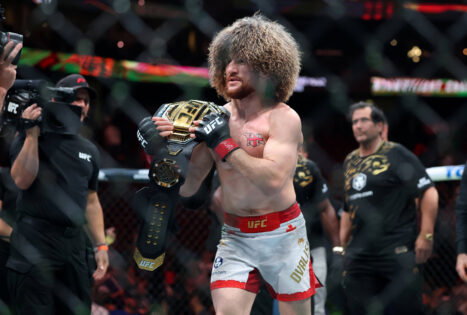
Imago
MMA: UFC 316 – Dvalishvili vs OMalley Jun 7, 2025 Newark, New Jersey, UNITED STATES Merab Dvalishvili red gloves reacts after defeating Sean OMalley not pictured in a bantamweight title fight during UFC 316 at Prudential Center. Newark Prudential Center New Jersey UNITED STATES, EDITORIAL USE ONLY PUBLICATIONxINxGERxSUIxAUTxONLY Copyright: xVincentxCarchiettax 20250606_jhp_cb6_0923
Georgia’s identity is closely linked to Orthodox Christianity, its distinctive Georgian language, and traditions such as polyphonic singing and communal feasts.
Particularly Georgia’s wine culture is closely connected to hospitality, and centuries-old customs. The Supra, a traditional Georgian feast, brings people together for elaborate meals, with a designated Tamada or toastmaster, guiding speeches and toasts about family, friendship, peace, and remembrance.
The country’s ancient winemaking heritage is also reflected in the traditional Qvevri method, which remains an important part of its cultural identity. Notably, drinking customs are not uniform across Georgia.
Dagestan, a republic within Russia, is predominantly Muslim and stands out for its remarkable ethnic and linguistic diversity, with Russian commonly used between communities.
Beyond Merab Dvalishvili: The grappling gap between Georgia and Dagestan
Georgia also has a strong wrestling tradition. Its Chidaoba heritage and strong Greco-Roman wrestling program emphasize grappling, throws, and trips, while Dagestan’s success in freestyle has helped develop a reputation for relentless takedowns, chain wrestling, and positional control.
These are broad tendencies, however, and training methods vary between individual athletes and gyms.
The training environments also differ. Tbilisi, the capital of Georgia, offers organized facilities that accommodate international athletes, while access to certain Dagestani gyms may depend on experience, coaching arrangements, and language. Religious traditions and close-knit communities influence aspects of life in Dagestan.
The success of Khabib, Islam, and other Dagestani fighters has also encouraged MMA trainers to refine their approach to wrestling pressure, cage control, and repeated takedown attempts. These skills can make it difficult for opponents to create space, get back to their feet, or establish their own offense.
Recent fights also show that elite wrestlers can be challenged by effective striking, defensive grappling, and well-timed escapes. Sean Strickland’s decision to win over Khamzat Chimaev and Song Yadong’s knockout of Umar Nurmagomedov offer two examples of fighters finding ways to deal with wrestling-heavy opponents.
Strickland survived repeated takedowns and used his striking to stay competitive, despite Chimaev’s substantial ground control. Song, meanwhile, prepared with wrestlers in Georgia and escaped difficult positions before finishing Umar Nurmagomedov with a second-round uppercut.
Overall, these recent examples show how UFC game plans continue to evolve. Wrestling remains a major advantage, but defensive grappling, striking, and adaptability can help fighters counter it.