

With her sensational win over Bella Mir, Alex Apodaca finds herself in the spotlight. In what has been described as the biggest upset in the history of the Dana White Contender Series (DWCS), the 32-year-old fighter last week outpointed UFC legend Frank Mir’s daughter. Beyond the unexpected fame, the win helped Alex Apodaca secure a contract with the UFC.
Watch What’s Trending Now!
With so much focus on her now, the fighter remains grounded and clear about the priorities that lie ahead. These include continuing with her day job as a consultant at a firm in Texas. When asked if she was already back at her job despite winning a UFC contract, she revealed she was.
“Yeah, of course,” Apodaca told Ariel Helwani. “I want to, like, have, like, a 401k and, like, you know, good insurance and, like, that kind of thing.”
Considering the UFC does not offer standard, long-term health insurance to its fighters, it’s wise for Apodaca to want to keep her day job. The same goes for her retirement plan and 401k as well.
Those comments follow details the MMA fighter shared about her professional role. A graduate of UT Austin’s Red McCombs School of Business, Apodaca has been working as an IT consultant at an audit firm for the last ten years. Currently assigned to projects, the MMA fighter revealed that she had a call to attend early in the morning, the very next day after her big fight.
“I am gonna party my a– off, but I have work in the morning. I have a call at like 7:30 a.m,” she said at the post-fight press conference.
While she added that she planned to continue with her work since it gives her space to think continuously, on Helwani’s show, Apodaca acknowledged she might reach a point where she will be required to make a difficult choice between her job and the UFC.
Imago
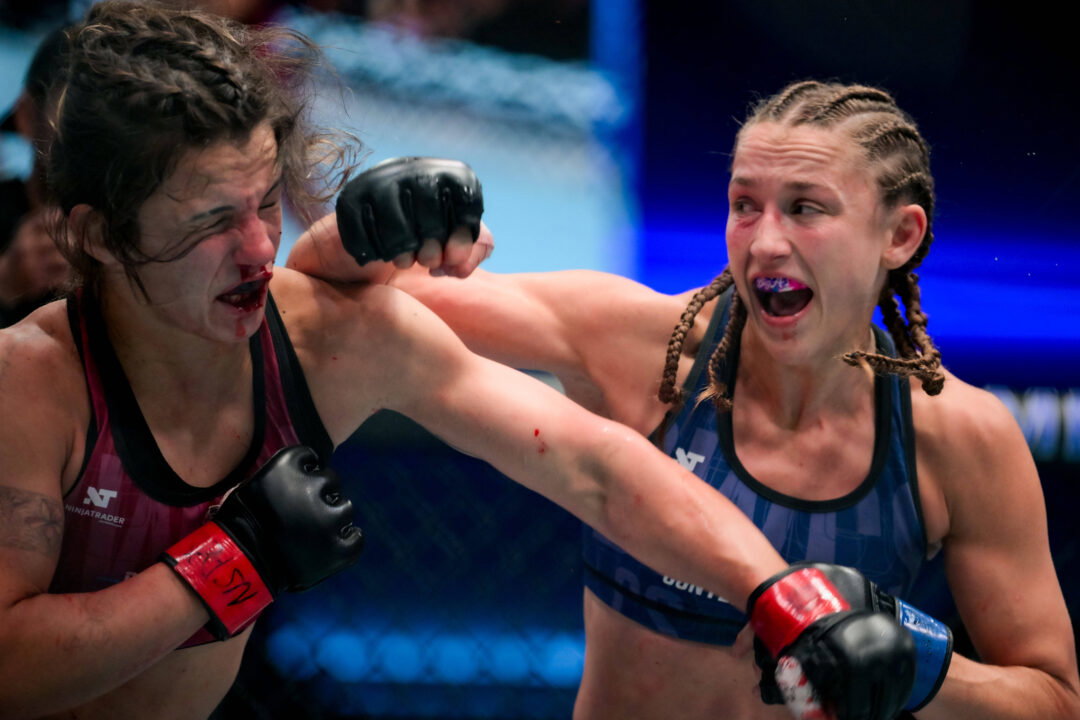
August 26, 2026, Las Vegas, Nevada, USA: ALEX APODACA R landed a right hook to BELLA MIR L during Dana Whiteà s Contender Series at the META APEX in Las Vegas Las Vegas USA – ZUMAo117 20260826_zsp_o117_010 Copyright: xMikaelxOnax
“I think I might have to make the decision or change how I do it, right? Like maybe it’s not a full-time position anymore, or maybe you know the hours are more flexible,” she admitted.
To that end, Alex Apodaca revealed how her company has been quite accommodating toward her training requirements.
With the UFC contract secured, the Denver, Colorado-based fighter now expects to make her UFC debut either by the end of this year or early in 2027. But first, she planned to take some time off.
On social media, Apodaca’s revelation has sparked debate surrounding the old-fighter-pay issue. Her desire to maintain financial security outside fighting has also brought attention to the larger conversation around UFC payouts. Despite promises about increases in fight purses and the visible surge in bonuses, payouts remain a contentious issue and continue to generate discussions among fans.
Apodaca is also not the first UFC fighter to keep a day job while pursuing a career as an MMA fighter and climbing the rankings within the promotion.
Fighting by night, working by day: UFC’s dual-career fighters
The most notable example is former heavyweight champion Stipe Miocic. Regarded by many as one of the greatest fighters in UFC history, Miocic, whose resume includes Daniel Cormier, Jon Jones, and Francis Ngannou, continued to work as a part-time firefighter and paramedic in Ohio.
Miocic turned to full-time duty in 2022. Like Apodaca, he cited health care and insurance coverage for his family as reasons for the switch. He wanted something to fall on once his days as a fighter were over, Miocic reportedly revealed.
Beyond the need to pay the bills, however, a case could be made for fighters who take a UFC career more as a side pursuit or simply for fun.
Now on a two-fight winning streak, Tommy McMillen, who secured his UFC contract after beating David Mgoyan at DWCS Week 4 last September, told Ariel Helwani in an interview how, coming off a sales job where he used to make six figures, he took up fighting to build a legacy.
After stepping away from work for a while, he rejoined his friends, who mostly handle the business.
In McMillen’s case, the money he made previously likely enabled him to pursue a career in the UFC.
The situation stands in contrast to fighters like Miocic and now Apodaca, who, given the uncertainty surrounding a fighting career, where an injury could potentially stall it, find it better to keep their day jobs for as long as it is possible. That way, they can maintain a steady source of income.
Given cases where a sole reliance on a fighting career has driven fighters to desperation and forced them to seek help, Apodaca’s choice appears to be a pragmatic approach, especially considering her current situation and her desire for financial security.