

“Why ring not a cage?” While its been over one month since Scott Coker and Peter Y. Levin formally launched Ki MMA, the question continues to echo across the MMA world. As it awaits the regulatory meeting that will determine just how different its rulebook will be, the promotion has gone all out, even resharing its co-founder’s past comments to explain why it wants to stage its fights in a ring rather than the more traditional cage.
Watch What’s Trending Now!
“It’s just great viewing through the ring,” Coker said when asked why fights in Ki MMA feature a ring. “And that really was, you know, I think the beginning of MMA fights was in a ring.”
While the veteran promoter’s response was straightforward, its roots trace back the days when he used to run Strikeforce. Founded in 1985 to promote kickboxing, the venture staged its first MMA event in 2006, with legends Frank Shamrock and Cesar Gracie headlining the card at the HP Pavilion in San Jose.
Ahead of the event, Coker approached the Californian State Athletic Commission (CSAC) to allow him to use a ring instead of the standard cage. Despite Coker sharing details, including the ring dimensions, the governing body reportedly rejected the request, since sanctioning the ring required careful consideration.
Coker’s fascination for the ring, meanwhile, stems from his deep appreciation of the golden era of the Japanese mixed martial arts.
Back in the 1990s and 2000s, when platforms like UFC were still growing, Japanese promotions like PRIDE dominated MMA. While the UFC traces its roots to Vale Tudo, which basically means “Anything Goes,” resulting in fights taking place inside a cage, the Japanese MMA events drew inspiration from shoot wrestling and kickboxing, which used to take place in traditional boxing-style rings.
The approach helped Japanese MMA retain the essence of standing-based fighting techniques. Coker likely wants to achieve something similar with fighters trading punches and kicks instead of going straightaway for takedowns, leading to grinding wrestling exchanges, which many fans essentially find boring.
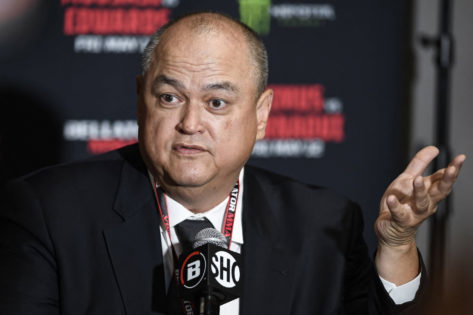
Imago
Mma Event Bellator 296 in Paris Bellator president Scott Coker during the Bellator 296 MMA mixed martial arts in Paris Bercy, Accor Arena, France on May 12, 2023. Photo by Victor Joly/ABACAPRESS.COM Paris France PUBLICATIONxNOTxINxFRAxSPAxUKxUSAxBELxPOL Copyright: xJolyxVictor/ABACAx 852671_051 JolyxVictor/ABACAx 852671_051
The approach helped Japanese MMA receive a more favorable response in media review. In comparison, the UFC faced intense scrutiny over its fights, which some termed as barbaric.
From a practical standpoint, cages seem to obstruct the cameras, preventing the audience from getting a clear view. A ring provides a better experience, allowing cameras to shoot clearly between the ropes and capture every micro-expression and technical movement as the fight progresses.
Beyond the ring, Coker has consistently pushed the boundaries of fight promotion with innovative measures.
Scott Coker: Never one to follow the usual script
He introduced a novel, untested model that enabled multiple promotions to collaborate on events. While the UFC is well known for staging stand-alone shows, rarely involving other promotions, Strikeforce has worked with platforms like M-1 Global to stage events.
When he was at Bellator, Coker struck a partnership with RIZIN, sending his top-tier fighters to compete in the Japanese MMA promotion’s cards.
Besides the ring, Coker plans to introduce a few other changes in Ki MMA, including a major rule variance related to grounded strikes. While most MMA platforms prohibit fighters from hitting when their opponent has hit the canvas, reports indicate Ki MMA had requested a provision allowing fighters to use the knee on a grounded opponent. Dangerous techniques like soccer kicks, stomps, and linear knee strikes remain excluded.
Coker reportedly plans to make his Ki MMA debut with a 32-fighter featherweight World Grand Prix, something similar to what he did at Strikeforce back in 2011, staging a massive 32-man Grand Prix tournament with fighters competing in a tournament-style format.
Ki MMA is not the only promotion that has resorted to using a ring for its fights.
As one of the most well-known combat sports brands, RIZIN Fight Federation (RIZIN FF) relies on the traditional 5-rope ring for its numbered events. Singapore-based ONE Championship also uses a customized 5-rope ring alongside their traditional cage.
A few promotions based out of Eastern Europe, like the Polish-based KSW (Konfrontacja Sztuk Walki) and FEN (Fight Exclusive Night), and the Russian M-1 Global also seem to have experimented with rings or hybrid-designed platforms.
While promotions like PRIDE and K1 gained massive popularity despite using rings, most MMA promotions eventually switched to the cage. The primary motivation behind the change was to ensure continuity. Grappling inside the ring led to fighters’ legs getting entangled under the ropes, forcing the referee to break the fight and get them back to the center and resume it.
The cage removed that barrier, allowing fighters to keep competing against the fence.
The team at Ki MMA will likely come across those arguments at the regulatory meeting now set for December 1, 2026. Only then will it finally become clear how far Coker’s plan to stage a unique MMA platform has succeeded.