Imago
Credits: From the grounds of Augusta National, Joy Chakravarty, EssentiallySports
Imago
Credits: From the grounds of Augusta National, Joy Chakravarty, EssentiallySports
The ‘No Cell Phone’ policy of Augusta National Golf Club was the talk of the golf world once again when Mark Calcavecchia, the 1989 Open Championship champion, was reportedly escorted out of the golf course by security guards on Wednesday.
Watch What’s Trending Now!
Rules are rules, and it did not matter that 65-year-old Calcavecchia, a 13-time PGA Tour champion who has made 18 appearances at the Masters, is at this week’s tournament as an ‘honorary invitee’.
Calcavecchia joins a long list of patrons and other stakeholders who have fallen foul of Augusta National’s strict policy. There are places inside the property where you can take your phones, but once you are heading out on the course, small white boards at almost every exit door will remind you that ‘Cell phones are not permitted beyond this point’.
Top Stories





It was during my second Masters in 2008 that I heard about a BBC journalist being escorted off the golf course and permanently banned. He forgot to leave his phone in the media center, and while on the course, took it out for some reason. From what we later heard, security personnel approached him and said: “Sir, I think you have got an illegal object in your pocket”.
It all seemed very chilling, and every time I have left the Press Building after that, I have always patted my pockets.
As far as I am aware, the Augusta National Golf Club is the only organization that has enforced the rule in all sports. There have been variations of it, like the NBA not allowing players to use phones and social media during game time, but that’s for a completely different reason.
Apparently, no one seems to recall the year when phones were officially banned. It seems to be the case forever, and when I quizzed an Augusta National member a few years ago, his answer was: “I am guessing, but since 1934!”
Separating people from their devices has its negatives in this day and age. I know of parents, including yours truly, who have faced full-blown mutinies at home when such a rule has been enforced.
However, a majority of journalists and patrons welcome this forced break from their devices.
Over the years, I have asked people what purpose they thought such a move serves. Media rights and Augusta National’s efforts to control the narrative seem to be the two most popular answers.
But here is the thing. When the policy was first introduced – and I can say it with full authority that it was before the 2007 edition, because that was when I covered my first Masters – sports media rights were in a very nascent stage. I am also 100 per cent sure that nobody, including Mark Zuckerberg, envisaged that social media and picture/video sharing would become the monster that it is now.
So, if Augusta National somehow foresaw all this happening, hats off to their commercial acumen.
I believe that Augusta National Golf Club is truly one of those rare modern-day organizations that has remained true to the vision and philosophy espoused by its founders. The no-cell-phone policy, just like the massive new players’ services facility launched this year, was implemented to make it a better playing experience for the players.
Among all sports, golf probably gives fans the closest proximity to its stars. The flip side is that fans want to capture the moments forever, and you hear the cameras clicking and phones ringing at the most inappropriate times.
In my opinion, it also becomes a much better watching experience for the fans. I have heard the ‘what’s the use of paying for the ticket if you can’t Instagram it?’ argument. However, being able to focus on the action and being in the moment, and letting the lens of your eyes record the movie on the deepest part of your hippocampus, is what makes your memories. The anxiety to make reels and posts tends to take away from the true experience of watching sports.
There is a case to be made as to why we remember the great golf shots hit at Augusta National much more than in any other tournament. Not having your phone could be a big reason.
Imago
Credits: From the grounds of Augusta National, Joy Chakravarty, EssentiallySports
Bryson DeChambeau is one person in golf who gets the power of social media, but even he welcomes a week like the Masters.
“I do find a bit of nostalgia in having people watch through their eyes rather than through a phone. It is cool,” said DeChambeau. “There’s more of this presence. I feel like there’s a bigger buzz because of it.”
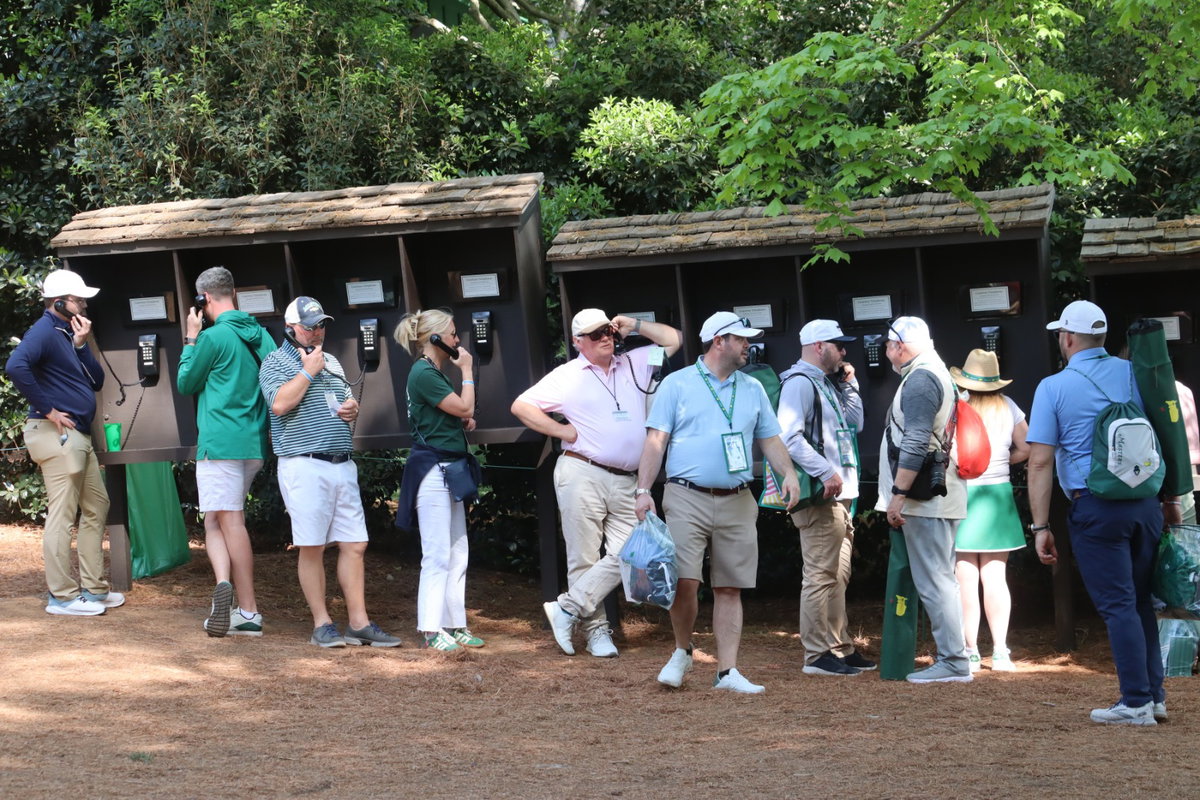
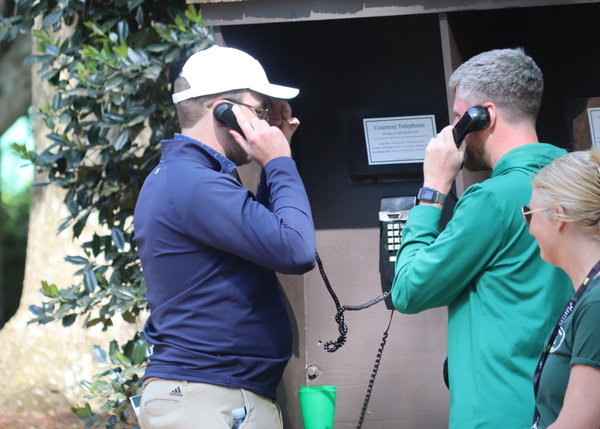
And it’s not like Augusta National doesn’t want you to get in touch with your near and dear ones. Throughout the property, but at very strategic locations and hundreds of yards away from the action, there are rows of phones that the patrons can use for free. The first couple of years I was here, I would make at least one call to my father in India.
Are there some people on the golf course who require their phones more than others? You’d think that is the case, and you’d probably say the media should be one to have that privilege. With the benefit of covering more than a dozen Masters, I can assure you the only time you feel its absence is when you have to coordinate the logistics for a meeting. Otherwise, it really is a cathartic experience.
You really cannot count the ‘no cell phones’ among one of the time-honoured traditions that make the Masters so different. But it has shown over the years how good it has been for golf and the tournament. Let’s keep it going!
