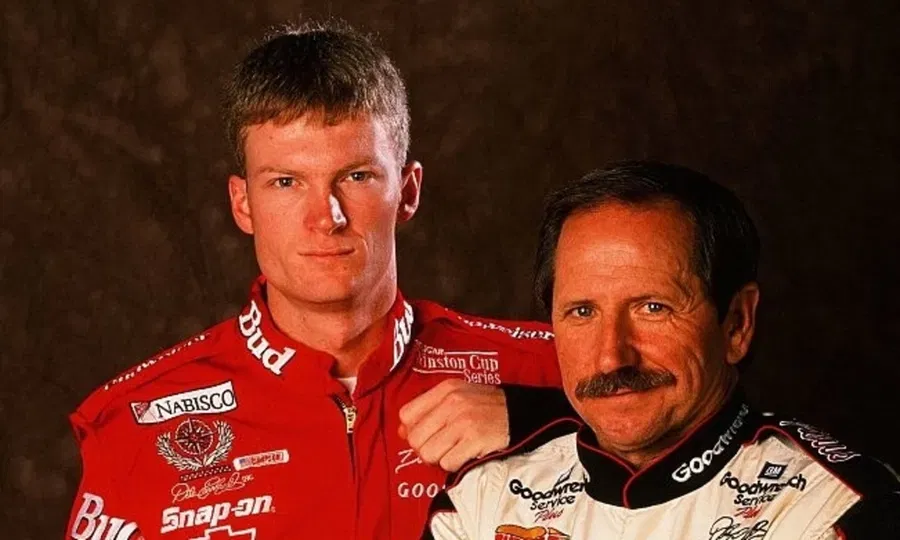
July 30, 1979. Hardcore NASCAR and Dale Earnhardt Sr fans will surely remember this date. For the unaware ones, this is the day Dale Earnhardt’s season, and body, came to a violent stop at Pocono. Leading on lap 98, a blown tire sent his Monte Carlo skidding helplessly into the Turn 2 steel guardrail. The impact broke both collarbones, and Earnhardt was airlifted to East Stroudsburg Hospital, admitted overnight with his year suddenly in doubt.
Watch What’s Trending Now!
It wasn’t just the injury that hurt. Rather, it was the timing. NASCAR was barreling into its most unforgiving stretch, and Dale Earnhardt was sidelined when momentum mattered most. What followed, as Dale Jr. now reveals, turned a brutal setback into one of the defining pivots of the Intimidator’s legend.
A perfect stand-in at the worst possible time
“Dad’s out injured and the series is going to start a stretch of nine races in ten weeks. Remember, this is a 31-race season. It’s a bad time to be injured…Pearson says he was let go from the Wood Brothers earlier in the season. He’s gonna get a call from Osterlund. Fill in for dad, while dad’s out injured.”
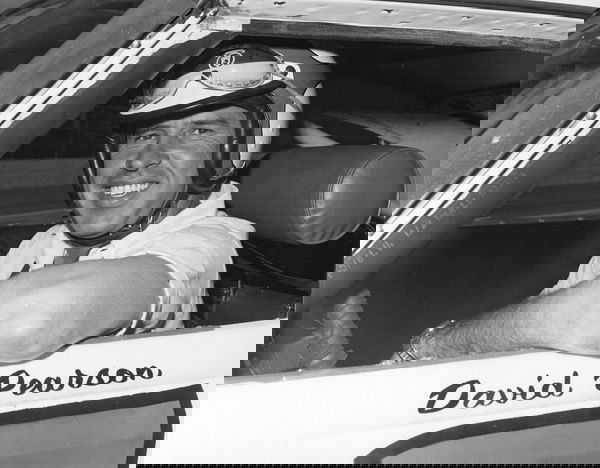
That moment, almost casual in how Dale Jr. recalls it, carried far more weight than it seemed. David Pearson wasn’t just any available driver. He was NASCAR royalty, freshly separated from the Wood Brothers team that had defined much of his career.
Pearson had joined the crafty Wood Brothers Racing operation back in 1972, forming one of the sport’s most efficient part-time juggernauts. But by 1979, the partnership was fraying. The official breaking point came at Darlington, when a disastrous pit stop saw Pearson drive off with missing tires.
Imago
@RichmondRaceway/X
It looked like a freak mistake, but insiders have long suggested deeper communication issues and rising tension between Pearson and Leonard Wood. Both sides, it seemed, were already searching for a reason to move on. Larry Pearson, David Pearson’s son, later explained how chaos sealed the split.
“When they dropped the jack, they ran around to the left side, and he took off. Eddie Wood was saying, ‘Woah, woah, woah,’ and Daddy thought he was saying, ‘Go, go, go.’ So that was the whole story.” A misunderstanding became an ending. That made Osterlund’s call perfectly timed.
With Dale Earnhardt sidelined by injury, the team didn’t need a placeholder. Rather, they needed trust, experience, and calm. Pearson answered without hesitation.
“I know it’s a first-class car and this opportunity is just what I was looking for,” Pearson said. “If I could help Dale while he’s hurt and carry on for a team that needs a driver, then I’m happy to do it.”
What followed was surgical brilliance. Pearson finished second at Talladega, won the pole at Michigan, and delivered a defining Southern 500 victory at Darlington. More importantly, he preserved Earnhardt’s rookie momentum. Dale returned a week earlier than expected, rejoined a season still intact, and ultimately claimed NASCAR Rookie of the Year.
Pearson didn’t just fill a seat. He protected a legacy before it fully began.
A look at Dale Earnhardt’s rookie year
Dale Earnhardt’s 1979 NASCAR Rookie of the Year award marked the beginning of one of the most legendary careers in stock car racing history. Driving the No. 2 Budweiser Chevrolet for Rod Osterlund Racing, the 28-year-old North Carolina native entered the Cup Series with a reputation from dirt tracks and late-model racing, but few expected his immediate impact.
Earnhardt competed in 27 of 31 races that season, posting impressive results that showcased his raw talent and aggressive style. His rookie campaign featured a win at Bristol Motor Speedway, eleven top-5 finishes, seventeen top-10s, and four poles. Dale Earnhardt finished 7th in points despite a major accident mid-season (mentioned earlier) that sidelined him temporarily.
This strong haul edged out competition from fellow rookie Davey Allison and others, earning him the unanimous Rookie of the Year honor from the National Motorsports Press Association. Earnhardt’s success stemmed from his fearless driving and quick adaptation to superspeedways.
Osterlund provided a top-tier operation, pairing Earnhardt with crew chief Jake Elder, whose guidance honed his skills. The award validated Earnhardt’s potential, silencing doubters who viewed him as too old for rookie status or overly brash. It propelled him to championships in 1980, 1986, 1987, 1990, 1991, 1993, and 1994, plus 76 Cup wins.
Reflecting on 1979, Dale Earnhardt often credited the foundation laid that year for his seven titles. His rookie triumph symbolized the rise of “The Intimidator,” transforming NASCAR and inspiring generations. Today, it remains a benchmark for newcomers, underscoring how determination and opportunity can forge immortality in the sport.