Imago
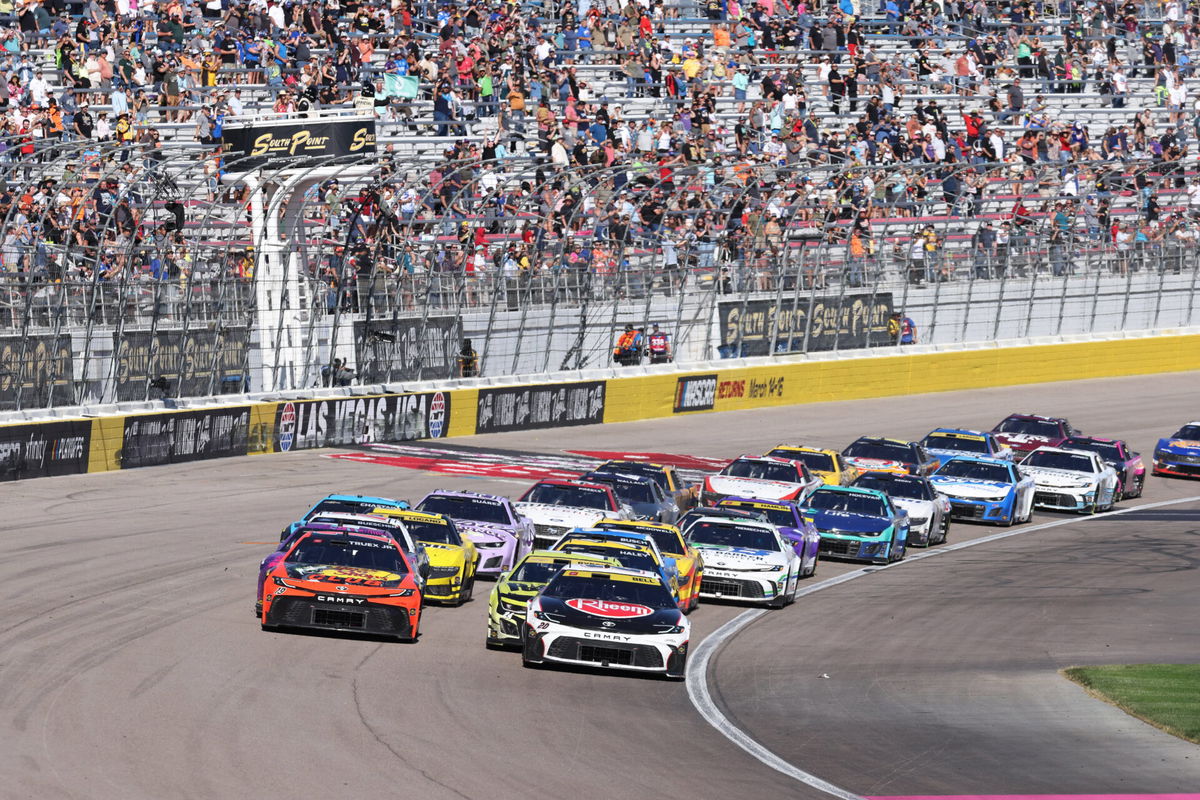
LAS VEGAS, NV – OCTOBER 20: Martin Truex, Jr. 19 Joe Gibbs Racing Bass Pro Shops Toyota and Christopher Bell 20 Joe Gibbs Racing Rheem Toyota lead a group of cars across the start line during a restart of the NASCAR, Motorsport, USA Cup Series South Point 400 race on Sunday, Oct. 20, 2024, at the Las Vegas Motor Speedway in Las Vegas, Nevada. Photo by Marc Sanchez/Icon Sportswire AUTO: OCT 20 NASCAR Cup Series South Point 400 EDITORIAL USE ONLY Icon1442410205177
Imago
LAS VEGAS, NV – OCTOBER 20: Martin Truex, Jr. 19 Joe Gibbs Racing Bass Pro Shops Toyota and Christopher Bell 20 Joe Gibbs Racing Rheem Toyota lead a group of cars across the start line during a restart of the NASCAR, Motorsport, USA Cup Series South Point 400 race on Sunday, Oct. 20, 2024, at the Las Vegas Motor Speedway in Las Vegas, Nevada. Photo by Marc Sanchez/Icon Sportswire AUTO: OCT 20 NASCAR Cup Series South Point 400 EDITORIAL USE ONLY Icon1442410205177
There was a time when NASCAR felt like a Saturday-night experiment that somehow turned into a national spectacle. If you had a car, a small crew, and enough nerve to mash the throttle, you could show up, take your chances, and belong. It wasn’t polished, it wasn’t perfect. But that was the point!
Watch What’s Trending Now!
Stock cars were truly stock, fixes involved hammers more than computers, and participation didn’t require a venture-capital-sized budget. But that version of NASCAR feels increasingly distant. Now, as the lawsuit dust settles, frustrations are boiling over as team owners, especially one in particular, argue the sport has quietly transformed into something far more exclusive. It’s now reserved less for racers with grit and more for those with deep pockets.
How NASCAR priced out its own people
“Now we’re just making that pool smaller and smaller and smaller and smaller and smaller, and that’s why I think you’re you’re seeing so much push back from the fans. It feels like we’re so far from where we were even just 15–20 years ago when it comes to participation and cost,” Alpha Prime Racing owner Tommy Joe Martins recently revealed in an interview.
Now, that frustration, clearly, isn’t coming from theory. Instead, it’s coming from the balance sheet. Modern NASCAR participation, as Martins revealed, is no longer just about fielding a competitive car. First, teams need charters, which now cost tens of millions of dollars just to secure a permanent seat and a share of the sport’s revenue.
No charter? No guarantees. Then comes the car itself. Teams must run NASCAR’s sanctioned stock car, use only NASCAR-approved vendors, and comply with ultra-tight tolerances that leave zero room for creativity or cost-saving ingenuity. Even staying on track has become expensive.


NASCAR cars don’t need to be wrecked to require repairs anymore. Parts wear, tolerances drift, and suddenly you’re forced into mandatory servicing cycles. That reality was laid bare during the recent antitrust lawsuit when Front Row Motorsports owner Bob Jenkins broke down the numbers. Before the Next Gen era, Jenkins spent roughly $1.8 million annually on parts. Today, that figure has ballooned to $4.7 million a year.
And it doesn’t stop there. NASCAR teams aren’t even allowed to fix many of these components themselves. The head and tail of the car must be shipped back to a single-source vendor, “repaired,” and sent back. And it often leads to a cost of around $30,000 per piece.
And it’s the same story for every other NASCAR team. Even Rick Hendrick, owner of Hendrick Motorsports, in a 2024 letter to Jim France, revealed that the team had lost $20 million in the previous five years.
If teams like Joe Gibbs Racing, Hendrick Motorsports, or Front Row Motorsports are feeling the squeeze, the impact on smaller operations like Alpha Prime Racing participating in the Xfinity (O’Reilly Parts) and Truck Series is magnified tenfold. What was once a sport built on ingenuity and access now feels locked behind financial gates. And for many, that’s where the real disconnect with fans begins.
Top Stories





NASCAR’s charter system explained
At its core, the NASCAR charter system is meant to provide stability. However, over time, it has quietly reshaped the sport into something far more exclusive. Simply put, ownership charters act as status tokens. A team holding one is guaranteed entry into every NASCAR Cup Series race and receives assured revenue based on negotiated terms set before each charter period begins. The first agreement aligned with the 2016–2024 TV deal, while the current one stretches from 2025 to 2031.
That’s the simple version. The reality is more layered.
Teams have increasingly treated charters like stick-and-ball franchises. Think the New England Patriots or the Los Angeles Dodgers, where the car number itself carries long-term value. The difference is that NASCAR isn’t an equal partnership. The sanctioning body still holds most of the power, a tension that sat at the heart of the 2024 antitrust lawsuit.
There are currently 36 charters in circulation, each tied to shared benefits under the Cup Series umbrella. Most importantly, chartered cars are guaranteed starting spots regardless of how many entries show up on race day. Non-chartered teams can still race (up to four per event), but they earn significantly less purse money.
Not all charters are valued equally. Their worth is calculated based on on-track performance over the previous two seasons, with payouts determined by a formula tied to championship finishes. There’s also a political layer. Charter ownership comes with a figurative “seat at the table,” similar to Formula 1’s Concorde Agreement, allowing teams limited dialogue with NASCAR on competition and business matters. Most teams negotiate through the Race Team Alliance (RTA), which functions like a union and even operates its own media arm.
Over time, scarcity created demand. Charters became assets that could be sold or leased, giving teams something tangible to cash out. Combined with the Next Gen car’s spec-model philosophy and rising broadcast revenues, the system was designed to create sustainability. Whether it’s actually doing that remains the sport’s biggest unanswered question.
Related Newsletters