Today, we live in the age of AI. From making our fitness plans to suggesting which stocks to buy, it handles it all. It’s omnipresent. And naturally, the motorsports world also couldn’t escape it.
Watch What’s Trending Now!
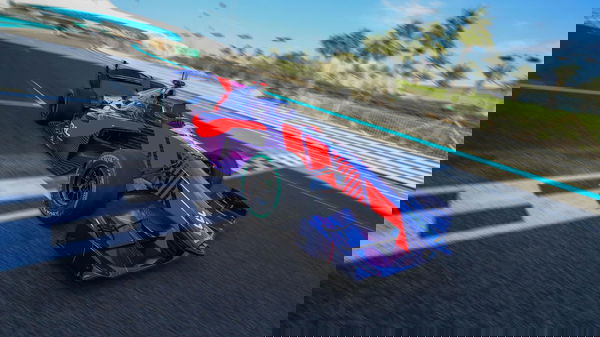
Last year, the Abu Dhabi Autonomous Racing League at the Yas Marina Circuit brought the self-driving cars competition to reality. Though it wasn’t perfect, where technical issues let only two cars win out of the four that qualified, the series will still continue into its next season, giving it a green light to AI taking over. But is this really the future? A physicist from Harvard explains why it isn’t.
Why AI racing will never take off, according to a Harvard physicist
Recently, Israeli-American physicist Avi Loeb made an appearance on the Danny Jones podcast. There, he broke down the reason why self-driving cars haven’t been tested at NASCAR yet.
“I wondered, why isn’t there a corporation that makes a self-driving car that will win the NASCAR. That’s obviously doable, and my answer is that we enjoy watching humans compete.”
That’s the secret at the core. It’s the human factor. And within humans, it’s the risk factor involved with humans. We love watching humans because we love the thrill at stake when they drive. And Loeb explained this with a personal example.
“The racer put me in the car after I signed my name on his t-shirt and then showed me how to drive it. He invited me to go to Daytona, and my wife said ‘No way! You’re not taking that risk.’”
Imago
via X (@EMMotorsport)
That’s it. That hesitation from his wife explains how, when humans are involved, risk is involved. And it’s not like we love seeing their lives at stake, but it’s about the element of thrill involved with a human winning or losing.
“Computers are able to do better than humans in chess, and by now there is art that is definitely competitive with human-made art. Nevertheless, we don’t pay much for it, and the reason is, we enjoy the human connection.”
View this post on Instagram
So, as we understand this further, we realize how the logic applies to everything. An AI painting isn’t as hit as a hand-made art, because what are you really paying for? The painting? No. You’re paying for the effort behind that painting, from a fellow human like yourself. A human made it, that’s why it got popular in the first place. Similarly, a racecar won’t be fun to watch if the artist behind it is absent. There is no one driving, no one to cheer for, and the human element is gone.
Meanwhile, while Abu Dhabi has its own series, Las Vegas isn’t behind either.
Indy Autonomous Challenge shines at CES 2025
This year, in January, the Indy Autonomous Challenge (IAC) became the world’s first multi-car autonomous race to take place. Held at the Las Vegas Motor Speedway, it was a groundbreaking milestone that marked the evolution of AI or autonomous racing.
“Since our first race in 2021, the IAC and our university teams have been making history with the world’s fastest autonomous racecars, said Paul Mitchell, president and CEO, Indy Autonomous Challenge.
“But our goal has always been multi-agent racing, so being the first to have all our AI drivers complete a race and do so with five overtakes, no accidents, and a nose-to-nose finish is a testament to the progress of the IAC’s global ecosystem of highly talented university researchers, industry partners, and government supporters.”
The Indy Autonomous car is getting faster and faster up the #FOS Hill. It’s quite amazing to see a completely driverless racing car. @IndyAChallenge pic.twitter.com/aRLYngaaX8
— Goodwood FOS (@fosgoodwood) July 13, 2024
The event was about four IAC AV-24 fully autonomous racecars piloted by AI drivers from top global university teams competing head-to-head in a 20-lap exhibition race.