Imago
Credit: Peter Casey-Imagn Images
Imago
Credit: Peter Casey-Imagn Images
If you have been following the NASCAR antitrust lawsuit, then you must be aware of the ugly truths it has revealed. With the financial models being exposed, top teams in the lower series, like Dale Earnhardt Jr.’s, have suffered tremendously, according to a fellow NASCAR team owner. And as the truth comes out, there is no going back from this system NASCAR created.


Tommy Joe Martins, ever the NASCAR Xfinity and Truck visionary, didn’t hold back. Speaking on Chase Holden’s YouTube video, the veteran laid it on thick.
Watch What’s Trending Now!
“The joke with Junior Motorsports is like they could go out and win every race, and they basically did,” he said. “They won 20 races. I guarantee you they lost money. It just doesn’t pay enough money.”
It is no secret that Dale Earnhardt Jr.’s JR Motorsports had a breakout season this year, with Connor Zilisch racking up 10 of the 17 wins for the team and three JRM drivers taking up spots in the championship finale at Phoenix. However, despite all these wins, the team seems to be losing, according to Martins.
Tommy Joe Martins’ blunt observation gets straight to the heart of a harsh reality in NASCAR’s lower and regional tiers. Prize money and payouts alone aren’t enough to sustain a race team, regardless of on-track success.
Independent teams like Dale Jr.’s and others in the Xfinity and Truck Series often rely heavily or entirely on sponsorship and outside funding to balance their books because race earnings rarely cover operating costs such as travel, equipment, salaries, parts of the car, and tires.
Unlike the Cup Series, the Xfinity Series does not use the charter system. In charter, teams are provided a guaranteed annual revenue with a base payout and performance-based bonuses that can translate to millions of dollars per race before sponsorship.
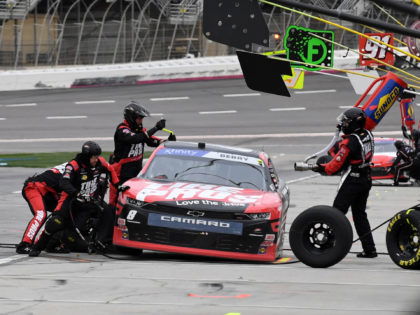
Imago
ATLANTA, GA – MARCH 18: The crew of Josh Berry 8 JR Motorsports Tire Pros Love The Drive Chevrolet services the car during the NASCAR, Motorsport, USA Xfinity Series RAPTOR King of Tough 250 on March 18, 2023, at Atlanta Motor Speedway in Hampton, GA.Photo by Jeffrey Vest/Icon Sportswire AUTO: MAR 18 NASCAR Xfinity Series RAPTOR King of Tough 250 Icon230318422
With no charter guarantees, teams must depend primarily on race payouts and external revenue like sponsorship to stay afloat. That creates a much more financially fragile model for the lower series.
More importantly, the prize money is significantly smaller than in the cup. For example, the total purse for the 2025 Xfinity Series championship race was about $2.15 million, compared to over $12 million for the Cup Series finale; that entire amount is split among all competing teams based on finishing order.
More importantly, this isn’t why Martins continued to field cars in the Xfinity Series.
“I think the sport that I fell in love with was one that felt like it was able to give people opportunities. And now, as a team owner, you spend all this money going through it. The reason that I’m not driving anymore as a race car driver is because it is a fundraising proposition,” Martins added.
NASCAR also flattened payouts so that full-time Xfinity teams receive the same base payout per race regardless of venue, meaning even marquee events don’t necessarily pay more than lesser-attended races.
With limited prize money, most teams rely heavily on sponsorship for the vast majority of their revenue, often 60 to 80% or more of total income.
Primary sponsorships typically come in at $150,000-$400,000 per race, or about $3 to $10 million for a full season, depending on team competitiveness, driver profile, and marketing deliverables.
Without strong sponsorship backing, teams often cannot cover basic operating costs, let alone make a profit. And with the charter becoming permanent, it has reduced the scope of lower-tier teams to move upward, and Dale Jr. knows it all too well.
Dale Jr. accepts his dashed Cup Series hopes
Before the settlement dust even settled, Dale Earnhardt Jr. knew what he was walking into. And the fallout from turning NASCAR charters into permanent assets didn’t look promising for his Cup Series ambitions.
He warned that locking in guaranteed entries for current holders could push the sport closer to a closed league model, creating enormous financial barriers for anyone trying to buy their way in. In his view, the charter is already more than just an entry pass, and making it permanent would only reinforce that reality.
It acts as a gatekeeper, deciding who can realistically compete at the top level. He went further, suggesting that owners and executives are acutely aware that giving charters permanent status could push their value, effectively turning each grid slot into a high-end, franchise-style property.
“They’re no longer charters. They go from franchises worth around $25 million to charters worth about $150 million or more,” he said. “And so I’m just saying like, once you become a series that has 36 franchises, they are now way over here on an island, even more than ever, unrelated to Xfinity, Truck, and everything below it—ARCA, regional, local.”
Once the settlement cemented the system’s future, he argued, the market would treat each charter as a scarce commodity, driving its value even higher.
And this definitely shattered his dream to move JRM to the Cup Series. And now, as Junior accepts his fate, he shifts his focus to having another standout Xfinity season in 2026.