Imago
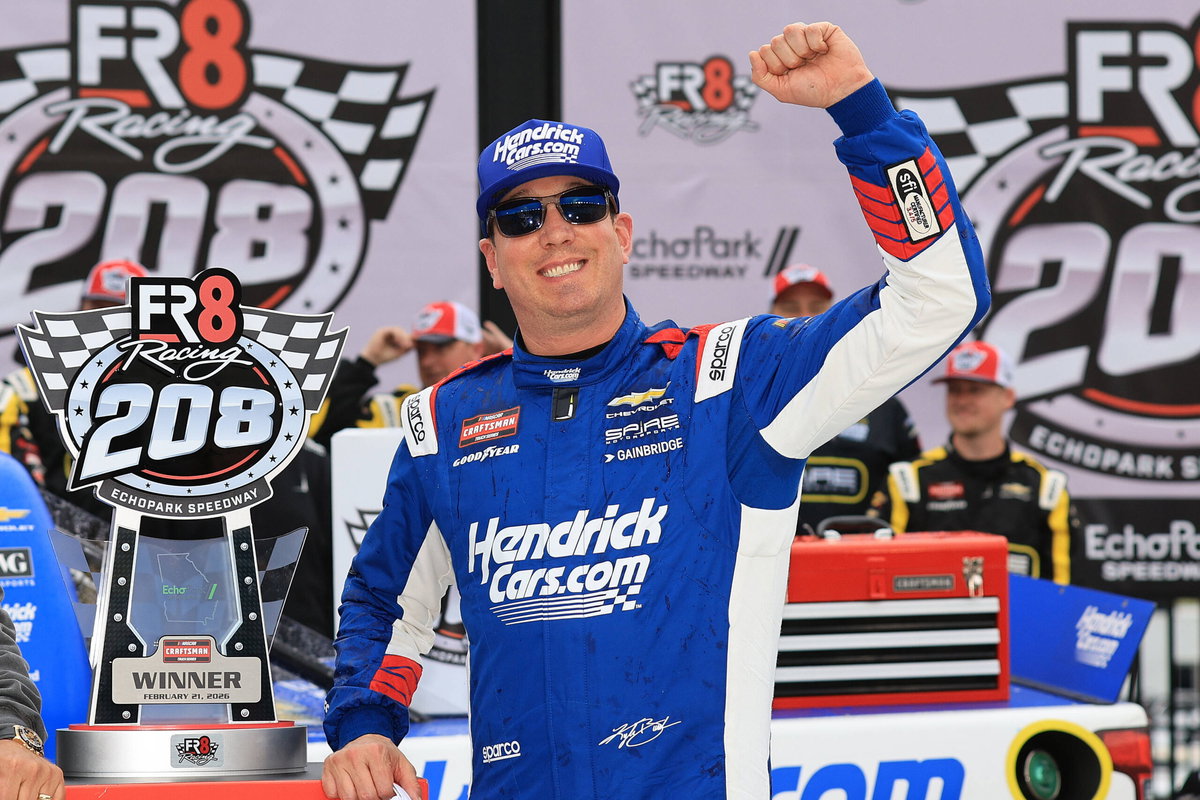
HAMPTON, GA – FEBRUARY 21: Kyle Busch 7 Spire Motorsports HendrickCars.com Chevrolet celebrates in Victory Lane after winning the NASCAR, Motorsport, USA CRAFTSMAN Truck Series FR8 208 race on February 21, 2026 at EchoPark Speedway in Hampton, GA. Photo by David J. Griffin/Icon Sportswire AUTO: FEB 21 NASCAR CRAFTSMAN Truck Series FR8 208 EDITORIAL USE ONLY Icon953260221807
Imago
HAMPTON, GA – FEBRUARY 21: Kyle Busch 7 Spire Motorsports HendrickCars.com Chevrolet celebrates in Victory Lane after winning the NASCAR, Motorsport, USA CRAFTSMAN Truck Series FR8 208 race on February 21, 2026 at EchoPark Speedway in Hampton, GA. Photo by David J. Griffin/Icon Sportswire AUTO: FEB 21 NASCAR CRAFTSMAN Truck Series FR8 208 EDITORIAL USE ONLY Icon953260221807
The Easter break was a much-needed for many in the NASCAR world, including Kyle Busch. The reset was meant to change the rhythm of a struggling season, where the legendary driver has struggled to find any form of consistency. Instead, the first moments back suggest something far more stubborn, the presence of a slump that no break seems to shake.
Watch What’s Trending Now!
Reset came, performance didn’t: Bristol exposes the same old struggles
“It stalled out on me there, and I couldn’t get it refired, and obviously lost the track position, and then once you do that, those things were impossible to pass,” said Busch. “So that was the trucks at Bristol are more of an aero game than ever. That’s not fun.”
This opening admission from Kyle Busch didn’t just capture a single moment, but it extended to show a picture of the entire trail. At such times, a racer needs a break, and that was exactly the next question to which Busch replied.
Top Stories





“Yeah, no, it was really good. The off week was much needed, just a little rest and relaxation, if you will,” he added. “You know, we’re always running 100 miles an hour with Brexton doing stuff, us doing, me doing stuff, my schedule, and all that. So it was nice to just kind of get a little refresh on that aspect.”
On the surface, it sounds exactly like what a team that struggles would need, but the next answer, when Busch was asked whether the break came at the right time, quickly cut through that optimism.
“The off week was much needed of just a little rest and relaxation.”@KyleBusch on how his off week was. He also talks about his run in Trucks Friday night at Bristol.#NASCAR pic.twitter.com/dfEafBIILv
— Frontstretch (@Frontstretch) April 11, 2026
“I think it was… I think that was a good time because you know, if you start really strong, yeah, you don’t want a break, right? You want to keep that momentum going. But if you don’t start very strong, which… You know, we haven’t… then I would say it would be nice to get sort of a break, a reset, fresh mind of being able to think about things maybe a little bit differently rather than going through status quo and just going to the racetrack every week.”
Even his forward-looking optimism felt cautious, “So hopefully we see some improvement here at Bristol,” as Busch added.
In no way did the driver feel dominant; what he came off as was very measured, even when the conversation switched to the truck race.
“That was good. Yeah, it was fun. I mean, that was one that was just on the schedule, so opportunity there. And thanks to Hendrick and Inspire for letting me go run the truck and have some fun,” said Busch. Adding on to the measured optimism, he said, “Wish we could have ended a little bit better. I felt like if we didn’t win the race because I could hold the rest of the guys off behind me, then I think maybe we would have got a third out of it. But, you know, we’re just there to win.”
And that was something that defied it all — the break was “much needed,” the reset was “good,” the mindset seemed “fresh.” Yet the result? Still the same.
This takes us to another possibility — is this a Busch problem or a wider issue that is being ignored?
The problem runs deeper than one driver
The early slump in 2026 cannot be attributed to Kyle Busch alone; in fact, if we were to note all data points collectively, it points us to a wider structural issue within Richard Childress Racing. Through the opening stretch of the season, both the entries fielded by RCR have showcased dismal performances, with neither Busch nor his teammate, Austin Dillon, registering a top 10 finish. Busch sits outside the top 20 in points with an average finish hovering above 21, while Dillon trails even further back with no laps led. A combination of both these factors shows us that, for now, it’s not a question of who leads, but rather who can even position themselves competitively.
This downturn becomes even more surprising if we take into account the fan expectation going into 2026. RCR went through a significant internal reset, appointing John Klausmeier as technical director and Andy Street to oversee performance, alongside a crew chief change for Busch. All these moves were made to ensure that the team better adapts to the Next Gen car, but adapting is the last thing that RCR is doing right now.
Instead, the gap to top-tier organizations like Hendrick Motorsports has widened. While front-running teams have adapted quickly to new body configurations and track-specific aero demands, RCR continues to search for even a speed that it’s proud to call its “baseline.”
For Busch, this shifts the driver to an even harsher reality where not only is he being restricted by a dip in personal performance, but add to that the incompetence of a car that lacks the pace to compensate. In previous times, drivers could compensate for deficiencies if they enjoyed an advantage in machinery. But due to today’s technological age, that advantage has, if anything, shrunk massively, leading us to the conclusion that this is not just a driver trying to find his form, but about an organization still searching for theirs.
Written by

Edited by

Godwin Issac Mathew