
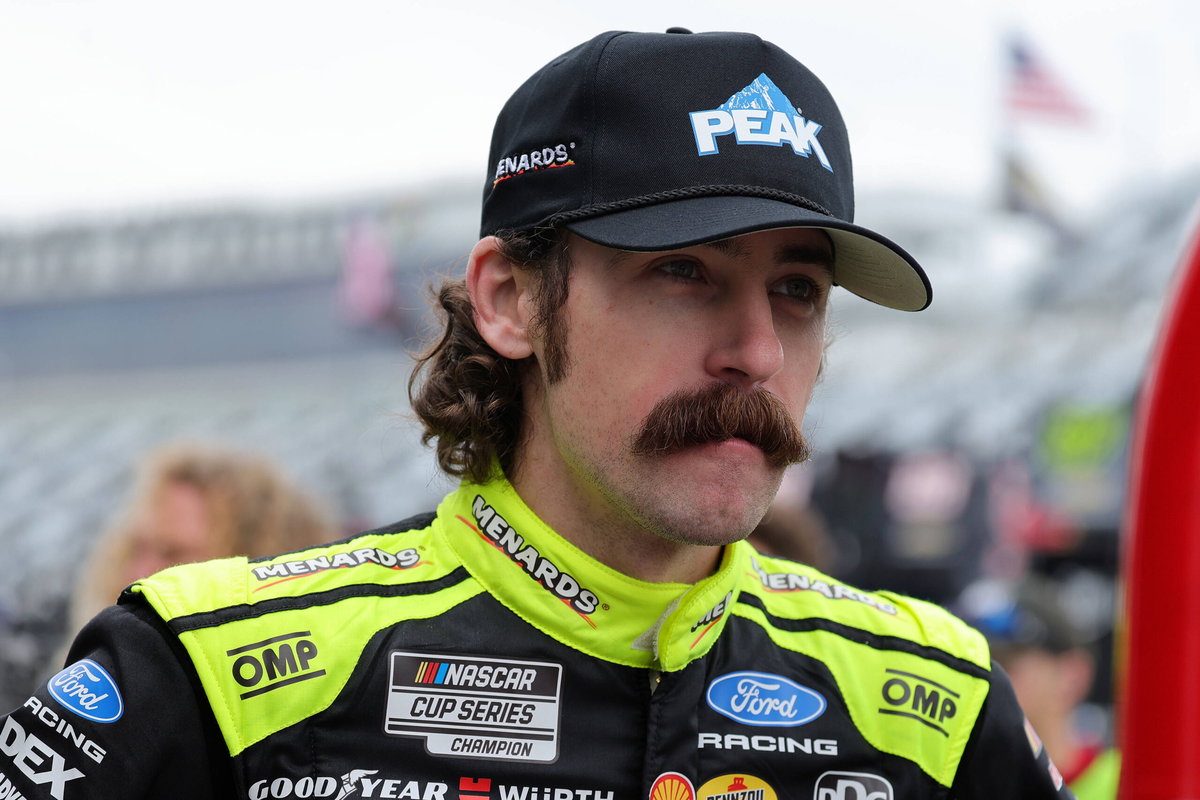
NASCAR has decided to address a massive concern raised by Ryan Blaney after the season-opening race at Daytona. The lack of competitiveness at superspeedways due to issues related to fuel saving has been a massive topic of discussion among the fans and the drivers, and after an extreme observation at Daytona, NASCAR is finally bringing a change.
Watch What’s Trending Now!
Talladega will observe a huge change in race structure
Heading towards the Cup Series’ first visit to the Talladega Superspeedway this year, NASCAR has decided to shorten the lengths of the final two stages in the race to tackle the fuel-saving issue that has been hurting the overall competitiveness on the field.
Superspeedways like Daytona and Talladega are meant for full-throttle action, considering how much the drivers are dependent on drafting. However, the drivers often find themselves running on vapors towards the end of stages because of the flat-out driving action. Subsequently, they start lifting off, packing the field up with minimal overtakes.

Ryan Blaney was not pleased that Toyota had all three lanes locked up and were running ultra-slow 52 second laps in the final stage. Says, “We need to fix that. It’s pretty bad,” in regard to the fuel saving racing in the #Daytona500
This was something that Ryan Blaney hinted at after the 2026 Daytona 500: “Just kind of got trapped with the Toyotas running 52-second laps. And were blocking the whole thing,” he said. “It’s going to happen eventually. I mean, they’ve talked about it. Toyota has got 3 cars and just blocked the whole field. And it’s unfortunate. We’ve got to fix that. It’s pretty bad.” His thoughts, however, did not sit well with fans.
NASCAR decided to work on creating a solution, which is cutting the last two stages to 50. This is a reduction from over 60 at Talladega. However, this means the first stage is going to be 100 laps.
“There’s certainly a lot of feedback from the fans that don’t always like to see some of the three-wide fuel saving that happens mostly at Talladega and Daytona,” said John Probst on NASCAR’s Hauler Talk podcast. “I think that coming out of Daytona, we have been working hand-in-hand with a lot of our race teams, trying to largely break into two categories of things that we could do. One being the sporting-related things, like rules around pit stops or stage lengths or things of that nature. The other being in a technical bucket, which would mean car changes, spoiler, power levels, and things of that nature.”
This was a major issue that NASCAR has been facing ever since it introduced the stage racing concept. While many fans have asked for the removal of the stage racing system, NASCAR seems to be looking forward to alternative changes.
Why does NASCAR keep up with the stage racing?
Believe it or not, NASCAR initially introduced stage racing to improve the viewing experience. Oftentimes in full-length races with no planned stages, the middle portions could get extremely predictable, especially after the first set of pit stops. The racing was packed, and the spectators did not have a lot to watch out for until the race ended the final few laps of the race.
To battle with this, the stage system saw the field getting bunched up more often, with more restarts, which sometimes do happen to be rather chaotic. Moreover, it also meant that every part of the race meant something. For the drivers, the stage added points mid-race, so the drivers had more incentive to push hard throughout.
And perhaps the most important part for NASCAR: the broadcast structure. Introducing stage breaks meant the track would go under planned caution for extended periods, which, on the other hand, meant that the broadcasters could place advertisements without interrupting green-flag racing. This proved extremely beneficial for NASCAR from a monetary perspective.
Despite all of this, however, the stage format is criticized largely because fans claim that the ‘artificial cautions’ can break the race flow. Moreover, it also manipulates strategies, making them more predictable, which also contributes to the fuel-saving strategies that Ryan Blaney subtly hinted at.
However, there seems to be no plausible reason for NASCAR to get rid of the format altogether, especially considering the profit it brings to the organization through the advertisements. But the structural changes they have introduced for Talladega could make a difference.