Imago
@Basso488/X
Imago
@Basso488/X
Longtime NASCAR fans might still remember how Tim Richmond lit up every room, every garage, and every racetrack he walked into. Known as NASCAR’s “Hollywood” star, he blended raw, fearless talent with a charisma the sport had rarely seen before. After transitioning from open-wheel racing, he became a dominant force in the 1980s, stacking 13 Cup Series wins and 78 top-10 finishes in just 185 starts across seven full seasons.


But Richmond’s story, like many NASCAR drivers of that era, was never just about numbers. It was about presence, personality, and an unshakable will to race. And by the summer of 1987, that will was about to be tested in heart-wrenching ways no stopwatch could ever measure.
Watch What’s Trending Now!
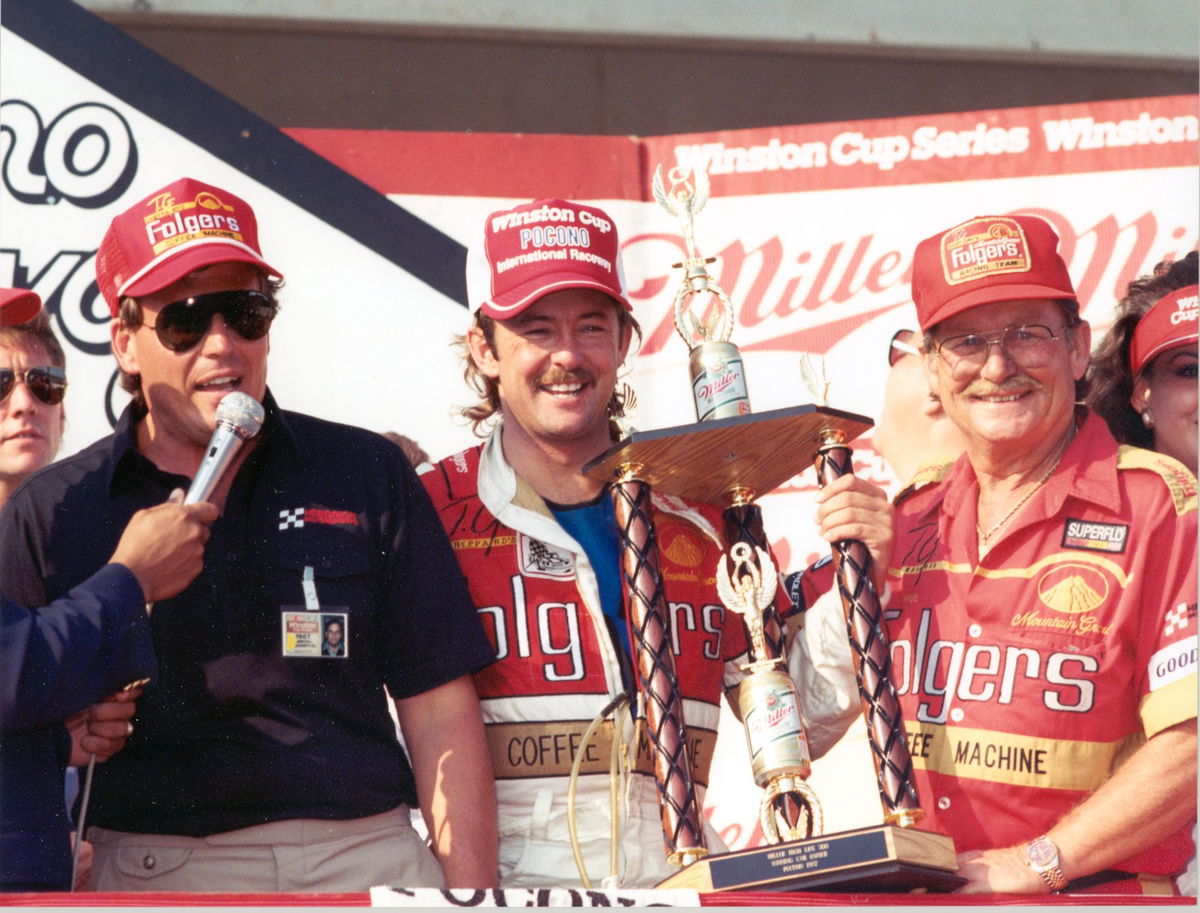
Pocono, pain, and a win that meant everything
When Tim Richmond rolled into Pocono Raceway for the Miller High Life 500 in June 1987, just seeing him back in a race car felt improbable. He had missed the entire first half of the season, battling a mysterious illness that had already sidelined one of NASCAR’s brightest stars. Officially, it was labeled double pneumonia. Unofficially, there were questions no one could or would answer at the time.
From the drop of the green flag, though, Richmond looked like the Tim Richmond everyone remembered.
Starting third, he took command by lap five and drove with a purpose that felt almost defiant. Despite still being visibly thin and weakened, Richmond led 82 laps, including the final 46, and pulled away late to beat Bill Elliott by eight car-lengths. It was vintage Richmond. Smooth, aggressive, fearless. And then the race threw one more obstacle his way.
June 14, 1987: Tim Richmond’s win in the Pocono 500 was stunning and emotional. Very sick, missed the 1st half of the year, privately battling terminal illness, won in his first race back
Richmond was able to overcome losing a lap early in the race with shifter linkage problems pic.twitter.com/85RHIqed6b
— nascarman (@nascarman_rr) June 14, 2025
Midway through the event, Richmond’s car developed gearbox problems. He was left with only fourth gear, forcing him to crawl out of the pits in high gear and nurse the car through the corners. Lesser drivers would’ve faded. Richmond didn’t flinch. He adjusted, adapted, and somehow got faster when it mattered most.
When he crossed the finish line, the emotion hit all at once. “I had tears in my eyes when I took the checkered flag,” Richmond admitted afterward. “Then every time anyone congratulated me, I started bawling again.”
But behind the scenes, the reality was far darker. Richmond had fallen seriously ill after the 1986 banquet during a trip to New York, leading to lengthy hospitalization in Cleveland and months away from racing. Years later, it would be revealed that he was battling AIDS.
On August 13, 1989, Tim Richmond died at just 34 years old, making that day at Pocono not just one of his final triumphs, but a haunting reminder of how fiercely he raced against time itself.
A legacy that outlived the controversy
Pocono should’ve been the start of a full-circle comeback for Tim Richmond. Instead, it became the final peak before everything unraveled. In 1988, after missing half of the 1987 season, Richmond attempted to return to NASCAR full-time with the Daytona 500. However, the effort was abruptly halted when the sanctioning body suspended him for testing positive for banned substances.
Days later, the situation took a bizarre turn. The substances in question were identified as Sudafed, an over-the-counter allergy medication, and Advil, a common pain reliever. No performance enhancers. No illegal drugs. Just the kind of medication a seriously ill person might reasonably be taking.
Richmond pushed back. In April 1988, he sued NASCAR over the suspension. He later retested, passed, and was officially reinstated. But by then, the damage was done. Teams stayed away. Doors quietly closed. Despite being cleared to race, Richmond couldn’t secure a ride, effectively ending his NASCAR career without ever getting a true farewell.
The controversy didn’t end there.
In 1990, just months after Richmond’s death, Washington-based WJLA-TV and investigative reporter Roberta Baskin dropped a bombshell. Their report alleged that Dr. Forest Tennant, then the NFL’s drug adviser, had falsified drug tests that played a direct role in shortening Richmond’s career.
According to sealed court documents and interviews, NASCAR allegedly relied on false test results in 1988 to keep Richmond sidelined. They even shaped substance-abuse policies with him specifically in mind. The New York Times later published the findings, giving national weight to the claims. Despite everything, Richmond’s legacy refused to fade.
He was inducted into the Ashland County Sports Hall of Fame in 1996, named one of NASCAR’s 50 Greatest Drivers in 1998, and entered the International Motorsports Hall of Fame in 2002. In 2009, an ARCA race at Mansfield Motorsports Park was renamed in his honor – a fitting tribute to a driver whose talent, courage, and fight extended far beyond the racetrack.