Imago
Image Credits: Imagn
Imago
Image Credits: Imagn
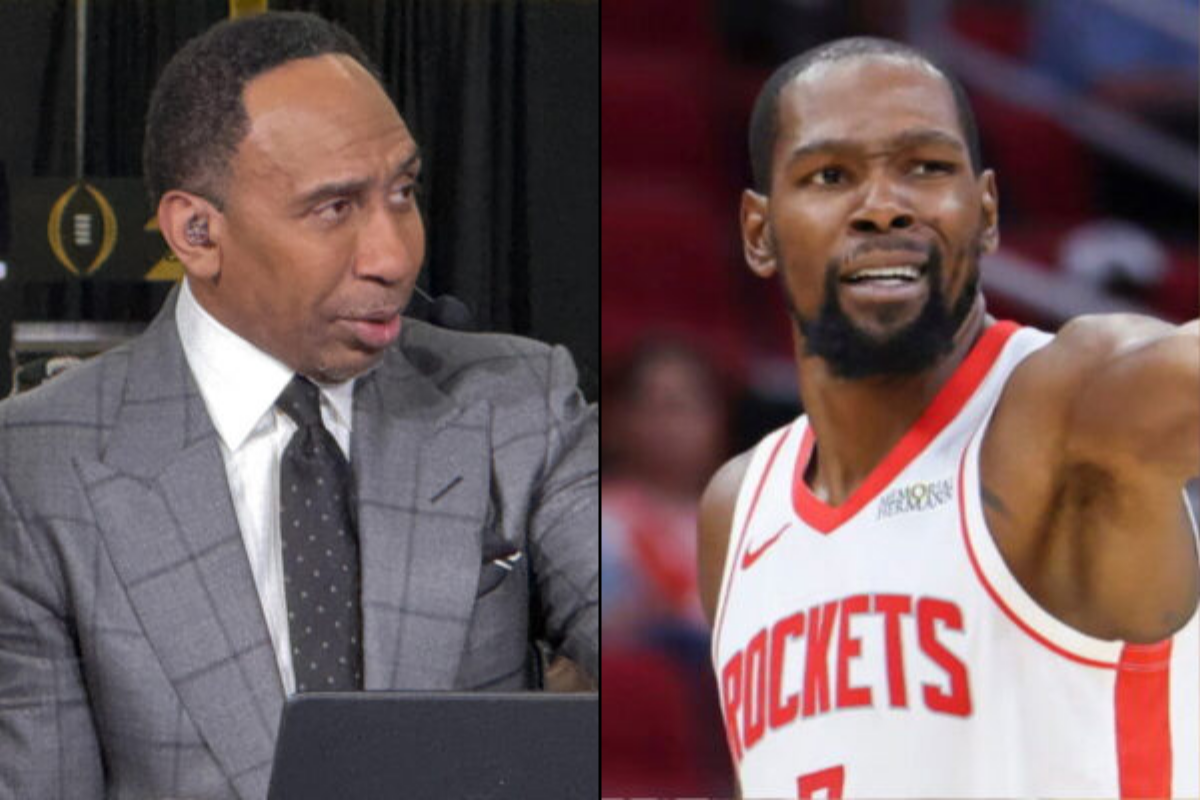
Stephen A. Smith and Kevin Durant are rarely on the same wavelength. But this time, the ESPN analyst has thrown his full support behind the 16-time All-Star’s pointed critique of the narrative surrounding American vs. European basketball. Durant suggested that constant praise for the “European style” of play often comes at the expense of American grassroots basketball. He implied that the hype around European basketball carries a deeper, racially coded subtext.
Watch What’s Trending Now!
“Ladies and gentlemen, I’m here to tell you I’m 10 toes down on this with Kevin Durant. He’s a 1000% right,” Smith declared on the Stephen A. Smith Show. “If you think for one second, it doesn’t involve a hesitancy to support the black athlete, or it doesn’t involve a tendency to point the finger at the black athlete, make no mistake about it, that’s exactly what Kevin Durant was alluding to.”
Smith argued that criticism of the American game often serves as a proxy for targeting the sport’s primary demographic in the United States.
Top Stories





“Race has always been an important factor in the selling of a predominantly Black product to white America,” Smith continued. “Even though it’s at 57% now and dwindling, I’m talking about the white populace in the United States of America. Once upon a time, it was at 80-85%, and even though it’s dwindled from that point in time, at about 1992, I’m speculating here because I don’t have the number in front of me, but one would easily surmise that the white population in the United States of America was hovering around anywhere from 77 to 80%.”
In reality, the NBA hadn’t had a native-born fair-skinned superstar for years before Cooper Flagg was drafted into the league. Smith argues that this was an issue decades ago, too, because when the league had the likes of Magic Johnson, Kobe Bryant, and Michael Jordan, they wanted to make the brand global. That, of course, led to international talents like Dirk Nowitzki, Manu Ginobili, and Luka Doncic entering the league over the years, but it took the focus away from the homegrown stars.
Shortly after Kevin Durant explicitly singled out Nikola Jokic and Luka Doncic for not upping the effort in the All-Star Game, All-Star MVP Anthony Edwards echoed his sentiment. Days later, Durant once again called out the bias in an interview with ESPN’s Vincent Goodwill.
Imago
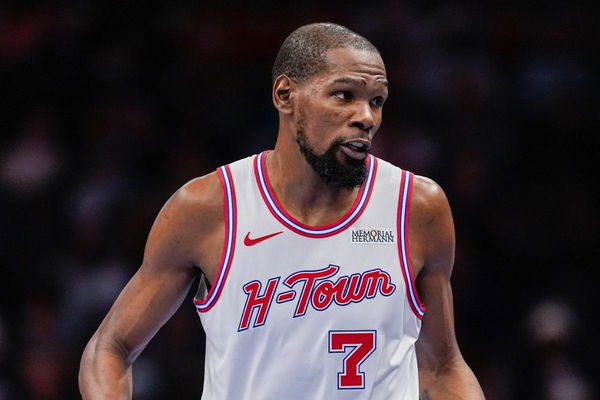
Feb 19, 2026; Charlotte, North Carolina, USA; Houston Rockets forward Kevin Durant (7) during the second quarter against the Charlotte Hornets at Spectrum Center. Mandatory Credit: Jim Dedmon-Imagn Images
Smith addressed the same points on First Take before speaking at length about them on his show. He emphasized that, as a prominent sportscaster, he feels a “personal responsibility” to speak up when players like Durant highlight these systemic narratives. Durant’s comments, with the likes of Smith chiming in, underscore those of a potential 2028 Team USA return.
Kevin Durant calls out bias against American basketball
One of Team USA’s most prolific scorers, Kevin Durant, recently confirmed his intention to represent the country again at the 2028 Los Angeles Olympics. While making that intention clear, he pushed back against the idea that the rest of the world has ‘caught up’ to American dominance on the hardwood.
“It’s a lot of b——- with that,” Durant said. “I can read between the lines on that. It’s a shot at Black Americans. We’re controlling the sport. They’re tired of us controlling the sport.”
Durant specifically took aim at the frequent disparagement of the Amateur Athletic Union (AAU) circuit, which is often blamed for a perceived lack of fundamental skills in young American players.
“I just don’t like the talk around the USA vs. European style of how you approach the game,” Durant told ESPN. “All I hear is ‘AAU is destroying the game. The Euros do it right while the Americans do it wrong.'”
Even the idea that France, led by Victor Wembanyama, could beat Team USA made him laugh.
“’France is coming for you.’ Really? We smacked them boys.”
Indeed, the host country of the 2024 Olympics couldn’t stop Durant in the gold medal game.
Smith’s defense of Durant’s comments included a historical perspective on how the NBA has been marketed since the 1992 Dream Team era. He claims that while globalizing the sport was a financial necessity, it also served to ‘whitewash’ the product to maintain mass appeal amid a changing American populace.
“If you wanted to be successful, if you wanted to have mass appeal, if it’s important even now in this day and age in the year 2026 to have it, imagine how important it was in the year 1992,” Smith said.
As the debate over the “globalization” of the NBA continues, marked by the fact that an American player has not won the MVP award since 2018 and Adam Silver’s active push for NBA Europe, Durant and Smith’s comments have shifted the focus to the social implications of the sport’s evolving identity.