Imago
unlicensed image
Imago
unlicensed image
The comparison was inevitable the moment the hype started building. With AJ Dybantsa headlining an upcoming class many scouts already view as special, the conversation drifted to the gold standard. The 2003 NBA Draft was a class that for two decades has been treated as untouchable, even sacred. A class so stacked at the top that the rest of the details rarely matter.


That narrative held until Gilbert Arenas decided the details actually mattered. On a recent episode of The Gilbert Arenas Show, Agent Zero launched into a six-minute teardown of what he believes is one of basketball’s most lazy narratives. Not that the 2003 draft wasn’t great, but that people stop counting far too early. “I’m calling a spade a spade. Cap,” Arenas said. “A draft means one through 58. One through 58 is a draft.”
Watch What’s Trending Now!
That line set the tone. What followed was not a hot take. It was an audit of the entire board.
Arenas’ core argument was simple. Fans and media celebrate the 2003 class by naming four players and ending the conversation. LeBron James, Dwyane Wade, Chris Bosh, and Carmelo Anthony. Four Hall of Fame level careers. Four faces of an era. Four players who reshaped the league.
That part, Arenas never disputed. What bothered him was everything that came after. “You can’t just name the same four players as if the draft is over after five,” Arenas said. “That’s not how drafts work.”
He then walked through the rest of the board, slowly and methodically, name after name. Some solid careers, some short stints, some lottery picks who never reached a second contract. Some second-rounders who barely lasted three seasons. In Arenas’ breakdown, five first-round selections never saw a second NBA deal. Eighteen second-round picks failed to reach three years in the league.
Getty
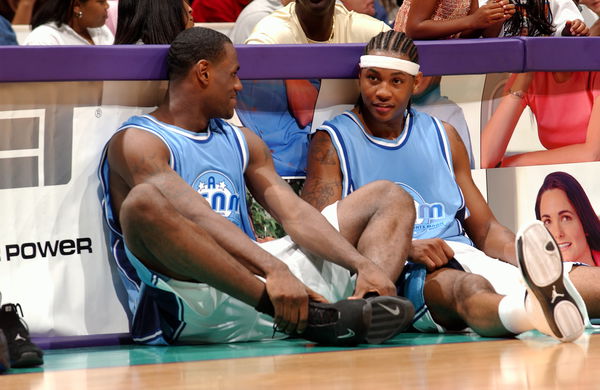
LOS ANGELES – JULY 27: LeBron James and Carmelo Anthony chat while waiting to check into the game during Magic Johnson’s18th annual “A Midsummer Night’s Magic” charity game at Staples Center on July 27, 2003 in Los Angeles, California. NOTE TO USER: User expressly acknowledges and agrees that, by downloading and/or using this Photograph, User is consenting to the terms and conditions of the Getty Images License Agreement. (Photo by Andrew D. Bernstein/NBAE via Getty Images)
Arenas’ frustration did not come from disrespecting the elite. It came from how rarely the middle of the class is discussed. Because when you evaluate a draft honestly, you evaluate sustainability, depth. How many players stuck. How many contributed meaningfully beyond highlight reels.
That is where his argument gained real weight. He compared 2003 to other drafts often left out of the conversation. The 2008 class that produced Derrick Rose and Russell Westbrook. The 2009 group that delivered Stephen Curry and James Harden. Drafts that also created MVPs, champions, and franchise-altering stars.
In digging through each year, Arenas noticed something else. No class consistently produces revolution across all 58 picks. Every draft, even the great ones, rely on a handful of players to define them.
That realization shifted his stance.
Gilbert Arenas reaches a reluctant conclusion on the 2003 draft
After nearly six minutes of arguing against the popular framing, Arenas stopped himself. Then he conceded. “I think just with those four alone, they clear as the best draft,” he said. “So, I take back everything I said.” That reversal was not accidental. It was the conclusion of his own process.
Because once you strip away longevity debates and mid-round attrition, the reality remains. No draft in NBA history has produced four careers of that magnitude, from the top five picks, in the modern era.
LeBron James is at the center of the greatest-of-all-time discussion. Wade, Bosh, and Anthony all landed on the NBA’s Top 75 list. Three became champions. One became one of the most prolific scorers the league has ever seen.
USA Today via Reuters
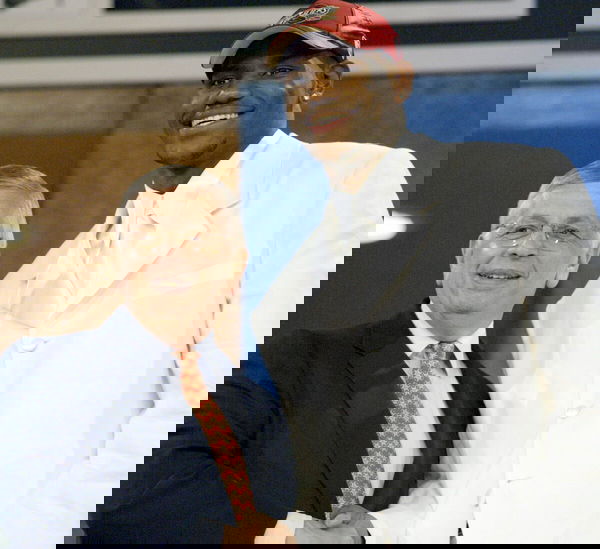
June 26, 2003; New York, NY, USA; FILE PHOTO; St.Vincent-St. Mary HS player LeBron James is selected as the 1st pick at the NBA Draft. Mandatory Credit: Robert Deutsch-USA TODAY Sports
Even beyond the headliners, the class still holds weight. Nine All-Stars emerged. Twenty-seven players logged careers of at least a decade. That combination of peak excellence and league longevity is rare.
With most of the 2003 class now retired, its legacy can finally be measured without projecting clarity drafts like 2009 or 2011 still lack as active players continue shaping their final chapters. The résumé is complete.
That does not mean it will never be surpassed. Future classes always have a chance. But as Arenas ultimately acknowledged, no amount of statistical dissection changes the gravity of four players redefining an era together.
For now, the throne remains occupied. And even one of its loudest critics had to admit it.
Written by

Edited by

Ved Vaze