

“If he feels like we have a need, he’s not shy about going out and addressing it,” Chiefs owner Clark Hunt said of GM Brett Veach ahead of the 2025 deadline. But when that “need” became a glaring hole in the backfield, that aggression that was needed simply vanished. Patrick Mahomes was literally struggling carrying the entire offense and running game on his back, yet when Breece Hall became available, the front office let him slip away over a single draft pick. That decision cost them big in the postseason, and now any hope of a redo by Kansas City Chiefs has officially left the building.
Watch What’s Trending Now!
On Friday, the Jets signed Hall to a three-year, $45.75 million extension just a couple of months after placing the franchise tag on him, which can be worth up to $45.75 million, according to ESPN. Per Hall’s agent, Nicole Lynn of Klutch Sports, the deal includes $29 million guaranteed, while the $14.5 million annual average now makes Hall the third-highest-paid running back in the league.
Now we know, the Chiefs did go out and get Kenneth Walker III this offseason to fix things. But Hall’s new deal just makes you think about the one that got away back in 2025. Because honestly, the stars were aligned for the Chiefs!
Hall reportedly was not fully satisfied with his situation in New York. With the Jets already moving on from players like Sauce Gardner and Quinnen Williams midseason, Hall seemed open to the idea of a fresh start elsewhere. And honestly, he fit into the Chiefs puzzle perfectly.

Imago
New York Jets running back Breece Hall 20 runs with the ball for a touchdown during an NFL, American Football Herren, USA football game against the Cleveland Browns, Sunday, Nov. 9, 2025, in East Rutherford, NJ. /Cal Media East Rutherford United States of America – ZUMAc04_ 20251109_zma_c04_437 Copyright: xChristopherxSzagolax
He was in the final year of his rookie contract and quietly putting together the best season of his career. Before the trade deadline, he had already piled up 581 rushing yards and two touchdowns while averaging an impressive 5.0 yards per carry. Considering the Jets were sitting at 1-7 at the time, those numbers stood out even more. And at one hand when he was doing great, at Chiefs side neither Isiah Pacheco nor Kareem Hunt managed to consistently spark the offense. Chiefs clearly could have benefitted, but then right when Brett Veach had to be aggressive which he usually is, he chose to act out of character.
According to reports, Chiefs offered a 2026 fourth-round pick for Hall. The Jets, however, wanted a 2026 third-rounder in return for the 24-year-old running back. They actually stayed in negotiations for Hall until the final minutes before the trade deadline, but neither of them budged and the deal never materialized. From Chiefs perspective they didn’t want to sacrifice meaningful draft capital for a running back who was going to become an unrestricted free agent after a few weeks. For them it was a “red flag” but from the outside looking in, it simply felt like they simply were overthinking it.
Because, just think about it. Veach has never really hesitated when it comes to sacrificing draft capital for players he believes can help immediately. Back during the 2022 season, the Chiefs traded a third-round and sixth-round pick for Kadarius Toney. That same third-round pick was later used by the New York Giants in the Darren Waller trade with the Las Vegas Raiders. So, Kansas City Chiefs refusing to give up another third-rounder definitely stood out.
At the same time, though, there was a major difference between the two situations. Toney was still only in his second NFL season when the Chiefs acquired him, while Hall was approaching unrestricted free agency after the 2025 campaign. That reality ultimately pushed Chiefs away from investing more draft capital into the running back.
The problem was that the Chiefs’ issues in the run game never really improved afterward. The inconsistency and lack of production lingered throughout the season and eventually played a major role in Chiefs missing the playoffs altogether.
The Chiefs’ run game fell apart after missing Breece Hall
The decision to pass on Breece Hall at the 2025 trade deadline quickly shifted from a quiet front-office calculation to one of the most debated moments of Chiefs season. And honestly, it is a decision that has truly cost them their postseason for the first time in a decade.
By the end of the 2025 season, Kansas City’s rushing issues were fully exposed. Isiah Pacheco finished with just 462 rushing yards and one touchdown while averaging 3.9 yards per carry. Kareem Hunt did produce 611 rushing yards and eight touchdowns, but the explosiveness simply was not there, as he averaged only 3.7 yards per attempt.
The bigger picture made things look even worse. Chiefs running backs averaged just 3.7 yards per carry overall, while the team ranked 25th in rushing offense. They also averaged only 21.3 points per game, good for 21st in the league, and stumbled to a 6-11 finish. This move to pass on Hall was also heavily criticised around the league.
Imago
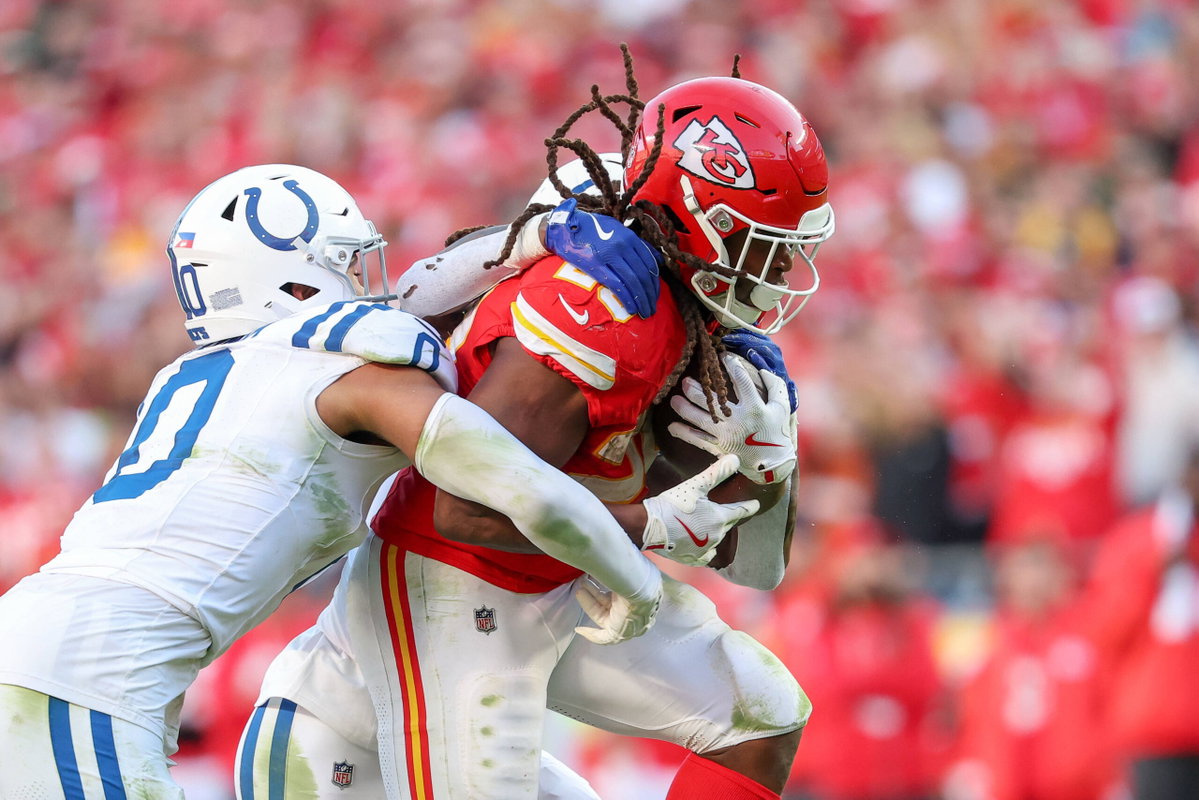
NFL, American Football Herren, USA 2025: Colts Vs Chiefs NOV 23 November 23, 2025: Kansas City Chiefs running back Kareem Hunt 29 runs the ball for a first down and is tackled by Indianapolis Colts safety Cam Bynum 0 and Indianapolis Colts cornerback Sauce Gardner 1 during overtime of an NFL football game at GEHA Field at Arrowhead Stadium in Kansas City, MO. David Smith/CSM Credit Image: David Smith/Cal Media Kansas City Mo United States of America EDITORIAL USE ONLY Copyright: xx ZUMA-20251123_zma_c04_274.jpg DavidxSmithx csmphotothree448171
ESPN NFL analyst Ben Solak even labeled the decision a “serious misstep” in an article published in December 2025. “If the reports are true that general manager Brett Veach could have had Jets running back Breece Hall for a third-round pick at the deadline this year and passed, that was a serious misstep. If the Chiefs’ draft capital has not gone into ancillary players around the running game, then where has it gone?” Solak wrote.
Well bygone are bygones and now the Chiefs have responded by acquiring Super Bowl MVP Kenneth Walker III as part of a larger offensive reset. And while passing on Hall will continue to be viewed by many as a major missed opportunity, the bigger question now is whether Walker can finally stabilize Kansas City’s ground game and help take some pressure off Patrick Mahomes.