

Before becoming a two-time Super Bowl champion and the Pittsburgh Steelers‘ all-time leader in receptions, receiving yards, and touchdown catches, Hines Ward was just a kid growing up in Georgia, navigating life as a biracial child. Born in Seoul, South Korea, to a Korean mother and an African American father, Ward moved to the United States with his parents when he was just a year old. But after his parents separated, he found himself facing challenges throughout his childhood. Now, the Steelers legend has opened up about those struggles.
Watch What’s Trending Now!
“I was teased every single day,” Ward said in his recently released documentary Becoming Hines Ward. “The black kids, they teased me to worse, calling my mom s***, and calling me Bruce Leroy. My insecurities started to kick in because now I’m ashamed of my mom. Nobody really saw my mom other than the people that I lived in the apartment complex. Now we come up, my mom, driving up to my middle school. Now, the whole school is seeing me get out of this car with an Asian mother.
“I saw the kids and I kind of slouched, like dipped down into the chair, and my mom looked over and saw me do that. And the, that’s where they just hammered me, and I looked back and my mom was full-blown crying. She was like pissed, ‘If you’re ashamed of me, then go back and live with your f—ing dad…’ From that day on, I vowed that I was never gonna be ashamed of my mom ever again.”
Ward’s dad, Hines Ward Sr., was stationed in South Korea, while his mother, Kim Young-hee, was a waitress in a bar that catered to American soldiers, where the two met. His family moved to Atlanta and East Point, Georgia, when Ward’s dad went to West Germany to serve a tour of duty. However, his parents got divorced just a year later.
At the time, Kim Young-hee spoke very little English and had almost no support system in the United States. During the custody proceedings, Ward’s father argued that she would struggle to raise him independently in America. The court awarded custody to his father and paternal grandmother. But when Ward turned 7 years old, he ran to live with his mother.
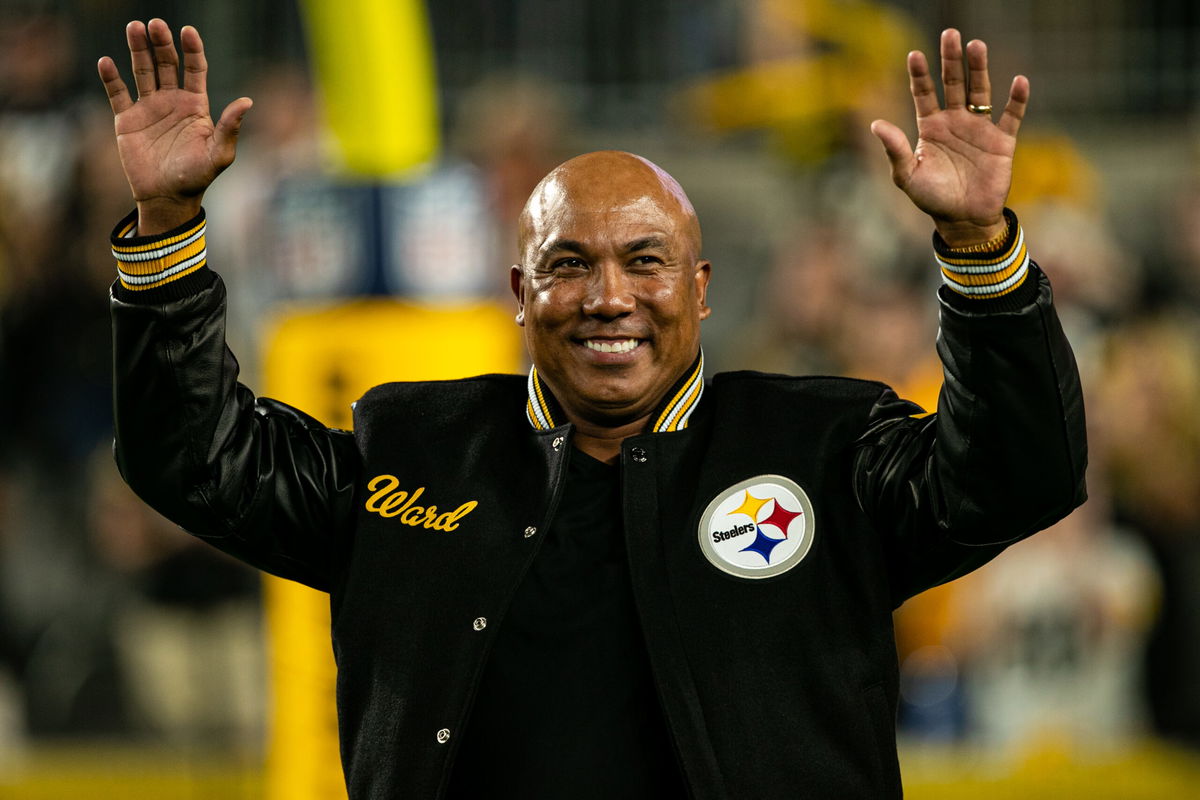
Imago
PITTSBURGH, PA – SEPTEMBER 30: Former Pittsburgh Steelers wide receiver Hines Ward looks on during the NFL, American Football Herren, USA football game between the Cincinnati Bengals and the Pittsburgh Steelers on September 30, 2019 at Heinz Field in Pittsburgh, PA. Photo by Mark Alberti/Icon Sportswire NFL: SEP 30 Bengals at Steelers PUBLICATIONxINxGERxSUIxAUTxHUNxRUSxSWExNORxDENxONLY Icon1909304220
From that point onward, Kim raised him largely on her own while working multiple jobs. When her son faced racial struggles during middle school and throughout his childhood, Ward’s mother never wanted others to look down on him.
“Then, we came in the USA. After one month, me, his daddy we break up,” Kim said. “Then, I really cried, I’m worried, scared. I cannot speak English. I had no time to think, I just got to make money, money, money, take care of him…I don’t want people to look down at him because he’s black, he doesn’t have a daddy, he’s got an Asian mama, that’s why I don’t want people to look down. I do money for him.”
Ironically, Hines Ward’s mother experienced discrimination from both sides. In Korea, she faced prejudice for marrying an African-American. And in the United States, some Korean immigrants excluded Hines because he was biracial. Ultimately, Hines Ward became one of the league’s leading receivers, helping the Steelers win two Super Bowls. In the process, he was also named the Super Bowl XL MVP.