Imago
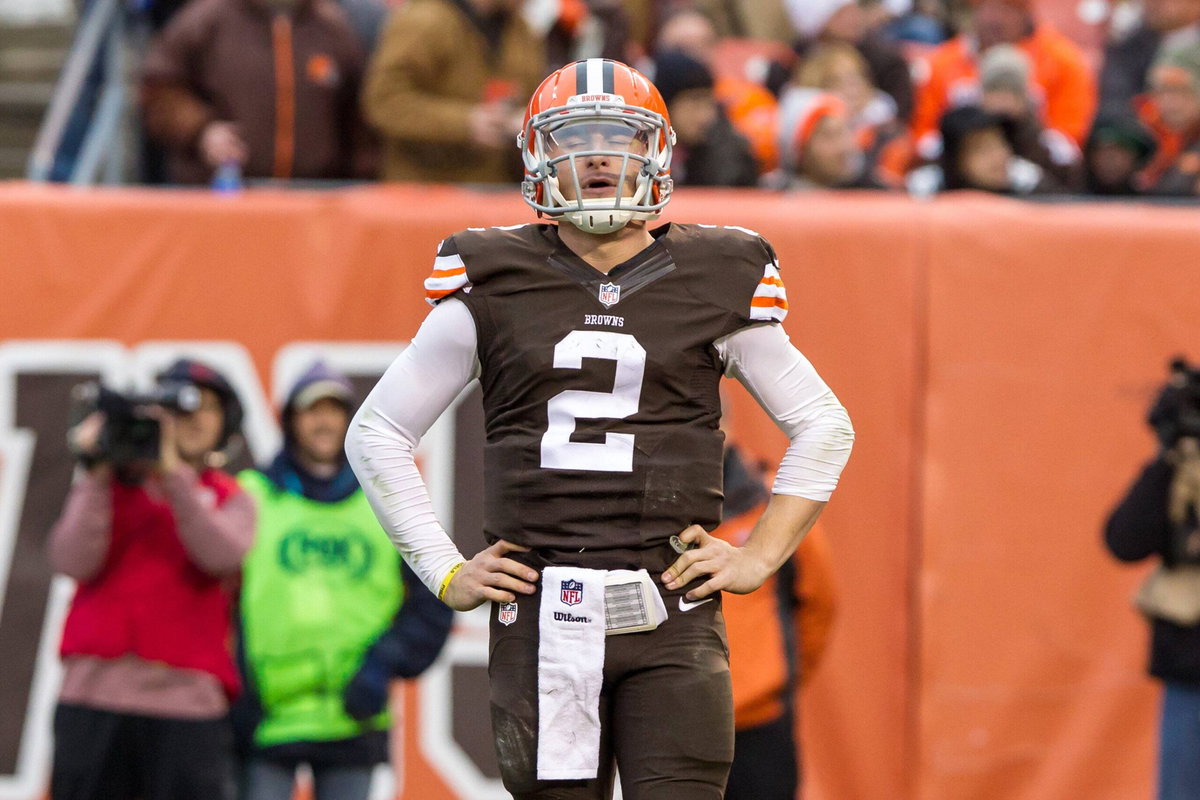
14 December 2014: A dejected Cleveland Browns Quarterback Johnny Manziel (2) during the game between the Cincinnati Bengals and Cleveland Browns played at FirstEnergy Stadium in Cleveland, OH. Cincinnati defeated Cleveland 30-0. NFL American Football Herren USA DEC 14 Bengals at Browns PUBLICATIONxINxGERxSUIxAUTxHUNxRUSxSWExNORxONLY Icon141214026 14 December 2014 A dejected Cleveland Browns Quarterback Johnny manziel 2 during The Game between The Cincinnati Bengals and Cleveland Browns played AT First Energy Stage in Cleveland Oh Cincinnati defeated Cleveland 30 0 NFL American Football men USA DEC 14 Bengals AT Browns PUBLICATIONxINxGERxSUIxAUTxHUNxRUSxSWExNORxONLY
Imago
14 December 2014: A dejected Cleveland Browns Quarterback Johnny Manziel (2) during the game between the Cincinnati Bengals and Cleveland Browns played at FirstEnergy Stadium in Cleveland, OH. Cincinnati defeated Cleveland 30-0. NFL American Football Herren USA DEC 14 Bengals at Browns PUBLICATIONxINxGERxSUIxAUTxHUNxRUSxSWExNORxONLY Icon141214026 14 December 2014 A dejected Cleveland Browns Quarterback Johnny manziel 2 during The Game between The Cincinnati Bengals and Cleveland Browns played AT First Energy Stage in Cleveland Oh Cincinnati defeated Cleveland 30 0 NFL American Football men USA DEC 14 Bengals AT Browns PUBLICATIONxINxGERxSUIxAUTxHUNxRUSxSWExNORxONLY
When 21 teams passed on Johnny Manziel, including the Cleveland Browns, the quarterback texted then-Browns quarterbacks coach Dowell Loggains, saying he wanted to “wreck the league” in Cleveland. Loggains forwarded that message to head coach Mike Pettine, and the Browns eventually traded up to select Manziel with the 22nd overall pick. From that moment, the expectation was clear. The Browns organization and its fanbase immediately viewed him as a potential franchise quarterback.
Watch What’s Trending Now!
That belief extended beyond the building. Michael “The Miz” Mizanin, a longtime Browns fan due to his Cleveland roots, was fully on board. But that optimism shifted the moment Manziel was set to make his first NFL start against the Cincinnati Bengals. Seeing him on the field next to players like Andrew Whitworth immediately changed the perception.
“I remember seeing you, Whit (Whitworth), and going, ‘Oh my god. Johnny Manziel is a child amongst men like the size of you, Whit, and your entire offensive line,” The Miz told Whitworth. “I was like, ‘What are we doing?’ When we drafted Johnny Manziel, I was like, ‘That’s our franchise quarterback. Let’s go. No one’s gonna be able to take us down. I mean, we got Johnny football, baby.’
Top Stories



“And so then he was gonna play. I was like, ‘I’m going to Cleveland.’ I saw Johnny, and then I saw you, and I went, ‘This isn’t gonna be good.’ But man, I was like, ‘Oh my god, if he’s going up against this size of player, this is gonna be a problem.”
“I remember seeing you Whit and thinking, “Oh my god, Johnny Manziel is a child amongst men.”
Longtime Browns fan The Miz remembers the first time seeing Johnny Manziel live 😂@turbotax pic.twitter.com/WVxoyUEP1K
— Fitz & Whit (@fitzandwhit) April 8, 2026
The initial optimism around Manziel was grounded in his college profile. Entering the 2014 NFL Draft as a Heisman Trophy winner, he brought improvisation, big-play ability, and confidence. In his junior year, he posted a 69.9 percent completion rate with 4,114 passing yards, 37 touchdowns, and 13 interceptions, while adding 759 rushing yards and 9 rushing touchdowns.
That production made the Browns’ first-round selection feel justified at the time. However, at No. 22 overall, Manziel also became the shortest quarterback drafted in the first round in NFL history until the Arizona Cardinals selected Kyler Murray in 2019. The physical profile was always part of the evaluation.
Manziel made his NFL debut against the Buffalo Bills in the fourth quarter, completing 5 of 8 passes for 63 yards and scoring his first NFL touchdown on a 10-yard rush, despite a 26-10 loss. But his first start against Cincinnati is where the concerns became more tangible.
The Bengals’ defensive front featured players like Geno Atkins, Carlos Dunlap, Will Clarke, and Devon Still, most of them over 6’5″ and 270 pounds. On the other side, the offensive line included Russell Bodine, Clint Boling, and Whitworth, all exceeding 300 pounds. Manziel, in comparison, measured 5’11 3/4 and 207 pounds.
What followed aligned with those concerns. His first NFL start resulted in a disappointing loss for both him and the Browns. The early narrative of a franchise quarterback quickly shifted, and within his rookie season and the following offseason, that initial hype had already begun to collapse.
When the Bengals dismantled Johnny Manziel and the Browns 30-0
Before facing the Bengals in Week 15, the Browns had already beaten their division rivals 24-3 on November 6, 2014. At that point, Cleveland was tied for first in the AFC North and positioning itself for a playoff push. What followed, however, was a sharp decline.
The Browns lost three of their next four games leading into that Week 15 matchup, which also marked Johnny Manziel’s first career start. The buildup centered less on the matchup itself and more on Manziel’s debut, shifting attention away from the broader team context. That dynamic ultimately worked in Cincinnati’s favor.
The Bengals controlled the game from start to finish, securing a 30-0 win. Manziel completed 10 of 18 passes for 80 yards, threw two interceptions, and took three sacks. After the game, he acknowledged his role in the outcome.
“It’s tough to come out there and lay an egg like that, and I put a lot of that on me.”
Cincinnati’s offensive approach reinforced that control, led by rookie running back Jeremy Hill, who rushed for 148 yards on 25 carries with two touchdowns. Giovani Bernard complemented him with 79 yards on 15 carries.
Cleveland, in contrast, managed only five first downs and converted just one of ten third-down attempts.
From that point, the trajectory for Manziel continued downward. What began as pre-draft momentum shifted into a difficult rookie season, followed by off-field issues in the subsequent offseason and a 2-6 record as a starter in his second year.
In the years that followed, he did not secure another sustained starting role in the NFL, with later stints across multiple leagues preceding his eventual retirement.
Written by

Edited by

Aatreyi Sarkar