Imago
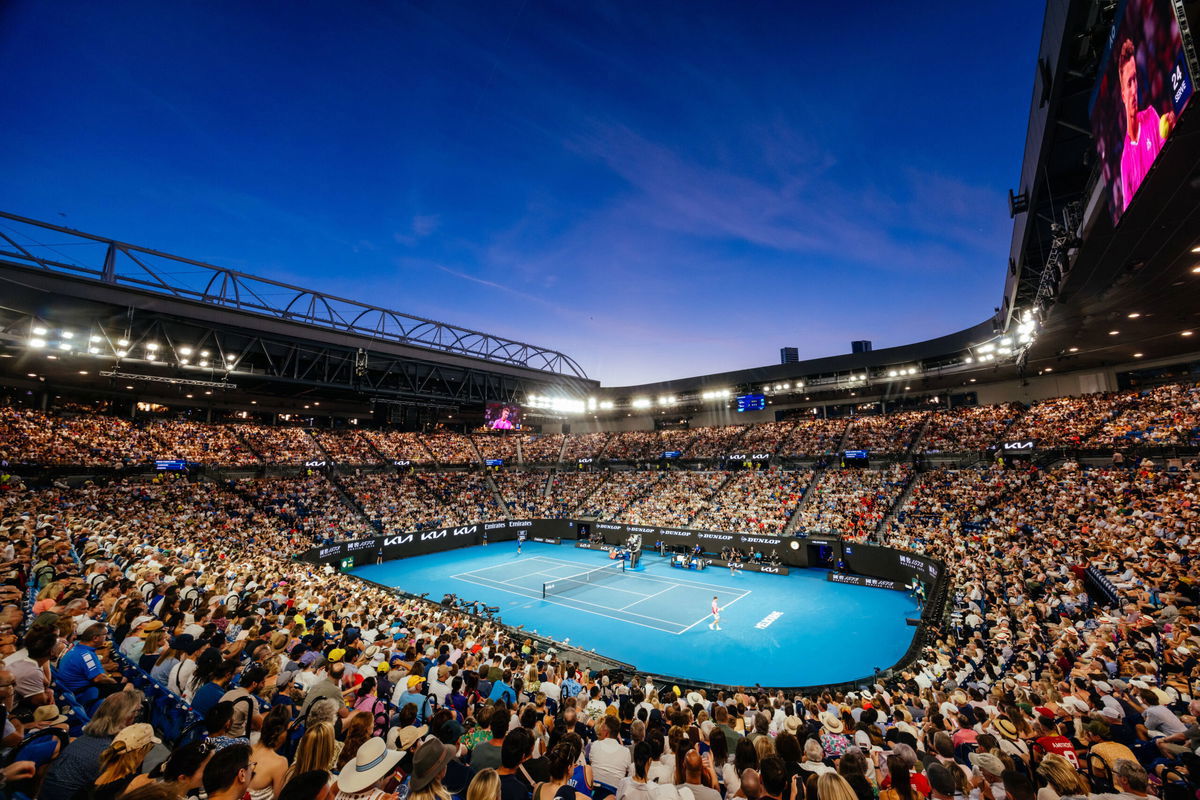
January 19, 2025: MELBOURNE, AUSTRALIA – JANUARY 19: Rod Laver Arena stadium atmosphere as Novak Djokovic of Serbia plays Jiri Lehecka of Czech Republic on day eight of the 2025 Australian Open at Melbourne Park on January 19, 2025 in Melbourne, Australia. – ZUMAp121 20250119_zsp_p121_112 Copyright: xChrisxPutnamx
Imago
January 19, 2025: MELBOURNE, AUSTRALIA – JANUARY 19: Rod Laver Arena stadium atmosphere as Novak Djokovic of Serbia plays Jiri Lehecka of Czech Republic on day eight of the 2025 Australian Open at Melbourne Park on January 19, 2025 in Melbourne, Australia. – ZUMAp121 20250119_zsp_p121_112 Copyright: xChrisxPutnamx
Ever since the Australian Open kicked off on January 12, the heat in Melbourne has been almost as intense as the action on court. Through the sweltering conditions, players have battled it out, and we’ve already seen Elena Rybakina lift the women’s singles trophy after defeating world No. 1 Aryna Sabalenka. Now, all eyes turn to the men’s final, where Carlos Alcaraz and Novak Djokovic are set to clash, each chasing a milestone that could carve their names even deeper into tennis history. Inside Rod Laver Arena, the energy is buzzing, with fans settling in under pleasant 22-degree weather and clear air, ready for a blockbuster finish.


But it’s not just the players who make the tournament what it is. Behind every point and every match, there are chair umpires, line umpires, volunteers, and ball kids working tirelessly to keep everything running smoothly. They’re the quiet force that keeps the show going. So, let’s talk about them and how much they earn during the Australian Open.
Watch What’s Trending Now!
How much do ball boys earn at the Australian Open 2026 final?
Ball kids at the Australian Open aren’t actually paid because they’re considered volunteers. Still, the tournament relies on about 435 of them, most between 12 and 15 years old, to help keep the “Happy Slam” running smoothly. Watching them sprint across the court, you realize just how big a role they play. That’s why the topic has sparked debate, and even Mark Philippoussis didn’t hold back when sharing his thoughts.
When the media asked him about it, he didn’t hesitate for a second. “Why not? Give them some pocket money,” said the former Wimbledon finalist and Australian Davis Cup hero. The 49-year-old added, “It’s a great opportunity for these kids to get out there and enjoy the atmosphere, to walk around, to watch some matches. But I know that this tournament spends a lot of money to make sure everyone’s happy.”
That said, it’s not like the ball kids walk away with nothing. Australian Open CEO Craig Tiley explained that they’re compensated in other ways. “The ball kids get paid in lieu of cash through tickets and transport, covering costs of food, and gifting,” he revealed.
Imago
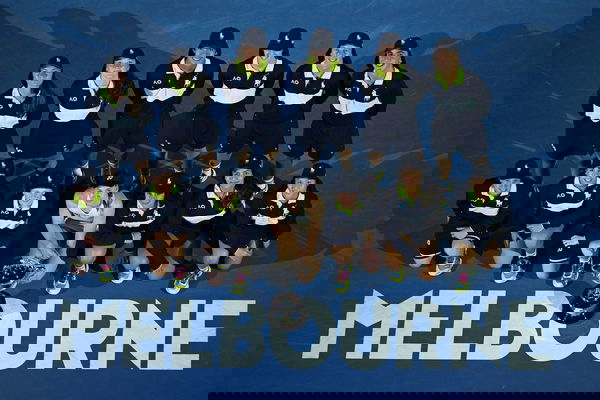
TENNIS AUSTRALIAN OPEN, Elena Rybakina of Kazakhstan poses for photographs with ball kids and the Daphne Akhurst Memorial Cup after winning the womens singles final against Aryna Sabalenka of Belarus on day 14 of the 2026 Australian Open tennis tournament at Melbourne Park in Melbourne, Saturday, January 31, 2026. NO ARCHIVING MELBOURNE VICTORIA AUSTRALIA PUBLICATIONxNOTxINxAUSxNZLxPNGxFIJxVANxSOLxTGA Copyright: xJAMESxROSSx 20260131129160192909
Still, the job isn’t easy by any stretch. It’s physically demanding, with kids spending close to eight hours a day at the tournament, rotating through 45-minute to one-hour shifts on court. Add in the late nights, long days, and the extreme Melbourne heat, and it’s clear they work just as hard as anyone else out there.
Umpires’ salaries for the Australian Open final
Umpires might not influence tennis betting outcomes as directly as they once did, especially now that players have challenges, but their role is still crucial. The best officials step in only when needed, keeping things orderly and making sure matches move along at a steady pace. If you’re wondering how much they earn, it really depends on where they officiate and what level they’ve reached, because the pay scale can vary quite a bit.
To become an International Level Tennis Umpire, you first have to pass a Level 3 School certification. Before that, there are Level 1 and Level 2 certifications for lower-tier events. Once an umpire clears Level 3, chair umpires start with a Bronze Badge and can move up to Silver and then Gold, based on performance reviews conducted annually by the ITF, ATP, and WTA. So how much are they paid each level?
At the entry level on the tours, umpires earn around £350 per match. Back at the 2018 US Open, gold badge officials received a standard day rate of $450, which was actually the lowest among the Grand Slams. In 2011, that figure was $250 per day, so there’s clearly been a noticeable pay bump over time, even after accounting for inflation. At Wimbledon in 2018, gold badge umpires earned £380 a day, roughly $495, compared to just £189 per day in 2011. With rising prize money, the increase only makes sense.
As for the Australian Open, officials were paid $375 AUD per day in 2011, and it’s the only Grand Slam that offers overtime for umpires working more than 10 hours a day. If we follow the same kind of growth seen elsewhere, like the US Open’s jump from $250 to $450 between 2011 and 2018, which is about an 80% rise, and apply that increase twice to cover the longer stretch to 2026, the estimated daily rate would land around $1,200 AUD per day. It’s not an exact number, but it gives a reasonable ballpark idea of how much rates may have climbed.
It’s also worth noting that all these figures come from different sources, since neither the ATP nor the WTA publicly share official salary details for their umpires. Still, one thing is clear: the pay has risen sharply, and it makes sense when you consider that these officials spend nearly 11 months a year traveling all over the world to keep the tour running smoothly.
Match fees for the Australian Open final
Thanks to a major investment from Tennis Australia, the Australian Open is rolling out a record-breaking prize pool of $111.5 million in 2026, marking a 16 percent jump from 2025.
Starting with the main event (the singles tournaments), both the men’s and women’s champions will take home a massive $4.15 million, which is up 19 percent from the $3.5 million winners earned in 2025. The runners-up won’t do too badly either, collecting $2.15 million, while semifinalists grab $1.25 million. Even players knocked out between the first and fourth rounds are seeing a 13 to 14 percent bump in prize money, and those who fall in qualifying still get a 16 percent raise. So even if you lose at the earliest stage, you’re still walking away with $40,500.
Over in the doubles events, the numbers are smaller than in singles but still pretty impressive. The men’s and women’s champion teams each earn $900,000 per team, with runners-up taking $485,000 and semifinalists pocketing $275,000. Quarterfinalists get $158,000, third-round qualifiers earn $92,000, second-round qualifiers collect $64,000, and first-round qualifiers receive $44,000. It may not match the singles prize pool, but it’s still a serious payday.
Line judges and other officials: earnings breakdown
If you’ve been following the Australian Open 2026 closely, you might have noticed that line judges don’t get the spotlight like chair umpires, but they can still earn a solid paycheck.
At non-Slam events, they typically make around £500, and at the Slams, that number jumps to about £1,500 per match. Not bad for a role that often flies under the radar but is just as important in keeping matches fair and on track.
Beyond that, there’s also a clear pay structure depending on the officiating role and whether it’s a full-day tournament or league. For a full day, referees or coaches earn $190, venue supervisors get $130, court supervisors and chair umpires each receive $115, and line umpires take home $80. When it’s only a half day, the numbers scale down accordingly, referees or coaches get $115, venue supervisors $90, court supervisors $80, chair umpires $60, and line umpires $50.
Of course, a full day simply means a full schedule of play, and the actual hours can vary. There’s no overtime pay, though, so what you see is what you get. Member associations decide half-day assignments based on how long they expect the tournament or league to run, and those same half-day rates also apply if an official is only available for part of the day during a full-day event.
