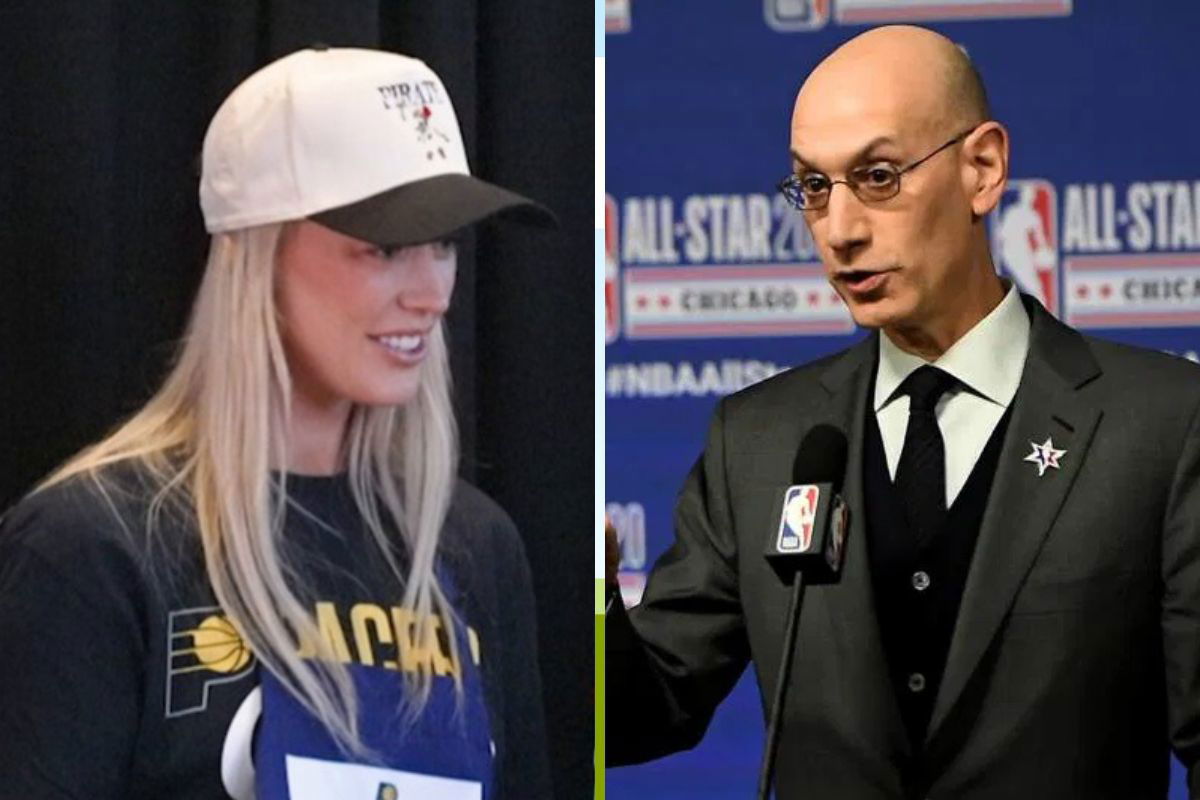
The momentum around the WNBA has never looked stronger from the outside. Attendance is up. Viewership is climbing. Star power is drawing national attention. Still, beneath that surface growth, the league is wrestling with a reality that refuses to go away. That reality resurfaced again this week when Indiana Fever guard Sophie Cunningham addressed the league’s finances during ongoing Collective Bargaining Agreement discussions.


Cunningham’s comments echoed a statement made years earlier by NBA commissioner Adam Silver, who publicly said in 2018 that the NBA loses more than $10 million annually operating the WNBA. This time, a current player acknowledged why that claim still matters.
Watch What’s Trending Now!
Cunningham made her comments while discussing revenue sharing and the stalled CBA talks, framing the situation from a business standpoint rather than a purely emotional one. “It all comes down to revenue share. And I get it. I totally understand the business side of things. The W has not always made money, and there’s still a big chunk of money that has been lost,” Cunningham said.
“How do you give owners who are willing to invest a return while also investing in the product now? It’s difficult and complicated. But there has to be a way to meet in the middle.” Her remarks directly align with the foundation of Silver’s original statement. The league has grown in popularity, but profitability has not followed at the same pace. That gap explains why the NBA has remained essential to the WNBA’s survival.
Without NBA backing, the WNBA’s recent growth would not be enough to sustain league operations. Even with improved visibility, revenue alone has not covered costs.
In 2024, the WNBA reportedly lost $40 million, according to the New York Post. The NBA did not expect returns from the league in the foreseeable future, underscoring the financial imbalance that still exists.
This is not a recent problem. Since the league’s launch in 1996, the NBA has consistently injected money to keep it operational. Cunningham’s comments were alluding to that long-term reality, not dismissing player concerns.
The current financial structure is at the center of the labor dispute. Roughly 40 percent of WNBA revenue goes to the NBA. Another 20 percent belongs to outside investors following the league’s $75 million capital raise in 2022. That leaves approximately 40 percent for WNBA teams and players combined.
Even within that share, players receive less than 10 percent of total league revenue. That disparity is a sharp contrast to the NBA model, where players split revenue evenly with team owners after the league office takes its portion. It is also why Cunningham believes the system must evolve.
The financial numbers explain why both sides are entrenched. Owners point to sustained losses. Players point to growth without proportional compensation.
“Laughingstock of Sports” Frustration Boils Over
Cunningham’s understanding of the business side did not stop her from criticizing how negotiations have unfolded. “It sucks, because how our negotiation is going, it feels like we’re the laughingstock of sports right now,” she said.
Her frustration followed an in-person meeting between the league and the WNBPA held on Monday in New York. According to ESPN, the league arrived without a formal proposal, and the session was spent explaining existing positions rather than advancing toward a deal. That lack of movement has compounded tension.

Imago
Mandatory Credits: Lucas Peltier-Imagn Images
The prolonged stalemate has created uncertainty across the league. Free agency remains frozen. Players cannot sign contracts. Planning for the upcoming season remains in limbo.
Cunningham acknowledged that frustration is mounting on both sides. “Both sides are getting frustrated, but us players are holding our ground,” she said. “So it should be interesting.” Her words capture the moment precisely. The league’s financial struggles are real. Player demands are not going away. And without compromise, the consequences grow heavier with every delay.
For now, negotiations continue. What remains unclear is how long the league can afford to wait before the business reality Cunningham described forces a resolution.
Written by

Edited by

Ved Vaze