
Imago
ATLANTA, GA – AUGUST 24: Justin Thomas of the United States hits his tee shot on hole 11 during the final round of the PGA, Golf Herren Tour Championship on August 24, 2025 at East Lake Golf Club in Atlanta, GA. Photo by Jeff Robinson/Icon Sportswire GOLF: AUG 24 PGA FedEx Cup Playoffs – Tour Championship EDITORIAL USE ONLY Icon25082464790
Imago
ATLANTA, GA – AUGUST 24: Justin Thomas of the United States hits his tee shot on hole 11 during the final round of the PGA, Golf Herren Tour Championship on August 24, 2025 at East Lake Golf Club in Atlanta, GA. Photo by Jeff Robinson/Icon Sportswire GOLF: AUG 24 PGA FedEx Cup Playoffs – Tour Championship EDITORIAL USE ONLY Icon25082464790
How does one become the best in swings? By chasing perfection? Well, if you actually ask the best, their answer would be different. Perfection rarely gets you anywhere; rather, it’s the clarity, or the idea to be organized under pressure. That’s a mantra golf’s three prodigies regularly follow: Justin Thomas, Bryson DeChambeau, and Dustin Johnson. Three completely different golfers, with polar opposite games. Yet, their core concept remains the same. Want to know how? We’ve got you covered.
Watch What’s Trending Now!
Top Stories
Nelly Korda & Co. Stopped From Teeing Up as $2.1M Tournament Faces Unexpected Disruption

Justin Rose Makes Honest Admission About Turning Down LIV After Brooks Koepka’s Return

Furious Golf Fans Sign Petition Demanding Suspended PGA Tour Pro’s Reinstatement

Jon Rahm Has the Last Laugh as DP World Tour Decides on LIV Golf Fines – Insider

Lydia Ko & More Livid as Nelly Korda Wins LPGA Title Due to Controversial Ruling: ‘Gutted’
Justin Thomas: Let obstacles pave your path
Have you ever watched Justin Thomas practice? If you have then you would have noticed several obstacles on his path. Sometimes alignment sticks are poking out of the ground. Other times, two golf balls kept close together, as he aims to swing one. In short, the entire scene looks quite chaotic. But of course, it’s done deliberately.
ADVERTISEMENT
“It’s something I’ve always done,” JT explained once to Golf Digest. “I feel like I react and respond well to objects or sticks or whatever it is.”
A method tried since his childhood, it still fits brilliantly. The idea is simple: instead of aiming for a perfect swing, force your body to find one. Once you place an object in the path, you’d be giving yourself instant feedback. As you avoid the object, you’ve automatically made a better move.
Imago
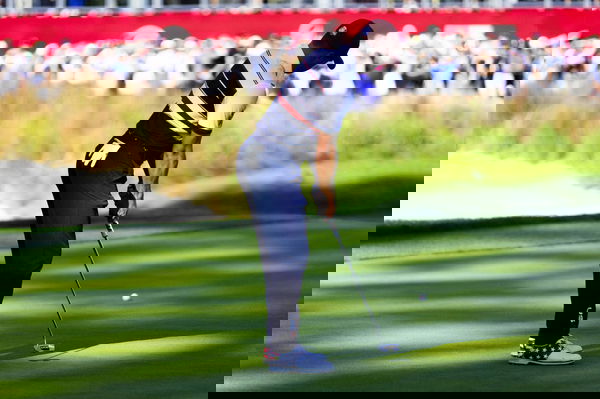
September 28, 2025, Farmingdale, Ny, United States: FARMINGDALE, NY – SEPTEMBER 28: Justin Thomas of Team USA putts on hole 17 during the Ryder Cup – Singles Matches at Bethpage Black Golf Course on September 28, 2025 in Farmingdale, NY. Ryder Cup – Singles Matches PUBLICATIONxINxGERxSUIxAUTxONLY – ZUMAt139 20250928_aaa_t139_194 Copyright: xAlxChang/IsixPhotosx
JT usually chooses a random object, something that, if broken, wouldn’t affect him. It could be a head-cover or an empty water bottle, you get the gist. Then, place the object where you need it.
ADVERTISEMENT
For golfers who swing over the top, they must place the object outside the ball as they aim with their club. Then, place the object inside the golf ball as the clubhead hits it. As you swing around those obstacles, you will be forced to swing more from the inside. If you swing too in-to-out, do vice versa.
ADVERTISEMENT
“…If something is there, I’m subconsciously going to miss it,” said JT.
As you become an expert, the objects will disappear, but the motion will stay.
ADVERTISEMENT
Bryson DeChambeau: Make the same move again
Bryson DeChambeau is perhaps the most different. With a surging YouTube career and fewer events to play on LIV, he doesn’t spend much of his time practicing, according to his own words. Yet, if you see him make a calculated and near-perfect swing, it’s due to what he calls the “repeated motion.” This was the mindset that helped him win the US Open last year.
The trick is to explore the edges of the club before settling into the middle. In other words, don’t just aim at the centre-face; instead, map it out.
“I start trying to hit it on different parts of the face to calibrate my brain of where the whole club is,” he once told Golf.com. “I just want to know.”
ADVERTISEMENT
Solid stuff from Bryson Dechambeau earlier this year on focusing on executing the motion of the golf swing and not worrying about the results.@GOLF_com pic.twitter.com/h9t3s3dMzP
— Tour Pro 🏌️♂️ (@OfficialTourPro) August 2, 2024
Basically, if DeChambeau wants to figure out that one sweet spot, he’ll miss it intentionally. That sounds abrupt, but it works. He’ll then exaggerate an inside-out swing and try to catch one off the toe. All this while, he’ll try to listen for a hollow sound. It doesn’t go on too long.
After a few swings, DeChambeau remembers the move. Once that’s done, he starts right back to grooving his stock shot. What’s more interesting is that his focus is always completely on his body. It’s not on the course, not on the situation, and not even on the golf ball. This is something he has been doing since his teens. He would hit the balls with his eyes closed and then try to memorise that motion.
ADVERTISEMENT
“Repeating motion, motion, motion. That’s all I focused on,” he said.
Dustin Johnson: Steer your lead wrist
For Dustin Johnson, every mantra is kept aside. The focus is on the wrist. If you have seen his swings, you’d agree that they look rather effortless. That’s because his lead wrist bows at the top. For a while in his career, many called it the wrong technique. But as DJ’s results stacked up, the critics went quiet.
ADVERTISEMENT
Imago
Bildnummer: 06346257 Datum: 15.08.2010 Copyright: imago/Icon SMI
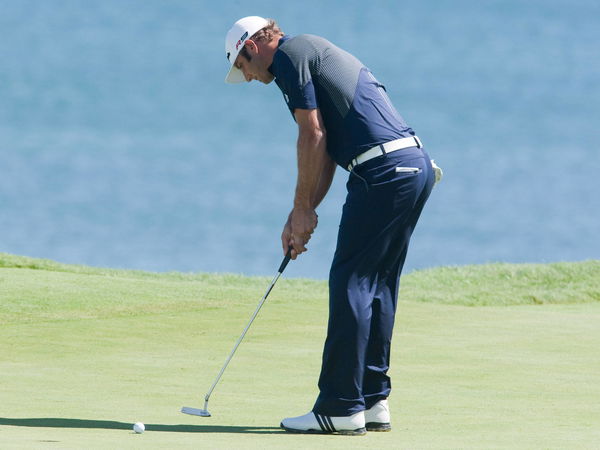
August 15 2010: Dustin Johnson (USA) puts out on the 5th hole during the final round of the 92nd PGA Championship at Whistling Straits, Kohler, Wisconsin. PUBLICATIONxINxGERxSUIxAUTxHUNxRUSxSWExNORxONLY Icon10081537; Herren Golf PGA Championship Kohler Aktion Einzelbild Freisteller vdig xsk 2010 quer
Image number 06346257 date 15 08 2010 Copyright imago Icon Smi August 15 2010 Dustin Johnson USA Puts out ON The 5th Hole during The Final Round of The 92nd PGA Championship AT Whistling Straits Kohler Wisconsin PUBLICATIONxINxGERxSUIxAUTxHUNxRUSxSWExNORxONLY Icon10081537 men Golf PGA Championship Kohler Action shot Single cut out Vdig xsk 2010 horizontal
Modern research confirms DJ’s way. Whatever your lead wrist does, your clubface will follow. So when Johnson flexes or bows his lead wrist, the club face naturally closes. There’s less manipulation and less reliance on timing, something that’s always emphasized by instructors for a perfect swing.
This method, in particular, is quite helpful for amateur golfers. Most of them struggle because their lead wrists cup while transitioning. That opens the face and forces a frantic compensation near impact. But if you follow DJ’s way, you’ll start with the grip. Have it strong, see at least two knuckles on the lead, and voila! Your wrist will bow naturally.
ADVERTISEMENT
From there, the story unfolds on its own. You just have to maintain that flexion into the downswing and rotate your body. Think of it this way: the lead wrist is the steering wheel, and your body is the engine. You have to let the engine keep running.
Three players. Three simple ideas. The secret? The right thought, in the right place, at the right time.
ADVERTISEMENT
ADVERTISEMENT
ADVERTISEMENT
Related Newsletters